

US intelligence services said on Thursday for the first time that climate change poses wide-ranging threats to national security and stability around the world.
More extreme weather “will increasingly exacerbate a number of risks to US national security interests, from physical impacts that could cascade into security challenges, to how countries respond to the climate challenge,” the White House said in a summary of the intelligence reports.
The prediction was made in the first official assessment by the Office of the Director of National Intelligence, which oversees the sprawling US intelligence apparatus.
The document “represents the consensus view of all 18" elements in the intelligence community, the White House said.
The agencies said that climate change is driving “increased geopolitical tension as countries argue over who should be doing more”, cross-border “flashpoints” as countries respond to climate change impact by trying to secure their own interests and fallout from climate on national stability in some countries.
On a practical level, US national security bodies will be integrating climate change effects into their planning, the White House said.
The Pentagon, for example, will consider climate change “at every level, which will be essential to train, fight and win in an increasingly complex environment".
Migration, a politically sensitive issue on the US southern border, will also be seen partly through the lens of climate change, the White House said.
-

Around $3.5 trillion is required between now and 2050 to meet targets for a 'sustainable path', according to the International Energy Agency. AP Photo -
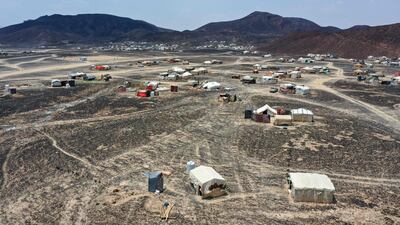
The makeshift Suweida camp for internally displaced people in Yemen’s Marib province. The effects of climate change have exacerbated the displacement of local populations during the country’s war. AFP -
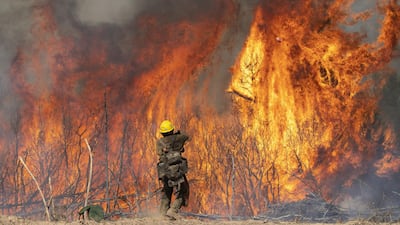
A firefighter monitors a controlled burn, near Jolon, California.Frequent wildfires are an indication of climate change further getting out of control, say environmentalists. Bloomberg -
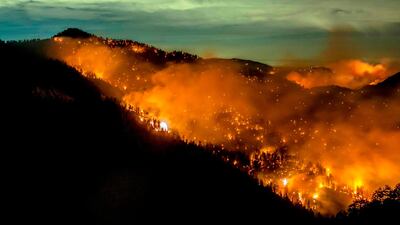
Wildfire burns through the Angeles National Forest in Los Angeles County, north of Azusa, California. AFP -
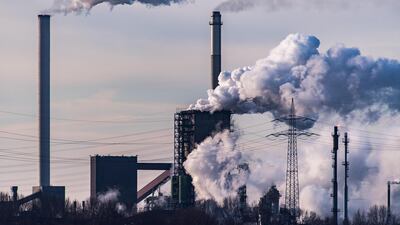
Steam rises from a steel mill in Duisburg, Germany. Some countries are using the coronavirus pandemic to wind back climate change commitments, say environmentalists. Getty Images -
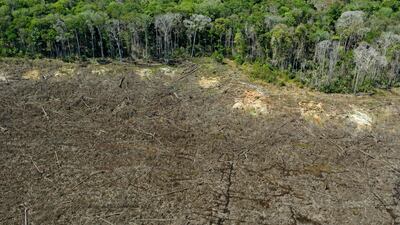
A deforested area close to Sinop, Mato Grosso State, Brazil. Deforestation in Brazil's Amazon rainforest rose by almost 22 percent from August 2020 to July 2021, compared with the same period the year before, reaching a 15-year high. AFP


“This assessment marks the first time the US government is officially recognising and reporting on this linkage.”
The report was issued right before the Cop26 climate summit in Glasgow, Scotland, which President Joe Biden will be attending.
“With more than 85 per cent of global emissions coming from beyond US borders, we alone cannot solve this challenge. We need the rest of the world to accelerate their progress,” a senior US official, who asked not to be identified, told reporters.
“It is definitely a security issue and a national security issue.”
A separate government report issued later on Thursday characterised climate-related risk as “an emerging threat to financial stability of the United States,” the Financial Stability Oversight Council reported.
Recommendations included directives for regulators to require additional climate disclosures of companies and other regulated entities and consider mandates for them to undertake “scenario analysis” on climate outcomes.
“This report puts climate change squarely at the forefront of the agenda,” Treasury Secretary Janet Yellen said at a meeting of the council, which was set up after the 2008 financial crisis.
Ms Yellen described the report as a “critical first step” as she called for immediate action, saying “the longer we wait to address the underlying causes of climate change, the greater the risk".

