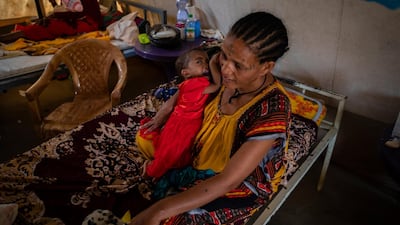
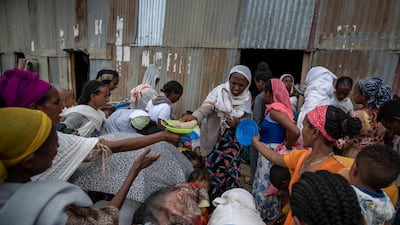
Children receive aid from the World Food Programme in Tigray, where a civil war has displaced millions of people. AP

Biden administration considering Tigray genocide determination


Bryant Harris
  • English
  • Arabic

A senior US official told The National on Friday that the State Department is conducting a legal review into whether Ethiopian and Eritrean actions in Tigray amount to genocide.

“I don’t want to get ahead of any process, but obviously the reports about the violence against women, the murders and the mass events that we’ve seen do give pause and could potentially lead to some sort of official determination regarding the acts that we know have been committed,” the senior administration official told The National.

“But that is a legal process that we have to let play out.”

The House of Representatives passed a bill on Thursday that would require Secretary of State Antony Blinken to determine whether the humanitarian crisis in Tigray amounts to genocide, but the senior administration official indicated that the State Department has already initiated the review.

“It’s a process that is not taken lightly and it’s a process that’s under consideration by the State Department,” said the senior official.

“We will just let the secretary determine whether or not, based on reports and things that we’ve seen and information that we have, whether or not that designation will be made.”

The US legal code defines genocide as “the specific intent to destroy, in whole or in substantial part, a national, ethnic, racial or religious group".

  • Mother Roman Kidanemariam, 35, holds her malnourished daughter, Merkab Ataklti, 22 months old, in the treatment tent of a medical clinic in the town of Abi Adi, in the Tigray region of northern Ethiopia. AP Photo
    Mother Roman Kidanemariam, 35, holds her malnourished daughter, Merkab Ataklti, 22 months old, in the treatment tent of a medical clinic in the town of Abi Adi, in the Tigray region of northern Ethiopia. AP Photo
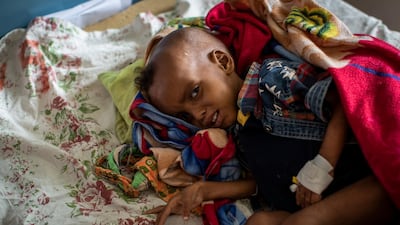
  • Gebre Kidan Gebrehiwet, 2, is treated for malnutrition after fleeing from the town of Abi Adi with his mother, Abeba Tesfay, at the Ayder Referral Hospital in Mekele, in the Tigray region of northern Ethiopia. AP Photo
    Gebre Kidan Gebrehiwet, 2, is treated for malnutrition after fleeing from the town of Abi Adi with his mother, Abeba Tesfay, at the Ayder Referral Hospital in Mekele, in the Tigray region of northern Ethiopia. AP Photo
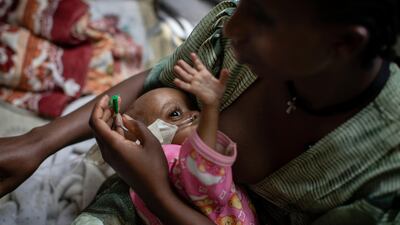
  • Birhan Etsana, 27, from Dengelat, uses a nasogastric tube to feed her malnourished baby, Mebrhit, who at 17 months old weighs just 5.2 kilograms (11 pounds and 7 ounces), at the Ayder Referral Hospital in Mekele, in the Tigray region of northern Ethiopia. AP Photo
    Birhan Etsana, 27, from Dengelat, uses a nasogastric tube to feed her malnourished baby, Mebrhit, who at 17 months old weighs just 5.2 kilograms (11 pounds and 7 ounces), at the Ayder Referral Hospital in Mekele, in the Tigray region of northern Ethiopia. AP Photo
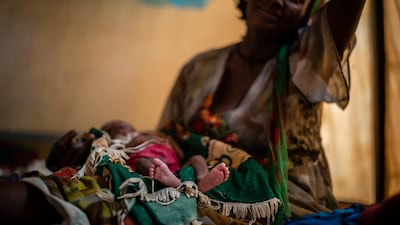
  • Abeba Gebru, 37, from the village of Getskimilesley, sits with her malnourished daughter, Tigsti Mahderekal, 20 days old, in the treatment tent of a medical clinic in the town of Abi Adi, in the Tigray region of northern Ethiopia. AP Photo
    Abeba Gebru, 37, from the village of Getskimilesley, sits with her malnourished daughter, Tigsti Mahderekal, 20 days old, in the treatment tent of a medical clinic in the town of Abi Adi, in the Tigray region of northern Ethiopia. AP Photo
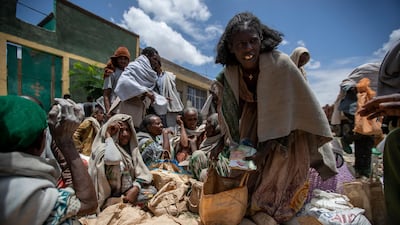
  • An Ethiopian woman scoops up portions of yellow split peas to be allocated to waiting families after it was distributed by the Relief Society of Tigray in the town of Agula, in the Tigray region of northern Ethiopia. AP Photo
    An Ethiopian woman scoops up portions of yellow split peas to be allocated to waiting families after it was distributed by the Relief Society of Tigray in the town of Agula, in the Tigray region of northern Ethiopia. AP Photo
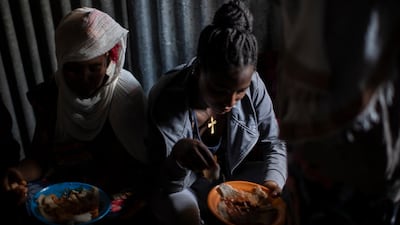
  • Displaced Tigrayan women sit in a metal shack to eat food donated by local residents at a reception center for the internally displaced in Mekele, in the Tigray region of northern Ethiopia. AP Photo
    Displaced Tigrayan women sit in a metal shack to eat food donated by local residents at a reception center for the internally displaced in Mekele, in the Tigray region of northern Ethiopia. AP Photo
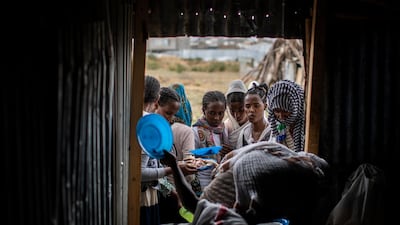
  • A woman stands in line to receive food donations at the Tsehaye primary school, which was turned into a temporary shelter for people displaced by conflict, in the town of Shire, Tigray region. Reuters
    A woman stands in line to receive food donations at the Tsehaye primary school, which was turned into a temporary shelter for people displaced by conflict, in the town of Shire, Tigray region. Reuters
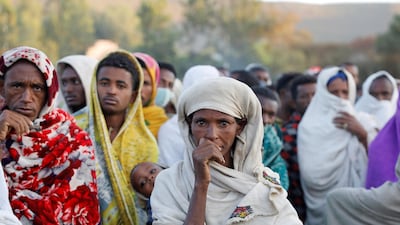
  • Tigrayans stand in line to receive food donated by local residents at a reception center for the internally displaced in Mekele, in the Tigray region of northern Ethiopia. AP Photo
    Tigrayans stand in line to receive food donated by local residents at a reception center for the internally displaced in Mekele, in the Tigray region of northern Ethiopia. AP Photo
  • An Ethiopian woman leaves with a portion of yellow split peas after it was distributed by the Relief Society of Tigray in the town of Agula, in the Tigray region of northern Ethiopia. AP Photo
    An Ethiopian woman leaves with a portion of yellow split peas after it was distributed by the Relief Society of Tigray in the town of Agula, in the Tigray region of northern Ethiopia. AP Photo
  • Displaced Tigrayans queue to receive food donated by local residents at a reception center for the internally displaced in Mekele, in the Tigray region of northern Ethiopia. AP Photo
    Displaced Tigrayans queue to receive food donated by local residents at a reception center for the internally displaced in Mekele, in the Tigray region of northern Ethiopia. AP Photo

President Joe Biden signed a broad executive order last week paving the way for sanctions on actors responsible for human rights violations in the Tigray civil war.

The Biden administration has said that it would enact those sanctions on the Ethiopian and Eritrean governments as well as the Amhara Regional Government and the Tigray People’s Liberation Front within a matter of weeks unless the parties agree to a ceasefire.

The US last month sanctioned the chief of staff of the Eritrean defence forces, Filipos Woldeyohannes. The Biden administration has repeatedly called on Eritrean forces to withdraw from Tigray.

Although Ethiopia has maintained an internet, phone and media blackout in Tigray, witnesses have described widespread human rights abuses, including the displacement and murder of civilians, gang rape, the destruction of civilian infrastructure and the burning of crops.

An Amnesty International Report released last month found that Ethiopian forces and their allies “subjected hundreds of women and girls to sexual violence”, war crimes that may also amount to crimes against humanity.

Fighters from the Tigray People’s Liberation Front have also retaliated with their own abuses during raids on villages in Amhara, including a massacre this month that killed 120 people.

The conflict broke out last year when Ethiopian Prime Minister Abiy Ahmed launched a military offensive against Tigray with the backing of Eritrean forces and Amhara militias.

Ethiopia is also embroiled in a border dispute over the fertile Al Fashaga border with Sudan and a tense diplomatic standoff with Khartoum and Cairo over the Grand Ethiopian Renaissance Dam. Sudan and Egypt say the dam would inhibit their fair share of access to Nile water

The White House announced on Friday that it had invited Sudanese Prime Minister Abdalla Hamdok to meet Mr Biden in Washington “in the near future” following a failed coup against the Sudanese transitional government this week.

In the meantime, Mr Biden’s special envoy for the Horn of Africa, Jeffrey Feltman, will visit Sudan as part of his trip to the region next week.

But the Grand Ethiopian Renaissance Dam is unlikely to be a priority for Mr Feltman, as the senior administration official said that Washington is largely deferring to African Union-led negotiations on the issue going forward.

“This is a regional issue, which, combined with the situation in northern Ethiopia and the Al Fashaga border, that really could further destabilise an already fragile region in the Horn of Africa,” the senior administration official told The National.

“Our interest is in a prosperous, stable and peaceful Horn of Africa, but we don’t want to insert ourselves into a process where we’re seen as supporting one side or the other to perhaps the detriment or the benefit of any party.”

Egypt asked former president Donald Trump to intervene in the Grand Ethiopian Renaissance Dam issue and enable negotiations with Ethiopia and Sudan. Mr Trump personally left the effort in the hands of Steve Mnuchin, an unusual choice to lead a major diplomatic initiative given his status as treasury secretary at the time.

Conversely, Mr Feltman has largely limited his role in the dam dispute, seeming to prefer African Union-led negotiations on the subject to continue.

“We give that support to the process, the AU-led process, to revitalise the negotiations on this and we give that support to that process,” said the senior administration official. “We are partners, but sort of on the margins of that process.”


The Old Slave and the Mastiff

Patrick Chamoiseau

Translated from the French and Creole by Linda Coverdale

Company profile

Name: Steppi

Founders: Joe Franklin and Milos Savic

Launched: February 2020

Size: 10,000 users by the end of July and a goal of 200,000 users by the end of the year

Employees: Five

Based: Jumeirah Lakes Towers, Dubai

Financing stage: Two seed rounds – the first sourced from angel investors and the founders' personal savings

Second round raised Dh720,000 from silent investors in June this year

At Everton Appearances: 77; Goals: 17

At Manchester United Appearances: 559; Goals: 253

Our family matters legal consultant

Name: Hassan Mohsen Elhais

Position: legal consultant with Al Rowaad Advocates and Legal Consultants.

Mercer, the investment consulting arm of US services company Marsh & McLennan, expects its wealth division to at least double its assets under management (AUM) in the Middle East as wealth in the region continues to grow despite economic headwinds, a company official said.

Mercer Wealth, which globally has $160 billion in AUM, plans to boost its AUM in the region to $2-$3bn in the next 2-3 years from the present $1bn, said Yasir AbuShaban, a Dubai-based principal with Mercer Wealth.

Within the next two to three years, we are looking at reaching $2 to $3 billion as a conservative estimate and we do see an opportunity to do so,” said Mr AbuShaban.

Mercer does not directly make investments, but allocates clients’ money they have discretion to, to professional asset managers. They also provide advice to clients.

“We have buying power. We can negotiate on their (client’s) behalf with asset managers to provide them lower fees than they otherwise would have to get on their own,” he added.

Mercer Wealth’s clients include sovereign wealth funds, family offices, and insurance companies among others.

From its office in Dubai, Mercer also looks after Africa, India and Turkey, where they also see opportunity for growth.

Wealth creation in Middle East and Africa (MEA) grew 8.5 per cent to $8.1 trillion last year from $7.5tn in 2015, higher than last year’s global average of 6 per cent and the second-highest growth in a region after Asia-Pacific which grew 9.9 per cent, according to consultancy Boston Consulting Group (BCG). In the region, where wealth grew just 1.9 per cent in 2015 compared with 2014, a pickup in oil prices has helped in wealth generation.

BCG is forecasting MEA wealth will rise to $12tn by 2021, growing at an annual average of 8 per cent.

Drivers of wealth generation in the region will be split evenly between new wealth creation and growth of performance of existing assets, according to BCG.

Another general trend in the region is clients’ looking for a comprehensive approach to investing, according to Mr AbuShaban.

“Institutional investors or some of the families are seeing a slowdown in the available capital they have to invest and in that sense they are looking at optimizing the way they manage their portfolios and making sure they are not investing haphazardly and different parts of their investment are working together,” said Mr AbuShaban.

Some clients also have a higher appetite for risk, given the low interest-rate environment that does not provide enough yield for some institutional investors. These clients are keen to invest in illiquid assets, such as private equity and infrastructure.

“What we have seen is a desire for higher returns in what has been a low-return environment specifically in various fixed income or bonds,” he said.

“In this environment, we have seen a de facto increase in the risk that clients are taking in things like illiquid investments, private equity investments, infrastructure and private debt, those kind of investments were higher illiquidity results in incrementally higher returns.”

The Abu Dhabi Investment Authority, one of the largest sovereign wealth funds, said in its 2016 report that has gradually increased its exposure in direct private equity and private credit transactions, mainly in Asian markets and especially in China and India. The authority’s private equity department focused on structured equities owing to “their defensive characteristics.”

Russia's Muslim Heartlands

Dominic Rubin, Oxford

MOUNTAINHEAD REVIEW

Starring: Ramy Youssef, Steve Carell, Jason Schwartzman

Director: Jesse Armstrong

Rating: 3.5/5

Brief scores:

Kashima Antlers 0

River Plate 4

Zuculini 24', Martinez 73', 90 2', Borre 89' (pen)

The%20Woman%20King%20
%3Cp%3E%3Cstrong%3EDirector%3A%3C%2Fstrong%3E%20Gina%20Prince-Bythewood%3C%2Fp%3E%0A%3Cp%3E%3Cstrong%3EStars%3A%3C%2Fstrong%3E%20Viola%20Davis%2C%20Thuso%20Mbedu%2C%20Sheila%20Atim%2C%20Lashana%20Lynch%2C%20John%20Boyega%C2%A0%3C%2Fp%3E%0A%3Cp%3E%3Cstrong%3ERating%3A%3C%2Fstrong%3E%203%2F5%3C%2Fp%3E%0A
Updated: September 24, 2021, 6:20 PM