

Frank Nieslanik’s calloused hand pulls hard on the gear shift of his 1951 Jeep Willys as he navigates the bumpy roads of the land he has farmed for the last 30 years.
On one side of the road, the fields are verdant, filled with rows and rows of young sweetcorn. On the other side, the fields lie fallow. It is one of the many efforts that Mr Nieslanik has made in recent years to conserve water at his farm in Grand Junction, Colorado.
“We’re using less,” he said. “We’re trying to leave one piece fallow off of each headgate just to give more water to the others in case they cut us back — or when they cut us back, which they will. We’ll have some vacant ground we don’t have to water."
The Colorado River, which runs adjacent to his farm, has been in a drought for 22 years.
The waterway and its tributaries snake through seven US states and Mexico. Along the way, the river provides drinking water for about 40 million people and nourishes the farmland that helps feed families across the country.
In western Colorado, where Mr Nieslanik farms, the river has supplied agricultural producers for generations and made the state famous for its cattle and produce.
But exceptionally hot weather this year coupled with an increase in water demand downriver means there is mounting pressure on farmers in the area to use less water.
“Seems like we’re shorter every year,” Mr Nieslanik told The National. “We’re in an extended drought and we keep hoping that they’re going to get a big snowpack to alleviate part of that, but we just haven't had it.”
The source of the Colorado River lies high in the Rocky Mountains, which serve as the continental divide that separates the water basins of the Pacific and Atlantic Oceans.
The region’s heavy snowfall fuels the river, but several years of low snow levels have left the river a shadow of its former self.
Scientists say climate change is exacerbating the problem.
A study by the US Geological Survey published in February found that global warming is causing the Rocky Mountain snowpack to shrink at a rate of about 9.3 per cent per degree Celsius increase in temperature.
“Climate change is having a pretty profound impact on snow in the west and our water supply,” said Keith Musselman, a scientist at the University of Colorado’s Institute of Arctic and Alpine Research.
The Rockies' snowpack is like a water tower for the Colorado River: snow accumulates in the winter and melts in the spring, filling the river when demand is at its highest.
-
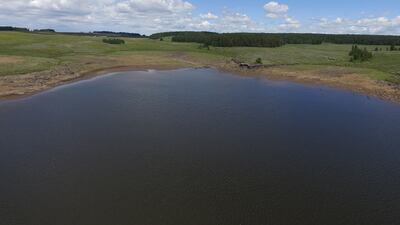
An aerial shot of a depleted reservoir on Grand Mesa outside Grand Junction, Colorado. Janie VanWinkle relies on the reservoir to feed her cattle. -

An aerial view of Frank Nieslanik’s farm. On one side of the road, the fields have been irrigated. On the other, they haven’t. -
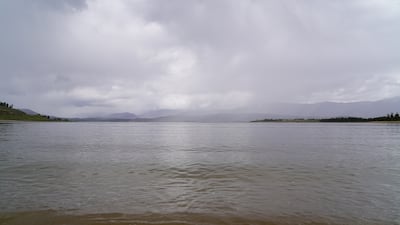
Lake Granby in Colorado is part of the headwaters that feed the Colorado River. -
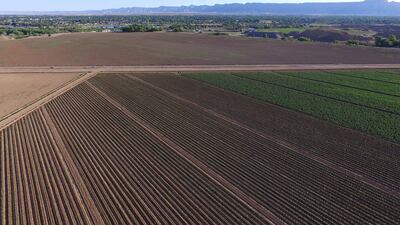
An aerial view of Frank Nieslanik’s farm in Grand Junction, Colorado. -

An aerial shot of Janie VanWinkle’s ranch shows how dry conditions have become. Down the hill, where the grass is green, shows the difference irrigation makes. -

Frank Nieslanik poses next to produce grown on his farm. He’s farmed the land for 30 years and has never seen it so dry. -

An aerial view of an irrigation canal on Frank Nieslanik’s farm shows the difference water makes to crops. -

Farm workers sow a field at Frank Nieslanik’s farm in Grand Junction, Colorado. The Colorado River has been in a drought for 22 years, putting stress on the state’s farmers. -
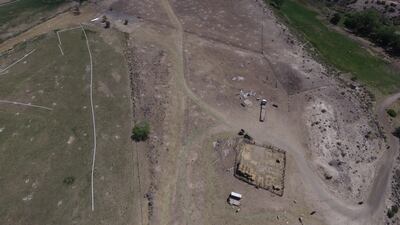
An aerial shot of Janie VanWinkle’s ranch outside Grand Junction, Colorado, shows how dry conditions have become. -
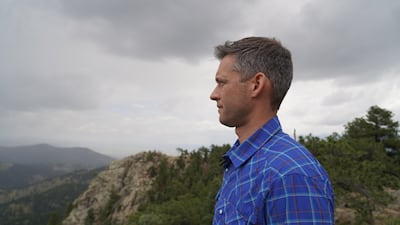
Keith Musselman, a scientist at the University of Colorado’s Institute of Arctic and Alpine Research, looks out towards the continental divide. -
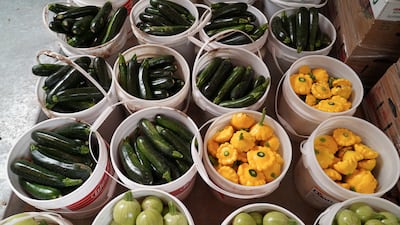
Produce from Frank Nieslanik’s farm in Grand Junction, Colorado. The Colorado River has been in a drought for 22 years, putting stress on the state’s farmers. -
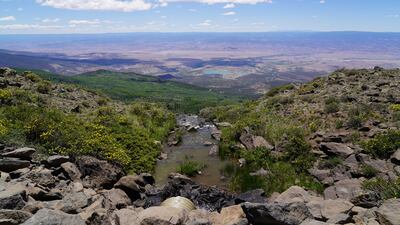
A view from the top of Grand Mesa overlooking the dry Western Slope of Colorado. In July, the state’s governor declared a drought emergency. -

Janie VanWinkle drives a tractor as she collects hay for her cows. The drought has meant she needs more hay than usual to keep her cattle healthy. -

Snow still graces the top of a peak in the Rocky Mountains of Colorado. Snowpack from the mountains is vital to the health of the Colorado River, which provides water to 40 million people in the American South-West and Mexico. -
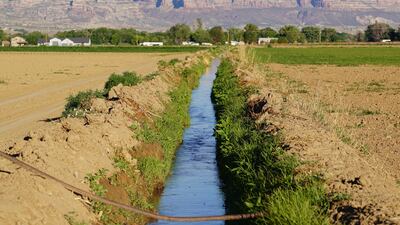
An irrigation canal runs through a farm in Grand Junction, Colorado. The area is famous for its cattle and produce. -

A view of Frank Nieslanik’s farm. On one side of the road, the fields have been irrigated. On the otherside, they haven’t. -
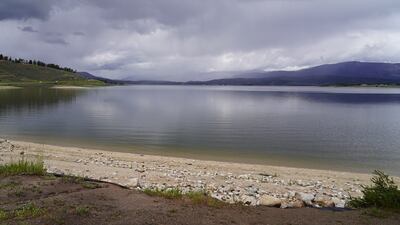
Lake Granby in Colorado is part of the headwaters that feed the Colorado River. -
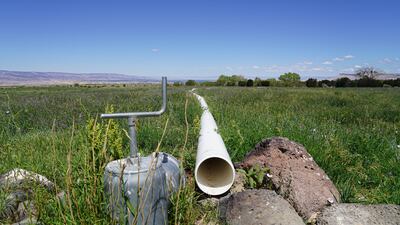
An untapped irrigation pipe at one of the tracts of land Janie VanWinkle and her family graze their cattle on. -

Janie Van Winkle’s husband, Howard, drives a tractor as she collects hay for her cows. The drought has meant she needs more hay than usual to keep her cattle healthy. -
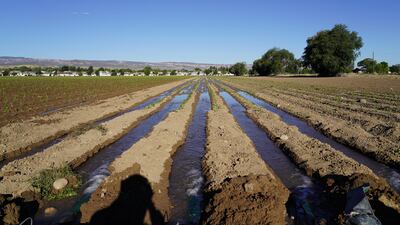
A field is irrigated at Frank Nieslanik’s farm in Grand Junction, Colorado. The Colorado River has been in a drought for 22 years, putting stress on the state’s farmers. -

A winding portion of the Colorado River. -

A depleted reservoir high on top of Grand Mesa near Grand Junction, Colorado. -
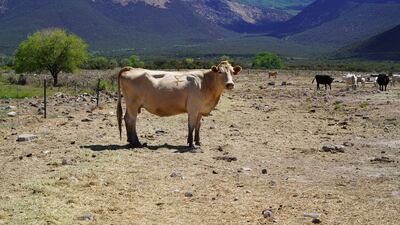
A cow stands on a dry patch of grass on one of the tracts of land Janie VanWinkle and her family use to graze them on. -
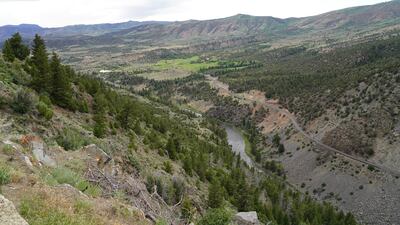
A stretch of the Colorado River, near the river’s headwaters.


“Climate change is affecting that in a couple of different ways,” Mr Musselman said, standing on a rocky outcrop overlooking the continental divide.
“It's changing the type of precipitation that we get; instead of getting snowfall in the winter, we’re frequently seeing rain and that rain doesn't persist into the dry seasons as readily, so that leaves our soils dryer, vegetation thirstier and more stressed.”
Janie VanWinkle has been working the land near Grand Junction her entire life. The fourth-generation cattle rancher has seen good, bad and even really bad years. This year is shaping up to be the latter.
“We’ve been through dry spells before and we’ve been through droughts,” she told The National.
“The hard part is the cumulative effect. We saw 2018 was dry, 2019 was an average year, 2020 was dry and here we are again, so the soil moisture is just gone. There’s just nothing left in the soil.”
This means there is very little food for her cattle.
“They’re just not happy,” she lamented, looking at her cows. “It’s not because they don't have food and not because they don't have water, because they do have feed, but they have to walk a lot farther and they have to work a lot harder.”
Clad in a cowboy hat and sunglasses, Ms VanWinkle treks along the rocky banks of a reservoir high above the land she ranches. Her loyal and capable border collie, T-Bone, bounces along the shore next to her. Beneath her work boots, the dry soil crunches where it would normally be soft and spongy.
“I’m appalled at how low it is,” she said, inspecting one of her reservoirs for the first time this season. “This is the level I would expect it to be for September.”

The reservoir is Ms VanWinkle's primary source of water for two of the tracts of land she grazes her cattle on.
She estimates it is only about 40 per cent full, leaving her unsure of how her cows will manage in the autumn and winter months.
“If we're lucky, we’ll be able to irrigate until the first of August.” In a good year, she would irrigate the ranch until the first of October.
Ms VanWinkle, 60, runs VanWinkle Ranch with her husband, Howard, and their son, Dean, who has just returned home from university.
The family has already had to sell 70 heads of cattle in an attempt to preserve the health of the herd and the land.
The drought has taken an emotional and psychological toll on Ms VanWinkle as well.
“The drought is just right here in front of our face in everything that we do,” she said. “It's just hard to stay positive and stay looking forward and do the hard work that we do.”
Every meal as a family is spent talking about the drought, strategising ways to try to mitigate its devastating toll on the land and animals.
“We can't keep doing the same thing and expect different results,” she said.
But without a good snowpack, there is little the VanWinkles can do but sell more cattle and try to find alternative sources of food for the cows.
They’re discussing hauling in hay from Kansas to offset their own hay production issues.
But the family is unbowed by the drought and Ms VanWinkle is determined to see the ranch she has worked her entire life building succeed into another generation as her son Dean learns the ropes.
Mr Nieslanik is less optimistic. With no children to pass the farm to, he doesn’t believe the land he has tilled for three decades will survive into the future.
“It’s sad and it’s discouraging,” said Mr Nieslanik as he gazed out over a bend in the Colorado River. “The water is really concerning. In my opinion, we won’t be farming here in 30 years.”

It's a stark outlook, but one shared by many climate scientists.
“Life in the west is going to be different,” Mr Musselman said. “And life globally is going to be different going forward until we mitigate the changes that are occurring.”
Agriculture is a major component of Colorado’s economy, contributing $47 billion and employing more than 195,000 people. The success of farmers like Mr Nieslanik and ranchers like Ms VanWinkle are critical to the state’s well-being.
The state is working hard to protect farmers and ranchers from the effects of the drought.
On July 1, Governor Jared Polis declared a drought emergency for the western slope of Colorado where Mr Nieslanik and Ms VanWinkle live and work.
At the federal level, Michael Bennet, a Colorado senator, introduced the Outdoor Restoration Partnership Act, which would invest $60bn in local forests and watershed restoration. The bill, which was included in President Joe Biden’s American Jobs infrastructure package, aims to help prevent wildfires in the West and to preserve the region's fragile watersheds.
Mr Nieslanik doesn’t blame anybody but the weather for the current drought. But he said he is concerned by the growing populations downriver in Arizona, Nevada and Colorado that he said are using more water than ever before.
While some accuse farmers and ranchers of abusing their water rights, both Mr Nieslanik and Ms VanWinkle bristle at the idea.
Ms VanWinkle sees herself as a steward of the land.
“We look at ourselves as a part of the solution to food security, part of the solution to climate change, with the carbon sequestration that we can do on range land — part of the solution to ensuring these open lands and these big expanses of lands continue. I think livestock production is the most efficient way we can utilise these lands to meet all of these other goals.”
This story is part of a series on the Colorado River drought in the American West. Read more here.

