


Hundreds of Venezuelan cancer sufferers, including children, could die because US sanctions are blocking their access to medical treatment overseas, UN experts have said.
Alena Douhan, a sanctions expert, and other UN investigators, said US financial curbs on Venezuela and its state-owned oil company Petroleum of Venezuela (PDVSA) have effectively ruined a much-needed treatment programme.
The Simon Bolivar Foundation, the charity arm of US-based Citgo Petroleum Corporation, which is majority owned by PDVSA, has been forced to scrap a project that took Venezuelan cancer sufferers abroad for treatment not available in their homeland.
“Targeting PDVSA as a way to control the political agenda of Venezuela has had devastating consequences for hundreds of people undergoing treatment for transplant rejection, in Venezuela and abroad,” the experts said.
“People on a state waiting list for transplants have also been informed that their treatments will not continue.”
The US sanctioned Venezuela’s state oil company in early 2019 over allegations that President Nicolas Maduro had rigged his re-election in 2018. Various other sanctions have been imposed on the country over the past 15 years.
Still, US sanctions and diplomatic pressure have had little effect. Mr Maduro’s allies, who deny election rigging, said they will not hold presidential elections before 2024.
Ms Douhan says US sanctions have had a devastating effect on the country.
Foreign governments, banks and private companies have been cautious in dealings with Venezuela for fear of reprisals from US regulators and have blocked financial transactions with the Opec nation, she said.
-
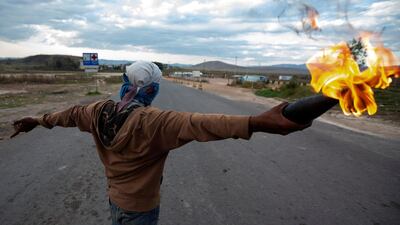
Opponents of Venezuelan President Nicolas Maduro clash with members of the National Guard on the border between Brazil and Venezuela. EPA -

Venezuelan demonstrators throw stones during clashes with authorities at the border between Brazil and Venezuela. AP Photo -
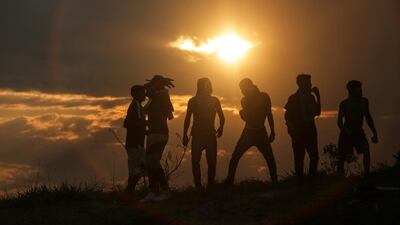
Venezuelan demonstrators gather during clashes at the border between Brazil and Venezuela. AP Photo -
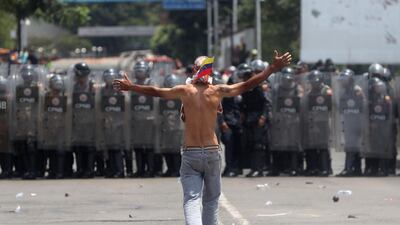
Opposition protesters face the Venezuelan Police at the Simon Bolivar International Bridge in Cucuta, Colombia. EPA -

A protester uses a slingshot during clashes with Venezuelan soldiers along the border between Venezuela and Brazil. Reuters -

A supporter of Venezuela's opposition leader Juan Guaido kneels in front of members of Venezuela's National Police standing guard at the Francisco de Paula Santander International Bridge between Colombia and Venezuela. AFP -
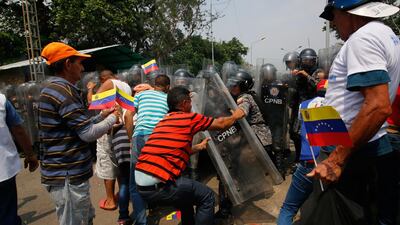
Supporters of Venezuela's opposition leader Juan Guaido struggle with police standing guard at the Francisco de Paula Santander International Bridge. AFP -
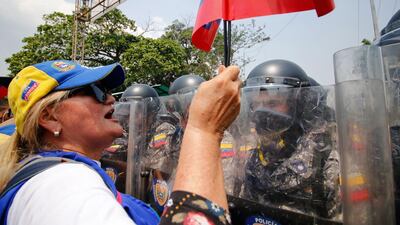
An opposition supporter demonstrates in front of police standing guard at the Francisco de Paula Santander International Bridge. AFP -
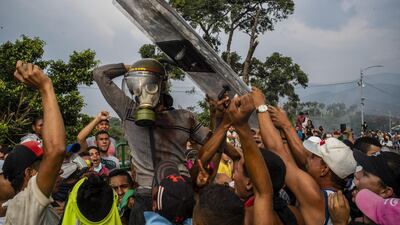
Demonstrators react after capturing a gas mask, helmet and shield from a Venezuelan soldier during clashes on the Simon Bolivar International Bridge near the border with Venezuela in Cucuta, Colombia. Bloomberg -

A truck is lit on fire during clashes on the Simon Bolivar International Bridge. Bloomberg -
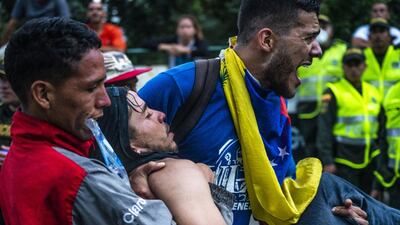
Demonstrators carry a wounded man during a clashes on the Simon Bolivar International Bridge. Bloomberg -

A supporter of Venezuela's opposition leader Juan Guaido kneels in front of police standing guard at the Francisco de Paula Santander International Bridge. AFP


As a result, the experts said some Venezuelan cancer patients are unable to access funds needed for foreign medical trips, while some have been stranded overseas after travelling for treatment.
“A trip abroad for treatment has become the only hope for hundreds of critically ill patients,” the experts said.
“The lives of Venezuelan transplant patients who are stranded in foreign countries, as well as those waiting to travel abroad for life-saving operations, are under threat.”
The experts said they had contacted the US government about the problem and urged Washington to “mitigate the unexpected consequences of sanctions” so patients could access chemotherapy and other treatments.
The US State Department and the Treasury did not immediately reply to The National’s request for comment.
The US has faced mounting criticism for its overuse of sanctions and the collateral economic damage they cause. The administration of US President Joe Biden is reviewing its punitive sanctions policy and is expected to make changes at the end of the summer.
Ms Douhan made the statement along with Nils Melzer, Obiora Okafor, Livingstone Sewanyana, Saad Alfarargi and Tlaleng Mofokeng, who are all part of the UN’s human rights apparatus.

