


Sir Martin Sweeting was a university lecturer in his late twenties when he built a home-made satellite that in 1981 he persuaded Nasa to launch, free of charge.
Four decades on he is still enthralled by the idea of sending machines into space, and the implications of them being joined by human beings.
The company he went on to found, Surrey Satellites, is setting up the first lunar orbiters that will give Moon explorers the equivalent of mobile phone coverage and GPS navigation.
While the name Surrey Satellites might sound parochial and prosaic, it has a formidable reputation in the space industry, largely founded on its success in sending 72 space vehicles into space. It employs 400 people with an average annual turnover of £75 million ($95 million).

Modest to a fault, Prof Sweeting would not claim to be the father of the British satellite industry, but the past and future suggest he is.
His first satellite, remarkably, remained in space photographing the Earth for eight years. His next raft of Moonlight spacecraft will orbit for decades as Moon exploration takes off.
But space is a hostile environment that requires pinpoint engineering where unforeseen events can have a catastrophic impact on exploration.
“We're on the cusp of space changing everything for humankind and what impact that might have on our planet,” he told The National. “But there are great risks too.”
Space 2075
Part of that risk will be how colonies and then societies and governments evolve on planets in the future. This is now being studied in detail by the professor and others who will submit a report on the implications of people living on other planet in 2075, that will publish in the spring.
“The idea is to get people thinking what will space be like in 2075? How do you manage colonies and society on Mars? For people born on Mars who may never be able to come back to Earth? Is it democratic? If you've got people working on the Moon, what about trade unions?”
The thinking is that when the internet was evolving four decades ago not many people considered the social fall-out. “It’s better to have at least a structure of policy, rather than try to fix it later,” he said.
It will also ask questions about what type of government might work on other planets, whether democratic, autocratic, socialist or something yet to be invented.

Apollo inspiration
As a budding 18-year-old scientist, it was watching Neil Armstrong descend on to the lunar surface in 1969 and the subsequent manned programmes that fired his imagination.
“I'm a child of the Apollo era,” Prof Sweeting confessed. “That really got me interested in space and caught my imagination.”
That inspiration initially led him to amateur radio, where by using shortwave devices bouncing signals off the ionosphere he was able to chat with fellow hobbyists around the world. For free.
“In the day of the internet this doesn't seem quite so exciting as it was back in the era of the Cold War,” he said.
That long-distance thinking began at university where Prof Sweeting designed a satellite tracking station to receive images from Russian and American orbiters, spending hours staring at the images of Britain taken from space. Since then, his satellites have gone on to picture cities and landmarks around the globe.
Dubai, Egypt and world capitals from space - Surrey Satellites view of Earth - in pictures
-

A NigeriaSat-2 panchromatic image of Dubai, including the Burj Khalifa, in 2012. NASRDA -
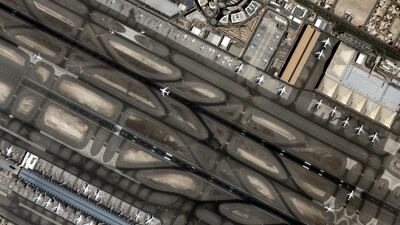
Dubai Airport captured by Carbonite-2 in 2018. SSTL -
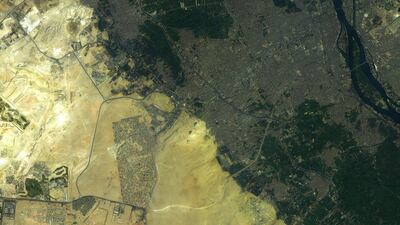
The Great Pyramids near Cairo, Egypt, taken by NigeriaSat-2. NASRDA -
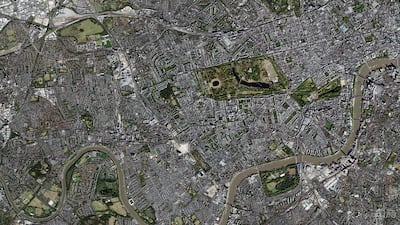
London imaged by SSTL S1-4 in 2019. SSTL -
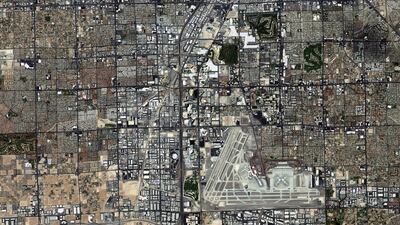
Las Vegas taken by SSTL S1-4 satellite in 2020. SSTL -
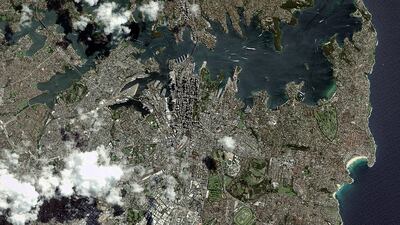
Sydney, Australia, taken by SSTL S1-4 in 2020. SSTL -
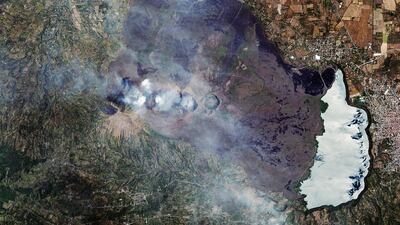
An SSTL S1-4 image of the Masaya volcano, Nicaragua, in 2020. SSTL -
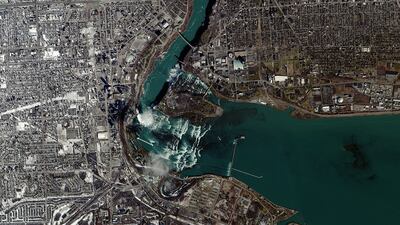
Niagara Falls, on the US-Canada border, captured by SSTL S1-4 in 2020. SSTL -
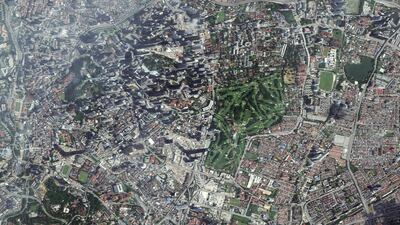
Kuala Lumpur, Malaysia, taken by SSTL S1-4 in 2020. SSTL -

San Francisco, US, captured by SSTL S1-4 in 2019. SSTL -

A multispectral image of Manhattan Island, New York, US, captured by NigeriaSat-2. NASRDA -

Iceberg calving off coast of Greenland. DMCii -
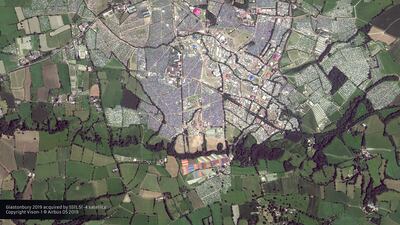
Glastonbury Festival in 2019, taken by SSTL S1-4. Airbus Defence and Space -

Suez, Egypt, in November 2021, captured by SSTL S1-4. SSTL -

Davis-Monthan Air Force Boneyard near Tucson, Arizona, US, taken by SSTL S1-4. SSTL -
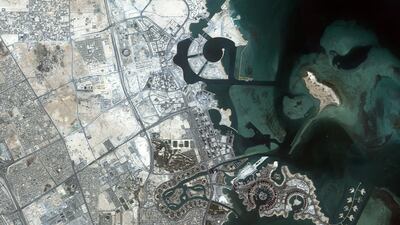
Lusail City, The Pearl and Qetaifan Islands in Qatar, taken by SSTL S1-4 in 2020. SSTL -
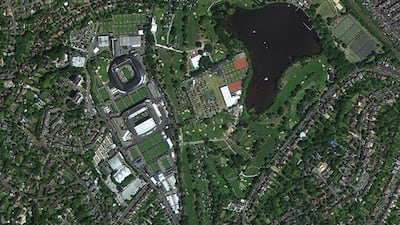
A DMC3/TripleSat Constellation image of The All England Lawn Tennis Club in Wimbledon, London, UK, in July 2018. 21AT


With micro-computers available for consumers in the late 1970s he realised that “all of a sudden you could start to do things in computing that were unimaginable before”.
His links in the amateur radio community had built some very simple satellites and “I thought if we just combined this new microprocessor technology we could build much cleverer small, simple local satellites”.
With financial support from government and industry, plus the odd free component, he designed UoSAT-1, the world’s first modern 70kg radio microsatellite that was “literally built on the kitchen table”.
Via another radio operator who happened to work at Nasa headquarters, the US space agency said “Why not? We'll help the Brits, it seems like a crazy idea, but let's give it a go”, saving him the equivalent of $200,000 for a trip on an Elon Musk SpaceX at today’s prices.
UoSAT-1 survived eight years in space, way beyond its expected two-year lifespan.
Close encounters
Since the early 1980s, space activity has gone from American and Russian dominance to 120 countries involved, 85 of whom have satellites.
“The broadening of access to space has been colossal,” Prof Sweeting said, but, he added, that could also create serious problems.
Beyond registering spacecraft with the UN, there is very little cosmic regulation for the more than 8,000 satellites currently in space.
“The numbers are growing by the day and the risks associated with space debris are increasing,” he said.

While there was an acceptance of mutual self interest in limiting the amount of space debris, including ending anti-satellite tests done by Russia, China and America, the risk of a catastrophic collision was growing.
“We used to get close-encounter alerts once every couple of weeks, now we're getting them several times a day,” he said.
With cosmic junk increasing, Prof Sweeting argued that space powers should consider some form of AI or machine learning in satellites to autonomously dodge hazards.
An accident could lead to the dreaded Kessler Effect in which a chain reaction of colliding satellites takes them all out.
“If everybody behaves responsibly, it's manageable and we won't get to the Kessler threshold but it doesn't require much to go wrong before we'd start to see that happen,” he said.
Most worryingly are the new-comers to space, either start-ups or private ventures, unaware of the risks, said Prof Sweeting, who was also involved in the UAE’s early space programme as a member of its advisory board.

Solar max
This year’s “solar maximum”, the 11-year cycle of major Sun eruptions, could have another devastating effect on Earth.
Already there have been some major solar eruptions that have fortunately pointed elsewhere in the solar system, including Mars.
“On Mars you would have got hit by some recently as bad as a Carrington,” said Prof Sweeting, referring to the 1859 geomagnetic event that caused telegraph systems to go haywire. Some lines caught fire when the biggest solar storm in recorded history hit Earth with the power of 17 nuclear bombs.
“If you did have an eruption and it's pointing to Earth, then the implications are far greater than Carrington, with a dramatic impact on all our satellite communications and terrestrial infrastructure,” he said.
“If we were to lose our communications and timing from satellites, society as we know it would no longer function because we are fundamentally dependent on satellites for everything.”
While it is on the UK government's “risk register” there is no guarantee that much can or has been done to mitigate the effects. “You should be OK if you've got a bicycle,” Prof Sweeting drily remarked.
Moonlight mission
Catastrophes aside, the race for the Moon is on. Forty different lunar missions are planned in the next five years with the expectation very high of finding water, that will provide fuel and air. That would make lunar colonies possible within a decade.
Surrey Satellites' position within that economy will be to provide the infrastructure like “Vodafone around the Moon” with its exploratory Lunar Pathfinder satellite.
If successful, within three years a raft of Moonlight satellites will form a lunar constellation providing communications and navigation “because one crater is going to look much like the next”, Prof Sweeting said.

A Moon base is also a key stepping stone for Mars, a six-month trip away. “The Moon is a very good place to start before you take the long leap – to try stuff out and correct what goes wrong.”
Indeed, it was in a breakfast conversation with Elon Musk about getting a greenhouse on Mars in which Prof Sweeting attracted the entrepreneur’s investment in Surrey Satellites that lasted for several years before the company was bought out by Airbus in 2008.
“He's extremely impressive in terms of his intellectual capability,” Prof Sweeting said. “Although his social skills are a little in need of refinement, he has a vision and he's technically highly competent, very driven and not too worried about the collateral damage that causes.”

Exploring space for so long has left Prof Sweeting confident that lifeforms in some state will be discovered, perhaps within a decade.
“Personally, I’d be very surprised if we don't discover irrefutable evidence of life somewhere else in the next 10 years, maybe sooner,” he said, speaking in the canteen at Surrey Satellite’s headquarters in Guildford.
“If we identify a form of life which didn't evolve from where we are, then that opens up a whole heap of questions. Because if it happens once it'll have happened many times and there's going to be an amoeba at one end and there's going to be super folk at the other end.”

