


Summers in the Arctic for climate expert Dame Jane Francis usually mean remaining wrapped up tight against the chill.
That has changed.
When the director of the British Antarctic Survey – which covers both poles – returned to the Svalbard archipelago for a week’s research in July this year, she spent the entire time in T-shirts or a light coat at most.
“I couldn't believe how warm it was,” the climate veteran said. “In the 24-hour sunshine, you could see that the glaciers were melting and discharging the rocks and silt into the fjord.
“So yes, in the Arctic, global warming is definitely taking its toll.”

The heat, which came as Europe endured record 48°C temperatures and wildfires, was even more worrying for the local Norwegians.
“A few years ago, people were happy about having a nice day in the Arctic but now they they're saying this warmth isn't natural, it shouldn't be like this,” she said.
“They are very concerned.”
More disconcerting is the changes occurring at the opposite pole which, with its vast ice coverage, has a more drastic effect on global climate.
“Scientists are discovering that strengthening winds are blowing warm sea water under the ice shelves that fringe the Antarctic continent, melting them from below,” said the scientist, whose experience in the Antarctic is such that a mountain-top has been named after her: Francis Peak.
“The ice shelves act like door stops, preventing the huge glaciers on land from flowing into the sea. But if the ice shelves melt away all that glacial ice will flow into the ocean and that’s what will cause the sea level to rise across the planet.”
As glaciers melt, rising sea levels will affect coastal regions around the world, affecting billions of people who live in low-lying areas.
Tipping points
Climate scientists are frequently asked about “tipping points”, in which an irreversible change occurs before humankind can find a remedy.
“The danger about tipping points now is that we won't know whether we're tipped into a new climate state until it’s too late,” said Ms Francis.

“People think tipping points are a specific thing that's going to happen, say that on 25 November in 2025 we're going to suddenly tip and we'll be into another state.
“It's just not going to be like that. It’s more likely to be a gradual change and we have tipped into a different climate state when we look back in hindsight.”
The upcoming Cop28 climate conference, which begins in the UAE at the end of this month, could be a key moment to accept the seriousness of the situation, she said, and in future climate change would be considered the most dangerous kind of global event.
Rising waters
Ms Francis spoke to The National as the world news agenda is dominated by events in Gaza. Beyond the death and destruction, she argued that Gaza has a relevance for those identifying issues that climate change will bring.
In the immediate term, the effect would be greatest on small Indian Ocean states.
“What Gaza shows us is how hard it is for two nations to share” but when islanders have to be evacuated, it is a “situation that will have to be addressed” with a new home found for them.
Previously sea levels rose at 1mm a year from the Antarctic melt but this has now accelerated to nearly 4mm.

That will soon also affect coastal cities and key agricultural areas such as the deltas in India or the Mississippi and key coastal sites including nuclear power stations.
The strengthening winds are now blowing warm water up to the ice shelves that hold back the huge continent-sized slabs of Antarctic, allowing warmer water underneath.
“Ice shelves are like a doorstop buttressing the glaciers on land and if you remove the shelves then the ice floe from the land will speed up,” said Ms Francis, who has been BAS director since 2013.
Warm earth
As a geology graduate who subsequently specialised in palaeoclimatology, she has unique insight into when the world’s climate last had 420 parts per million of carbon dioxide molecules, the unit of measurement for pollution in the atmosphere
Three million years ago, natural climate warming meant that the ice caps were smaller and sea levels were up to 20 metres higher than they are today. About 100 million years ago, volcanic activity led to even warmer climates.
“Antarctica was a very different place then, it was covered in forests and dinosaurs,” said Ms Francis. But the key point, she insisted, was that when the Earth warmed in the past, it took “millions of years for the climate to change, not like the rapid change we are seeing now, in a few tens of years”.
This might also explain recent major weather events.
“The Earth is trying to catch up very fast to get in balance with a 420 ppm CO2 world and personally I think that's why there's so much extreme weather.”

Cop28 message
Despite conflict elsewhere, the international community needs to unite at Cop28 and focus on the key requirement “to stop putting CO2 and other greenhouse gases into the atmosphere”, she said.
While there is much more press coverage today on Antarctica’s issues “not everybody necessarily understands the consequences it will have around the whole planet”.
“We really need to tackle this as a global community, not just country by country,” she added. “There needs to be more world leaders engaged and really committed as we can do a lot more and a lot faster if there's financial and political encouragement from the top.”
She suggested that people were inventive enough to find a way to reverse the situation, although that will largely depend on being able to put CO2 back in the ground.
“I think we're clever enough as a human race to do something about it – it's not all gloom and doom,” she said.
“But I wish governments were more proactive in supporting all the initiatives because we can do a lot more and a lot faster.”
Figurehead wanted
The departure of Alok Sharma as Britain’s “climate tsar” was a severe loss of a political heavyweight “to lead the charge” on the environment.

“We need a figurehead who represents our battle for understanding climate change. Alok Sharma got very engaged in climate change at Cop26 and afterwards, so it was very sad that he disappeared from the political arena because he was a real figurehead,” she said.
“He understood the issues and was ready to lead.”
Ms Francis believes a formidable political figure, either from Britain or beyond, is needed to take on the mantle.
“We need someone who can influence governments and make changes for the good of our planet.”
The BAS has become a world leader for investigating climate change and now have more instruments than ever before.
The Sir David Attenborough icebreaker ship can carry 60 scientists as well as an array of autonomous vehicles that can dive deep or sail across the surface gathering ocean data. Images from satellites also provide crucial information on changes across the polar ice caps.
“We have more instruments, such as autonomous vehicles that carry sensors that go under ice shelves or into deep ocean water enabling us to collect more data,” said the scientist, was appointed a dame in 2017.
“The new measurements will help us understand better what is happening and the potential impact across the planet.
“As a geologist, I know the Earth takes care of itself, that the planet will rebalance itself.
“But whether we have humans here or not is another question.”
Climate tipping points – in pictures
-
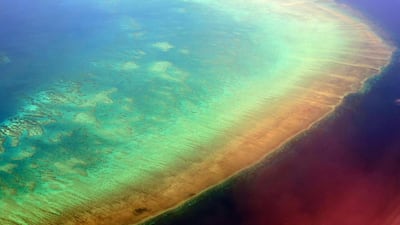
An aerial shot of the Great Barrier Reef in Australia, showing parts of the reef that has been subjected to coral bleaching. -

A house located on land that has been deformed by permafrost thaw at a former airfield in Churapcha, Russia. Reuters -

Native vegetation has been cut down to give space for eucalyptus plantations in the Setubinha region in Brazil. AFP -
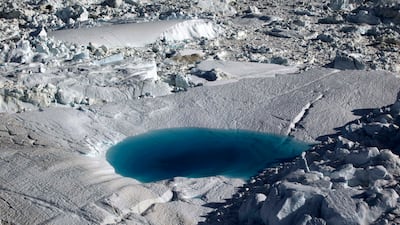
A large melt pool forms in the Ilulissat ice fjord below the Jakobshavn Glacier at the fringe of the Greenland ice sheet. AP -
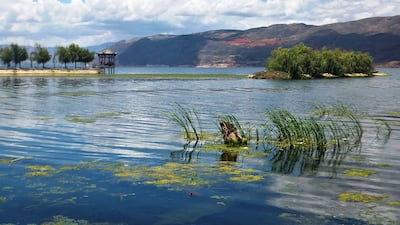
Lake Erhai in China has become eutrophic (where an entire body of water becomes enriched with nutrients and minerals) which caused algal growth that destroyed other life. Photo: Ronan O'Connell -
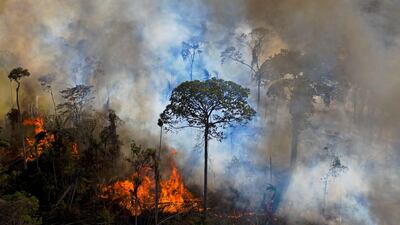
Deforestation in Para state, Brazil. AFP -
Moai statues in Easter Island, Chile, were damaged after a wildfire. Reuters



