


More than 200 health journals worldwide have emphasised that climate change and biodiversity loss is directly damaging human health, with vulnerable and impoverished communities bearing the most significant effects, facing rising temperatures, extreme weather events and the spread of infectious diseases.
Experts have collectively sounded the alarm, publishing a unified editorial that implores world leaders, health professionals and the World Health Organisation (WHO) to acknowledge and address these interlinked crises as a single global health emergency.
Treating these crises as separate challenges is a “dangerous mistake”, the authors said.
“It’s the serious, gravity and urgency of the problem that have led the journals to come together,” Dr Richard Smith, chairman of the UK Health Alliance on Climate Change, told The National.
“The destruction of nature and the climate is the major threat to health and is, indeed, an existential threat."
The intertwined crises have led to disruption in social and economic systems, causing essential resource shortages, exacerbating poverty, resulting in mass migration, conflicts and the emergence of new diseases and pandemics.
Dr Smith said: “This indivisible planetary crisis will have major effects on health as a result of the disruption of social and economic systems – shortages of land, shelter, food and water exacerbating poverty, which in turn will lead to mass migration and conflict.”
Kamran Abbasi, editor in chief of the British Medical Journal, emphasised the interconnected nature of these crises. He said: “The climate crisis and loss of biodiversity both damage human health and they are interlinked.
“That’s why we must consider them together and declare a global health emergency.”
-
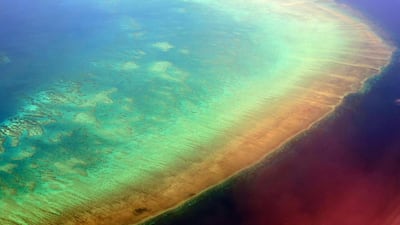
An aerial shot of the Great Barrier Reef in Australia, showing parts of the reef that has been subjected to coral bleaching. -

A house located on land that has been deformed by permafrost thaw at a former airfield in Churapcha, Russia. Reuters -

Native vegetation has been cut down to give space for eucalyptus plantations in the Setubinha region in Brazil. AFP -
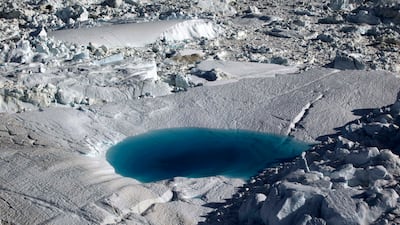
A large melt pool forms in the Ilulissat ice fjord below the Jakobshavn Glacier at the fringe of the Greenland ice sheet. AP -
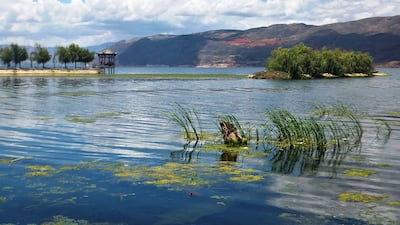
Lake Erhai in China has become eutrophic (where an entire body of water becomes enriched with nutrients and minerals) which caused algal growth that destroyed other life. Photo: Ronan O'Connell -
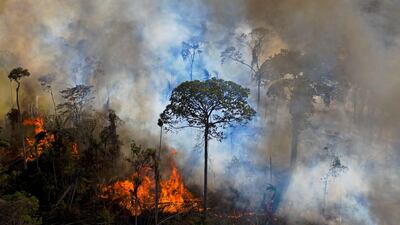
Deforestation in Para state, Brazil. AFP -
Moai statues in Easter Island, Chile, were damaged after a wildfire. Reuters


To combat such challenges, the editorial calls on the WHO to declare the climate and biodiversity crises as a global health emergency before or at the 77th World Health Assembly in May 2024.
“So far the global and usually national response to the destruction of nature and the climate has been adequate,” Dr Smith told The National.
“We need concerted action – as occurs when a country goes to war and all else is put to one side to counter a major threat. We need similar global emergency action to prevent the destruction of nature and the climate.
“We face a dangerous and hazardous future if this action is not taken.”

