


Flooding in Libya, which has killed almost 4,000 people and left 9,000 missing, was made 50 times more likely due to human-caused climate change, a study has revealed.
A report by the World Weather Attribution group, compiled by an international team of climate scientists, says heavy rainfall, which caused devastation in large parts of the Mediterranean in early September, was made more likely to happen by climate change resulting from greenhouse gas emissions.
It found that the destruction caused by the heavy rain was much greater due to factors that included construction in flood-prone areas, deforestation, and the consequences of the conflict in Libya.
Maya Vahlberg, from the Red Cross Red Crescent Climate Centre, told The National that urgent action needs to be taken to reduce people's exposure to flood risk and has called for a full review of the designs of the Libyan dams, which collapsed and failed.
It comes as the report, which was published on Tuesday, warned that human-caused warming made the heavy rainfall up to 10 times more likely in Greece, Bulgaria and Turkey, and up to 50 times more likely in Libya.
"What needs to happen now is that we urgently need to reduce exposure to flood risk in Libya," Ms Vahlberg said.
"For instance in the river where these two dams were built, it was super densely populated and roughly 2,000 homes were exposed to this massive flood risk, so a first step is to definitely reduce exposure and look at nature based solutions to reduce and increase the ground’s ability to absorb this water compounding and cascading impact."
Scientists call for improved early warning systems
She said the impact of the failure of the dams could have been reduced if better warning systems had been in place.
"In Libya, there was three days warning but the impact of that potential rainfall on infrastructure and people was not clearly understood in advance," she said.
"It is not clear to what extent forecasts and warnings for it were communicated and received by the general public. In Libya the big driver was the volume of water and overnight timings of the dam failings. This meant that anyone in the path of the water was at risk.
"Libya is a country in continuing conflict and state fragility which likely contributed to a lack of maintenance and deterioration of the infrastructure over time increasing the risk of dam safety issues. The dams were built in the 1970s using relatively short rainfall records and may not have been designed to withstand a one in 600-year event.
"A full after-action review looking at the design criteria of the dams will be required to understand the extent to which the dams' design and the lack of subsequent maintenance contributed to this disaster. '"Even still, catastrophic dam failures and its impact can be limited through risk reduction protocols that involve real-time monitoring of forecasts and water volumes and warning systems that alert those downstream of possible failures and the need to evacuate.
"This disaster points to the need to design and maintain infrastructure. Improved early warning systems, adaptation planning and emergency planning could also help to avoid to repeat these events in the future.”
Half of Greece's road networks in flood-prone areas
She warned that Greece is also at risk due to its high rates of urbanisation having changed the scope of the landscape, while a quarter of the country is facing "very high" flood risk as 80 per cent of its urban areas and half its road network are located in flood-prone areas.
Spain, Greece, Bulgaria, Turkey and Libya were all hit by floods after a low-pressure system named Storm Daniel, which formed in the Eastern Mediterranean, brought large amounts of rain over a 10-day period.
Four people were killed in Bulgaria, five in Spain, seven in Turkey and 17 in Greece.
The greatest disaster occurred in Libya, where the floods caused the collapse of two dams.
Julie Arrighi, Director at the Red Cross Red Crescent Climate Centre, said improved warning systems and forecasts will help.
“This devastating disaster shows how climate change-fuelled extreme weather events are combining with human factors to create even bigger impacts, as more people, assets and infrastructure are exposed and vulnerable to flood risks," she said.
"However, there are practical solutions that can help us prevent these disasters from becoming routine such as strengthened emergency management, improved impact-based forecasts and warning systems, and infrastructure that is designed for the future climate.”
To quantify the effect of climate change on the heavy rain in the regions, scientists analysed climate data and computer model simulations to compare the climate as it is today, after about 1.2°C of global warming since the late 1800s, with the climate of the past, following peer-reviewed methods.
For Libya, the scientists found that human-caused climate change made the event up to 50 times more likely to happen, with up to 50% more rain during the period, as a result of human-caused greenhouse gas emissions.
They said the event is still extremely unusual, and can only be expected to occur around once in 300-600 years, in the current climate.
For Greece, Bulgaria and Turkey, the analysis showed that climate change made heavy rain up to 10 times more likely to happen, with up to 40 per cent more rain, as a result of human activities that have warmed the planet.
For this large region, which encompasses parts of the three countries, the event is now reasonably common, and can be expected about once every 10 years, meaning it has a 10 per cent chance of happening each year.
For central Greece, where most of the impacts took place, the event is less probable and only expected to happen once every 80-100 years, equivalent to a 1-1.25 per cent chance of happening each year.
In Spain, where most of the rain fell in just a few hours, the scientists estimated that such heavy rainfall is expected once every 40 years.
-
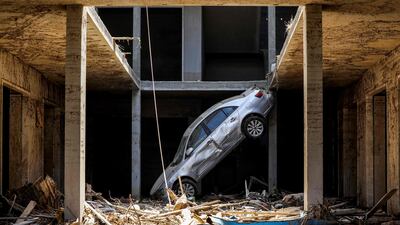
A tilted car sits above debris in Libya's eastern city of Derna. AFP -
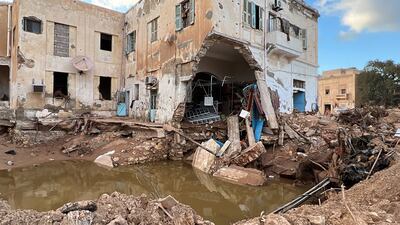
A damaged building, days after Storm Daniel swept across eastern Libya. EPA -
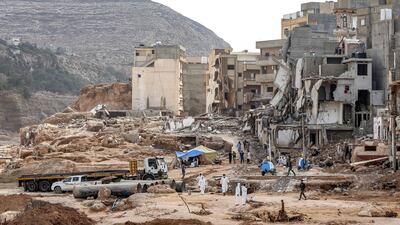
Rescue teams walk in Derna. AFP -
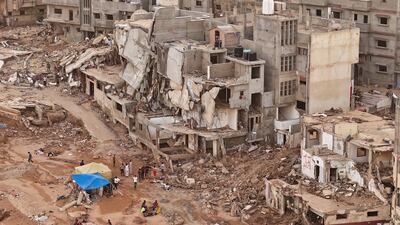
Thousands of people have died in devastating floods in Libya. AP Photo -

Abdulkarim Ben Ali uses crutches as he walks on the roof of his sister's damaged house. Reuters -
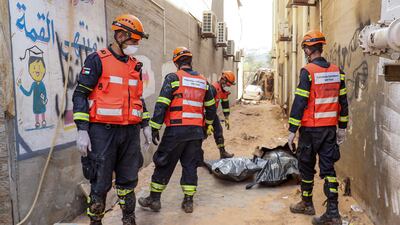
A Palestinian civil defence team. AFP -
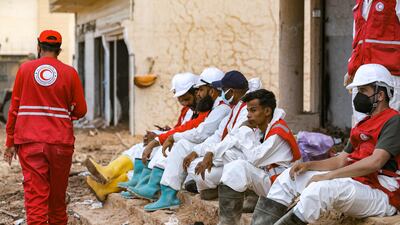
Rescue teams. AFP -

Youssef, 18, a survivor of the flooding, lies on a bed at the Benghazi Medical Centre hospital. AFP -
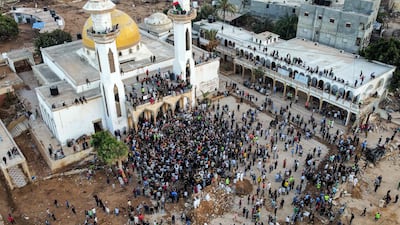
People gather for a demonstration outside the surviving Al Sahaba mosque. AFP -
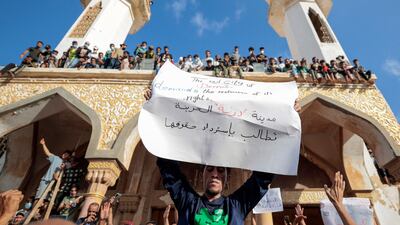
People who survived the deadly storm outside the Al Sahaba mosque. Reuters -
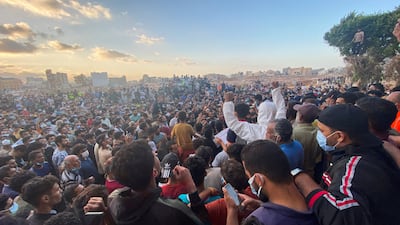
Demonstrators take part in protest against the government. Reuters -
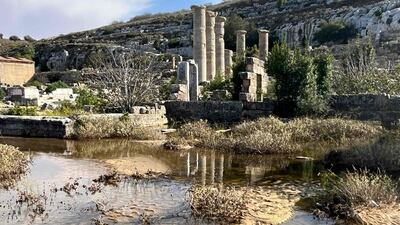
Ruins at the site of the ancient Greco-Roman city of Cyrene in eastern Libya, about 60km west of Derna. AFP


A key finding of the study is that the very large impacts observed in some of the regions were caused by a combination of high vulnerability of the population and their exposure to the event. In the affected area in Central Greece, most of the cities and communities and a large part of the infrastructure are located in flood-prone areas.
In Libya, a combination of several factors including long-lasting armed conflict, political instability, potential design flaws and poor maintenance of dams all contributed to the disaster. The interaction of these factors, and the very heavy rain that was worsened by climate change, created the extreme destruction.
Friederike Otto, Senior Lecturer in Climate Change and the Environment at Imperial College London, said action is paramount to ensure lives are saved.
“The Mediterranean is a hotspot of climate change-fuelled hazards. After a summer of devastating heatwaves and wildfires with a very clear climate change fingerprint, quantifying the contribution of global warming to these floods proved more challenging," he said.
"But there is absolutely no doubt that reducing vulnerability and increasing resilience to all types of extreme weather is paramount for saving lives in the future.”
The study was conducted by 13 researchers, including scientists from universities and research centres in Greece, the Netherlands, the UK and the US.

