


The UK this month experienced its hottest June since records began in 1884, meteorologists are poised to announce.
The Met Office is on Monday expected to officially confirm that June 2023 was the hottest month.
It has beaten the previous record set in 1940, as well as June 1976, which was the second warmest June on record.
Previous records for June saw temperatures hit an average of 14.9C whereas this year the average temperature has so far been 16C with average highs of 21.4C, the Met Office told The National.
Last year the average temperature was 13.9C.
Forecasters told The National the trend is expected to continue and there are fears the country will face droughts this summer.
"June is indeed likely to go down as the hottest June on record for the United Kingdom, with records going back to 1884," said Tony Zartma, senior meteorologist at AccuWeather.
"Much of the month of June, especially the first half, was under a stagnant weather pattern. High pressure stretched from a large part of the eastern Atlantic through western Europe, providing dry and sunny conditions along with warm air.
"Overall, with climate change, additional opportunities for warmer than normal weather would be expected in the future. Not only warmer air, but also warmer ocean temperatures. These warmer ocean temperatures also allow for increased humidity levels, which in turn keeps temperatures warmer at night.
"The rest of the summer months are expected to be on the warmer and drier side when compared with historical averages. There is a threat for drought to return, especially across England, but conditions are not expected to be as severe as last year."
Weather25 said temperatures in England in June usually range between 11ºC and 19ºC with up to eight days of rain, but this year temperatures soared to 32ºC in some places.
Last Sunday temperatures rose to 32.2°C in Coningsby, Lincolnshire, matching this year's record set on June 10 in Chertsey, Surrey.
Coningsby is also where the UK's hottest temperature, 40.3°C, was recorded on July 19 last year.
The Met Office’s Mike Kendon said the heat in June has been unusual.
“Meteorologically, June started with high pressure over the UK bringing often settled and dry conditions with plenty of sunshine. Once that high pressure subsided, warm, humid air took charge over the UK, with 32.2ºC the highest temperature recorded," he said.
“What has been particularly unusual is the persistent warmth for much of the month, with temperatures reaching 25ºC widely for at least a fortnight, and at times 28ºC to 30ºC – whereas we would more typically expect maximum temperatures in the high teens or low 20s at this time of year.”
Mr Zartma believes the UK could experience tropical weather later in the summer.
"The driest weather will likely be through July before relief potentially arrives later in the summer," he said. "At that point, attention will turn to any possible tropical features in the Atlantic Ocean that could get steered towards north-west Europe."
Drought warnings have been issued for much of the UK and Ireland, according to data from the Copernicus satellite, with a hosepipe ban introduced on Monday for South East Water customers in Kent and Sussex.
South West Water customers in Cornwall have been subject to a hosepipe ban since August last year, which has since been extended to others in Devon.
Along with parts of East Anglia, the region has not left drought status since the extreme heat last summer in which 40°C temperatures led to destructive grass fires and more than 3,000 excess deaths during the heatwaves.
Four of the top 10 warmest Junes have occurred this century: 2018 (14.8°C), 2003 (14.5°C), 2006 (14.5°C) and 2017 (14.4°C); while Sky News reported that the final average temperature figure for the month is on course to beat the previous mean average record of 14.9C set in 1940 and again in 1976.
The National Drought Group (NDG) has warned of a decline in reservoir and groundwater levels in parts of England.
It comes as February was recorded as the driest in 30 years.
Chaired by the Environment Agency, the NDG – which includes senior decision makers from the Environment Agency, government, water companies and key farming and environmental groups – met on Wednesday to discuss the current situation in England and the action being taken to ensure there is a plentiful water supply over the coming months.
"The recent heatwave has served as a reminder that we need to prepare for weather extremes and act now to ensure resilient water supplies," said Simon Hawkins, chairman of the NDG and director operations south-east and east at the Environment Agency.
"The Environment Agency, water companies and partners are working collaboratively to handle drought risk across the country; with our staff managing abstraction licences to balance need, ensuring water companies implement their drought plans, working with farmers to manage resources, and rescuing fish in areas where river levels are extremely low.
"We all have a role in easing pressures on our precious water supply to protect the environment, our wildlife and ensure clean and plentiful water for future generations."
As of Tuesday, total reservoir stocks for England were at 83 per cent of their total capacity.
In the Lake District, Haweswater and Thirlmere recorded a decrease of 13 per cent in reservoir stocks between the end of April and end of May 2023. In the North East, the Teesdale reservoir group also recorded a 13 per cent drop over this time.
Professor John Marsham, the Met Office's Joint Chair at the University of Leeds and Professor of Atmospheric Science, says it is important governments take action to combat climate change.
“High temperatures globally are being driven by the combination of climate change and the emerging El Nino," he told The National.
"The seas around the UK have been exceptionally warm, and although it’s been a record June here, we’ve escaped lightly compared with some other places: e.g. the record-breaking wildfires in Canada, and recent record-breaking temperatures in Spain, Mexico, Southern USA and China. Such remote events don’t just affect people locally, but drive up food prices across the globe.
"We saw record UK temperatures last summer, and until governments take the actions urgently needed, we will continue to see more records broken, with rapidly escalating impacts worldwide. As reported by the UK’s climate change committee on Thursday, the government is behind on almost every front even though many actions will improve energy security, reduce costs, create jobs and bring other benefits, such as cleaner air and better health.”
Britain coping with heat through the years - in pictures
-

Men cover their heads with newspapers to protect them from the summer sun in 1913. All photos: Getty Images -

Children enjoy their ice creams during a heatwave in 1914, outside Horse Guards Parade in London. -

London schoolboys bathe in the fountain at Trafalgar Square in 1919. -

A group of friends cool off in Mill Weir, Berkshire, during a heatwave in 1926. -

Workers at a hat manufacturers in Luton, in 1928, carrying piles of men's straw hats, which were in demand due to a heatwave. -
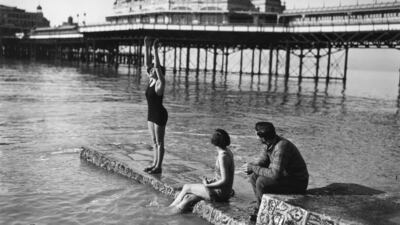
A girl prepares to take the plunge in Brighton in 1929. -
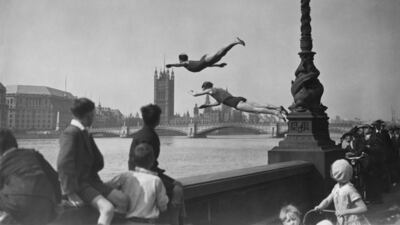
Two divers jump off the Embankment into the River Thames in London, in 1934. -
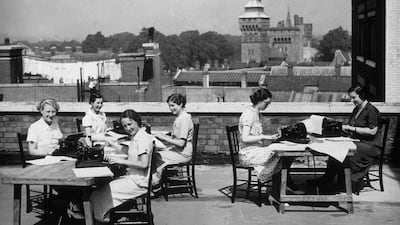
Typists cool off by working on a Cardiff roof-top in 1935. -

A bus driver and conductor stop for a water break in London in 1935. -

A passer by mops his brow as he reads a thermometer in Smithfield Market, London, in 1938. -

Schoolgirls wear newspaper hats to protect them from the sun while they watch the Wimbledon tennis championships during a heatwave in 1953. -
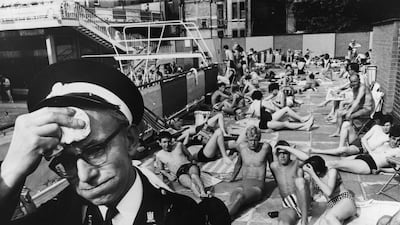
An ambulance man on duty at the Holborn Oasis swimming pool in London, in 1964. -

Holiday makers in Clacton-on-Sea relax in the heat by lying on top of their parked cars in 1967. -

A Londoner sunbathing in Kensington Gardens with a knotted handkerchief protecting his head from the sunshine in 1976. -

Two London policemen take the weight off their feet during a May heatwave in 1976. -
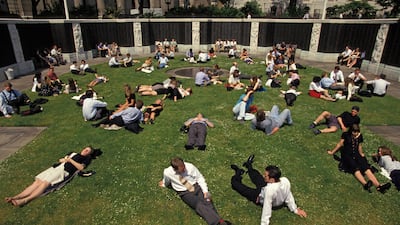
City office workers stretch out during a hot summer lunchtime in Trinity Square in London, in 1993. -
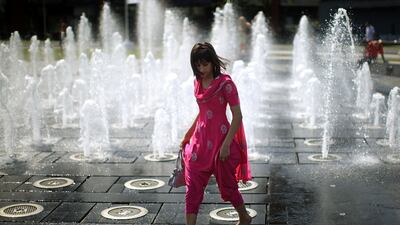
A student cools off in the fountains of Piccadilly Gardens in Manchester, in 2009. -
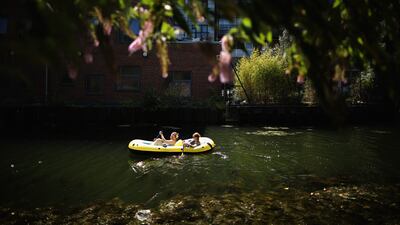
Two girls make their way down the Regent's Canal in London in 2014. -

A couple relax on deckchairs in the hot weather in Hyde Park, London, in 2014. -
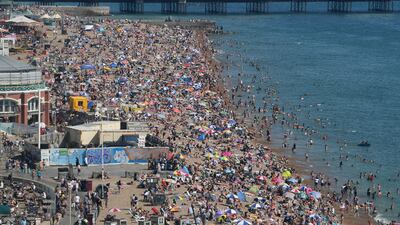
A packed Brighton beach during a heatwave in 2020.



