

The Royal Observatory Greenwich has unveiled the shortlist for the 15th annual Astronomy Photographer of the Year competition.
Showcasing awe-inspiring images of celestial wonders, this year's entries include a vibrantly coloured aurora over Ireland, the Milky Way arching over a deserted Namibian diamond processing plant, and the gas giant Jupiter accompanied by two of its moons, Io and Europa.
The competition has attracted more than 4,000 entries from 64 countries.
It offers a platform for professional and amateur photographers to share their passion and talent for capturing the beauty of the cosmos.
Among the shortlisted entries is an evocative image of star trails captured over the First World War trench memorial in Vimy, northern France.
The competition also recognises the remarkable auroral activity of the previous year, considered one of the astronomical highlights of 2022.
-
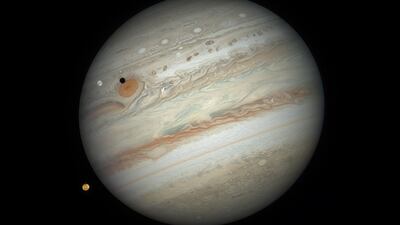
Jupiter flanked by two of its moons, Io and Europa. Photo: Damian Peach -
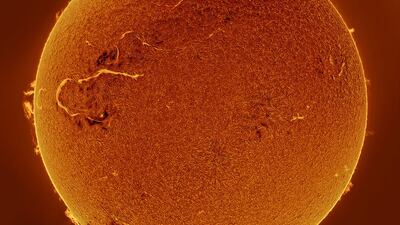
The Sun moving towards its maximum cycle. Photo: Mehmet Ergün -
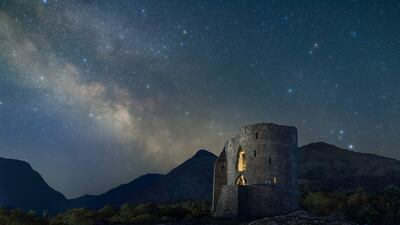
A clear night sky as seen from late 12th-century Dolbadarn Castle at the base of Llanberis Pass in Wales. Photo: Robert Price -
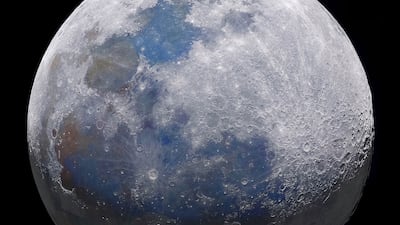
A composite image of the Moon 78% illuminated and the full Moon. Photo: Rich Addis -

The Northern Lights above Vestrahorn mountain in Iceland. Photo: Lorenzo Ranieri Tenti -
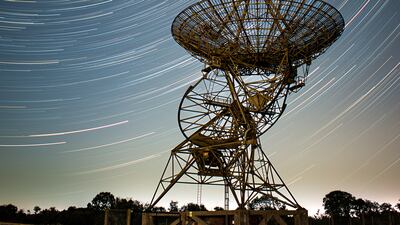
Star trails over a deactivated radio telescope antenna in Cambridge. Photo: João Yordanov Serralheiro -
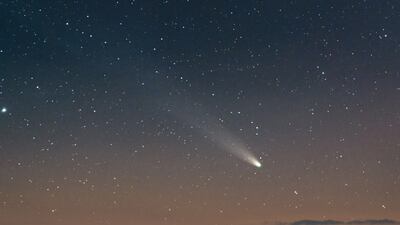
Comet Leonard over the Negev desert in Israel. Photo: Alex Savenok -
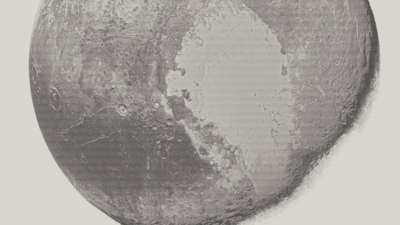
Image of Pluto generated using Nasa data, inspired by Jean-Dominique Cassini's 1679 map of the Moon. Photo: Sergio Díaz Ruiz -
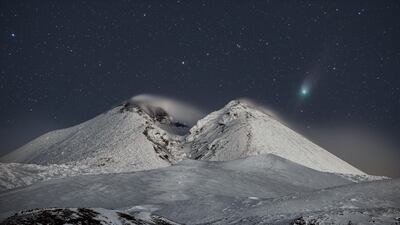
Comet passes over Mount Etna in Sicily. Photo: Dario Giannobile -
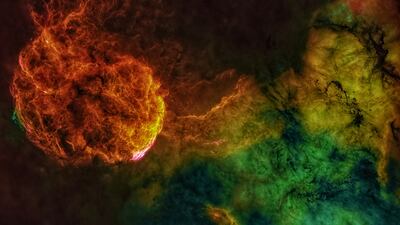
Jellyfish Nebula, a supernova remnant in the Gemini constellation, with stars removed to emphasise nebulous structures. Photo: Peter Larkin -
Northern Lights over the Great Pollet Sea Arch in County Donegal, Ireland. Photo: Brendan Alexander -
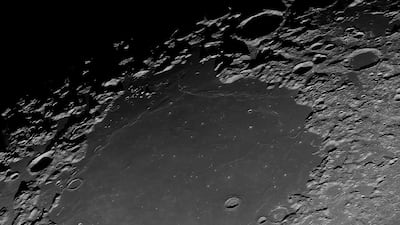
Mare Crisium, a lunar sea located northeast of the Sea of Tranquility. Photo: Andrea Vanoni -

The Milky Way galaxy over Pain-de-Sucre mountain on the French-Italian border. Photo: Jeff Graphy -
The Veil Nebula, a supernova remnant in the Cygnus constellation. Photo: Jia You -
Timelapse image of solar flare. Photo: Miguel Claro -
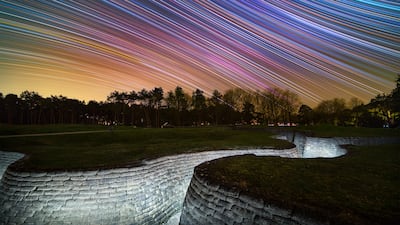
Star trails above preserved First World War trenches in Canadian National Vimy Memorial Park in France. Photo: Louis Leroux-Gere -
NGC 1097, a spiral galaxy 50 million light years from Earth. Photo: Mark Hanson and Mike Selby -
The Small Magellanic Cloud, a dwarf galaxy 200,000 light years from the Milky Way, surrounded by smaller, less distant galaxies. Photo: Jonathan Lodge -
Wolf Rayet Bubble nebula. Photo: Mark Hanson and Mike Selby


Now in its 15th year, the annual competition includes nine categories such as Skyscapes, Aurorae, Our Sun, Our Moon, and Young Astronomy Photographer of the Year.
The winners will be announced on 14th September 2023, with all winning and exceptional shortlisted images set to feature in an exhibition at the National Maritime Museum in London, opening on 16th September.
The competition offers a grand prize of £10,000 to the overall winner.
The winners of all other categories, including the Young Astronomy Photographer of the Year, will receive £1,500.

