


English universities and colleges based overseas are teaching one in six of all registered students, figures from the higher education watchdog have revealed.
An investigation by Office for Students into the scale of transnational education found students living overseas now account for 16 per cent of all of those registered at English institutions.
In 2021-22, 146 English universities and colleges had 455,000 students in other countries. China had the highest proportion, with 61,505 students – or 14 per cent of the total.
Twenty-seven per cent of students abroad were taught by overseas partner organisations and a quarter were taught by distance, flexible or distributed learning.
Six per cent studied at overseas branch campuses of English universities, with the remaining 42 per cent covered by other arrangements, including collaborative provision, according to the Office for Students report.
Transnational education constitutes an increasing proportion of the teaching of many English universities to “an increasingly significant income stream”, the report says.
The watchdog engaged with seven English universities in July last year to learn more about how they ensure high-quality education is delivered overseas.
Top 10 UK Universities – in pictures
-

1. University of Oxford. Getty -

2. University of Cambridge. Getty -

3.London School of Economics and Political Science. Getty -

4. University of St Andrews. Getty -

5. Imperial College London. Reuters -

6. Durham University. Alamy -

7. Loughborough University. Getty -

8. UCL (University College London). Alamy -

9. University of Warwick. Alamy -

10. University of Bath. Getty


Open University accounted for the largest population of students (46,300) overseas in 2021-22 – which equates to 10 per cent of the total transnational education population.
The University of London came next with 37,400 students (8 per cent of the total) in 2021-22, followed by Coventry University with 21,400 (5 per cent).
“As transnational education continues to grow, an increasing number of universities and colleges are seeing it as a component of their plans to diversify and grow their income,” Jean Arnold, director of quality at the Office for Students, said.
“Our regulatory remit is not limited to students located in England. It is important that students studying outside the UK are confident that their course is of the same high quality as would be the case if they were studying in England.
“Transnational education is a vital and thriving part of our higher education sector. By underlining that it is robustly regulated to ensure quality we intend to maintain and enhance the reputation of English higher education at home and across the world.”
World's best universities for key subjects – in pictures
-
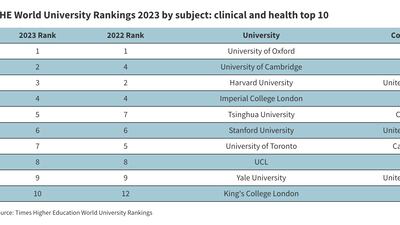
The top ten institutions for clinical and health studies. All photos: Times Higher Education -

The top ten institutions for business and economics studies. -
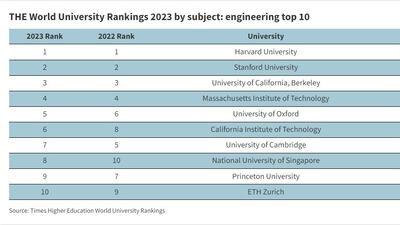
The United States is home to the top four universities for engineering, according to a global education league table. -
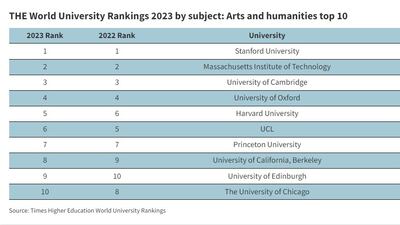
Stanford University leads the way for arts and humanities. -
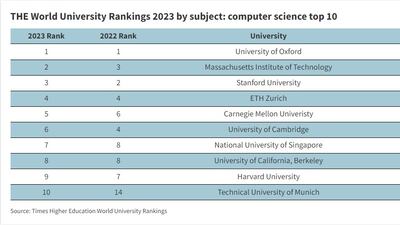
The top ten universities for studying computer science.


Nick Hillman, director of the Higher Education Policy Institute think tank, told The National: “Not everyone wants to move to study and not everyone can afford to do so.
“Transnational education allows people to get a trusted UK qualification without leaving their home.
“No one should assume that other students will stop wanting to come here to study because of the growth in TNE [transnational education].
“All the forecasts I have seen assume there will be further growth across the world in regular international students, who cross borders to study, as well as additional growth in transnational students.”

