A MiG-31 fighter jet of the Russian air force carrying a Kinzhal hypersonic cruise missile. AP

How Ukraine thwarted Russia's hypersonic missiles with its US Patriot defence system


Nicky Harley
  • English
  • Arabic

Ukraine’s use of the US Patriot air defence system is proving to be a game-changer in the war with Russia, after its successful destruction of a number of Kinzhal hypersonic missiles earlier this week.

Kyiv has been pushing to obtain Israel’s Iron Dome air defence system, which has had a 96 per cent success rate in intercepting rockets.

But the venerable Patriot system has proved its spurs in the heaviest blitz seen on the capital.

The destruction of the six Kinzhal missiles headed towards Kyiv has called into question Ukraine's need for the Israeli defence system.

Israel has so far resisted in a bid to maintain relations with both sides, and has instead only provided Kyiv with humanitarian support and civil defences.

The Kinzhal, which means “dagger” in Russian, is one of six next-generation weapons unveiled in 2018 by Russian President Vladimir Putin, who boasted that it could not be shot down by any of the world's air defence systems.

Ukraine has been using the Patriot air defence system, which stands for Phased Array Tracking Radar for Intercept on Target, as part of its arsenal against Russian attacks.

The mobile system, which has a radar range of more than 150km, has a control station, a power generator, launch stations and other support vehicles.

It was first used in combat during the 1991 Gulf War, with batteries protecting Saudi Arabia, Kuwait and Israel, and it was later used during the US invasion of Iraq in 2003.

Its success during Tuesday’s attack was described as “remarkable” by Ukraine’s defence spokesman Yuriy Ignat.

  • A Ukrainian soldier moves along a trench at a position near the front-line town of Bakhmut. Reuters
    A Ukrainian soldier moves along a trench at a position near the front-line town of Bakhmut. Reuters
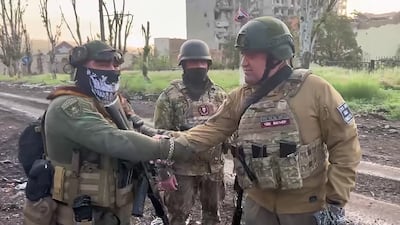
  • The leader of Russia's Wagner Group Yevgeny Prigozhin, right, talks to his fighters in Bakhmut. AFP
    The leader of Russia's Wagner Group Yevgeny Prigozhin, right, talks to his fighters in Bakhmut. AFP
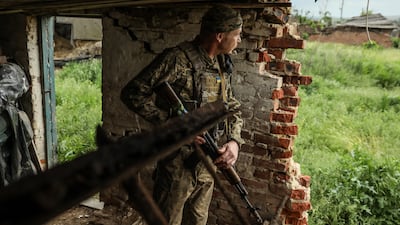
  • A Ukrainian serviceman from the 24th Separate Mechanised Brigade keeps watch on the front line. EPA
    A Ukrainian serviceman from the 24th Separate Mechanised Brigade keeps watch on the front line. EPA
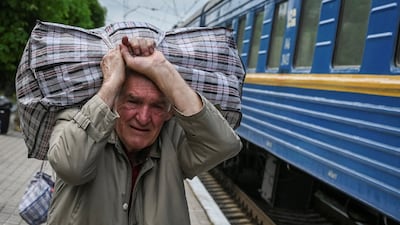
  • An evacuee from eastern Ukraine boards a train in Pokrovsk bound for Lviv. Reuters
    An evacuee from eastern Ukraine boards a train in Pokrovsk bound for Lviv. Reuters
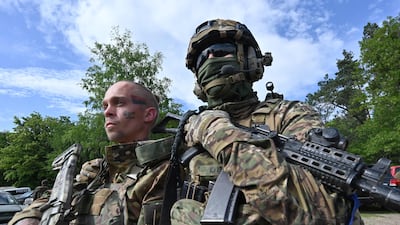
  • Fighters of the Russian Volunteer Corps, which fights on the side of Ukraine, in the north of the country, not far from the Russian border. AFP
    Fighters of the Russian Volunteer Corps, which fights on the side of Ukraine, in the north of the country, not far from the Russian border. AFP
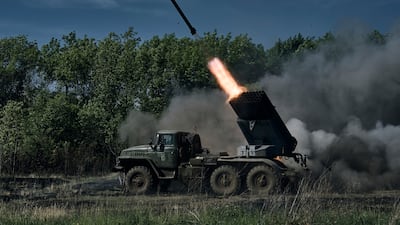
  • A Ukrainian army multiple rocket launcher fires at Russian positions on the front line near Bakhmut. AP
    A Ukrainian army multiple rocket launcher fires at Russian positions on the front line near Bakhmut. AP
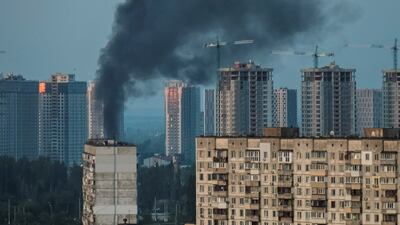
  • Smoke rises after a Russian missile strike in Kyiv. Reuters
    Smoke rises after a Russian missile strike in Kyiv. Reuters
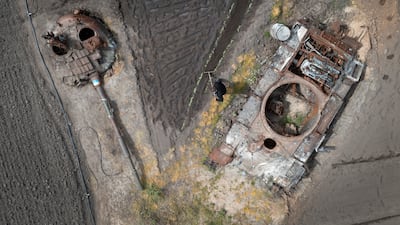
  • A Ukrainian man plants sunflowers between a damaged Russian tank and its turret in his garden in the village of Velyka Dymerka, Kyiv region. AP
    A Ukrainian man plants sunflowers between a damaged Russian tank and its turret in his garden in the village of Velyka Dymerka, Kyiv region. AP
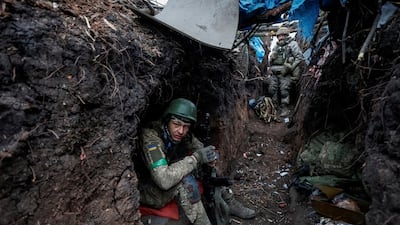
  • Ukrainian servicemen rest at their positions after a battle near the front-line city of Bakhmut. Reuters
    Ukrainian servicemen rest at their positions after a battle near the front-line city of Bakhmut. Reuters
  • A teenager aims a Kalashnikov AK47 rifle during defence training at a centre for school pupils in Lviv. AFP
    A teenager aims a Kalashnikov AK47 rifle during defence training at a centre for school pupils in Lviv. AFP
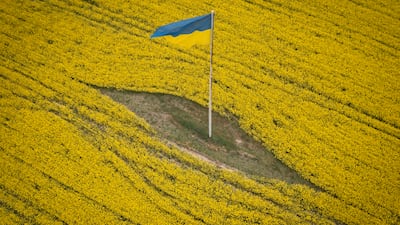
  • A Ukrainian national flag in the middle of a blossoming field near Brovary, east of Kyiv. AP
    A Ukrainian national flag in the middle of a blossoming field near Brovary, east of Kyiv. AP
  • Ukrainian servicemen check Russian positions near the front-line city of Bakhmut. Reuters
    Ukrainian servicemen check Russian positions near the front-line city of Bakhmut. Reuters
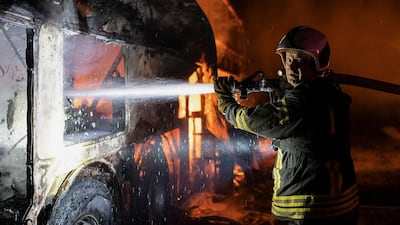
  • Rescuers put out a fire during a Russian air strike on Kyiv. EPA
    Rescuers put out a fire during a Russian air strike on Kyiv. EPA
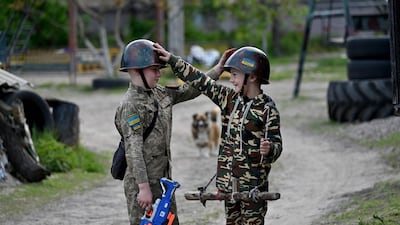
  • Ukrainian boys play at being soldiers in the village of Stoyanka. AFP
    Ukrainian boys play at being soldiers in the village of Stoyanka. AFP
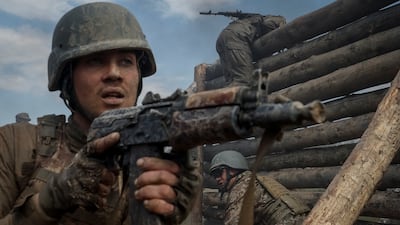
  • Ukrainian servicemen during an exercise in the Chernihiv region. Reuters
    Ukrainian servicemen during an exercise in the Chernihiv region. Reuters
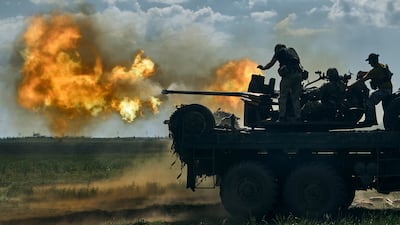
  • Ukrainian soldiers fire a cannon on the front line near Bakhmut. AP
    Ukrainian soldiers fire a cannon on the front line near Bakhmut. AP

“This is a remarkable result,” he said. “As you see, Kyiv remains the main target. That is why it is well protected by some serious air defence means.”

Patriot was developed by Raytheon Technologies and is considered one of the most advanced air defence systems in the US arsenal.

A single newly produced Patriot battery costs more than $1 billion – $400 million for the system and $690 million for the missiles in the battery – according to the Centre for Strategic and International Studies think tank.

Raytheon has built more 240 Patriot systems and they are currently used by 18 countries, including the US. The system has been in high demand in the Middle East because of the threat posed by Iran to the region.

According to Raytheon, the system has intercepted more than 150 ballistic missiles in combat since 2015.

To bolster its defences, Ukraine has also been testing an Israeli-designed missile detection system that would give residents more time to take shelter from Russian attacks.

Ukraine's ambassador to Israel, Yevgen Korniychuk, said the system – fed with data from Ukrainian radars – is now being tested in the capital.

“It allows for identifying the different objects, including ballistic missiles, and calculates where they will go and basically that allows us to close certain parts of the country rather than the whole country,” he said.

When complete, the system will warn residents of areas that are about to be struck by Russian missiles or drones, either by sounding sirens or through phone alerts.


Company%20Profile
%3Cp%3E%3Cstrong%3ECompany%20name%3A%3C%2Fstrong%3E%20Cargoz%3Cbr%3E%3Cstrong%3EDate%20started%3A%3C%2Fstrong%3E%20January%202022%3Cbr%3E%3Cstrong%3EFounders%3A%3C%2Fstrong%3E%20Premlal%20Pullisserry%20and%20Lijo%20Antony%3Cbr%3E%3Cstrong%3EBased%3A%3C%2Fstrong%3E%20Dubai%3Cbr%3E%3Cstrong%3ENumber%20of%20staff%3A%3C%2Fstrong%3E%2030%3Cbr%3E%3Cstrong%3EInvestment%20stage%3A%3C%2Fstrong%3E%20Seed%3C%2Fp%3E%0A
COMPANY PROFILE

Company: Bidzi

● Started: 2024

● Founders: Akshay Dosaj and Asif Rashid

● Based: Dubai, UAE

● Industry: M&A

● Funding size: Bootstrapped

● No of employees: Nine

Important questions to consider

1. Where on the plane does my pet travel?

There are different types of travel available for pets:

  • Manifest cargo
  • Excess luggage in the hold
  • Excess luggage in the cabin

Each option is safe. The feasibility of each option is based on the size and breed of your pet, the airline they are traveling on and country they are travelling to.


2. What is the difference between my pet traveling as manifest cargo or as excess luggage?

If traveling as manifest cargo, your pet is traveling in the front hold of the plane and can travel with or without you being on the same plane. The cost of your pets travel is based on volumetric weight, in other words, the size of their travel crate.

If traveling as excess luggage, your pet will be in the rear hold of the plane and must be traveling under the ticket of a human passenger. The cost of your pets travel is based on the actual (combined) weight of your pet in their crate.


3. What happens when my pet arrives in the country they are traveling to?

As soon as the flight arrives, your pet will be taken from the plane straight to the airport terminal.

If your pet is traveling as excess luggage, they will taken to the oversized luggage area in the arrival hall. Once you clear passport control, you will be able to collect them at the same time as your normal luggage. As you exit the airport via the ‘something to declare’ customs channel you will be asked to present your pets travel paperwork to the customs official and / or the vet on duty. 

If your pet is traveling as manifest cargo, they will be taken to the Animal Reception Centre. There, their documentation will be reviewed by the staff of the ARC to ensure all is in order. At the same time, relevant customs formalities will be completed by staff based at the arriving airport. 


4. How long does the travel paperwork and other travel preparations take?

This depends entirely on the location that your pet is traveling to. Your pet relocation compnay will provide you with an accurate timeline of how long the relevant preparations will take and at what point in the process the various steps must be taken.

In some cases they can get your pet ‘travel ready’ in a few days. In others it can be up to six months or more.


5. What vaccinations does my pet need to travel?

Regardless of where your pet is traveling, they will need certain vaccinations. The exact vaccinations they need are entirely dependent on the location they are traveling to. The one vaccination that is mandatory for every country your pet may travel to is a rabies vaccination.

Other vaccinations may also be necessary. These will be advised to you as relevant. In every situation, it is essential to keep your vaccinations current and to not miss a due date, even by one day. To do so could severely hinder your pets travel plans.

Source: Pawsome Pets UAE

ONCE UPON A TIME IN GAZA

Starring: Nader Abd Alhay, Majd Eid, Ramzi Maqdisi

Directors: Tarzan and Arab Nasser

Rating: 4.5/5

The%20specs
%3Cp%3E%3Cstrong%3EEngine%3A%20%3C%2Fstrong%3E2.3-litre%204cyl%20turbo%0D%3Cbr%3E%3Cstrong%3EPower%3A%20%3C%2Fstrong%3E299hp%20at%205%2C500rpm%0D%3Cbr%3E%3Cstrong%3ETorque%3A%20%3C%2Fstrong%3E420Nm%20at%202%2C750rpm%0D%3Cbr%3E%3Cstrong%3ETransmission%3A%20%3C%2Fstrong%3E10-speed%20auto%0D%3Cbr%3E%3Cstrong%3EFuel%20consumption%3A%20%3C%2Fstrong%3E12.4L%2F100km%0D%3Cbr%3E%3Cstrong%3EOn%20sale%3A%20%3C%2Fstrong%3ENow%0D%3Cbr%3E%3Cstrong%3EPrice%3A%20%3C%2Fstrong%3EFrom%20Dh157%2C395%20(XLS)%3B%20Dh199%2C395%20(Limited)%3C%2Fp%3E%0A
FA Cup quarter-final draw

The matches will be played across the weekend of 21 and 22 March

Sheffield United v Arsenal

Newcastle v Manchester City

Norwich v Derby/Manchester United

Leicester City v Chelsea

MIDWAY

Produced: Lionsgate Films, Shanghai Ryui Entertainment, Street Light Entertainment
Directed: Roland Emmerich
Cast: Ed Skrein, Woody Harrelson, Dennis Quaid, Aaron Eckhart, Luke Evans, Nick Jonas, Mandy Moore, Darren Criss
Rating: 3.5/5 stars

Key figures in the life of the fort

Sheikh Dhiyab bin Isa (ruled 1761-1793) Built Qasr Al Hosn as a watchtower to guard over the only freshwater well on Abu Dhabi island.

Sheikh Shakhbut bin Dhiyab (ruled 1793-1816) Expanded the tower into a small fort and transferred his ruling place of residence from Liwa Oasis to the fort on the island.

Sheikh Tahnoon bin Shakhbut (ruled 1818-1833) Expanded Qasr Al Hosn further as Abu Dhabi grew from a small village of palm huts to a town of more than 5,000 inhabitants.

Sheikh Khalifa bin Shakhbut (ruled 1833-1845) Repaired and fortified the fort.

Sheikh Saeed bin Tahnoon (ruled 1845-1855) Turned Qasr Al Hosn into a strong two-storied structure.

Sheikh Zayed bin Khalifa (ruled 1855-1909) Expanded Qasr Al Hosn further to reflect the emirate's increasing prominence.

Sheikh Shakhbut bin Sultan (ruled 1928-1966) Renovated and enlarged Qasr Al Hosn, adding a decorative arch and two new villas.

Sheikh Zayed bin Sultan (ruled 1966-2004) Moved the royal residence to Al Manhal palace and kept his diwan at Qasr Al Hosn.

Sources: Jayanti Maitra, www.adach.ae

Company%20profile
%3Cp%3E%3Cstrong%3ECompany%20name%3A%3C%2Fstrong%3E%20Fasset%0D%3Cbr%3E%3Cstrong%3EStarted%3A%20%3C%2Fstrong%3E2019%0D%3Cbr%3E%3Cstrong%3EFounders%3A%3C%2Fstrong%3E%20Mohammad%20Raafi%20Hossain%2C%20Daniel%20Ahmed%0D%3Cbr%3E%3Cstrong%3EBased%3A%3C%2Fstrong%3E%20Dubai%0D%3Cbr%3E%3Cstrong%3ESector%3A%20%3C%2Fstrong%3EFinTech%0D%3Cbr%3E%3Cstrong%3EInitial%20investment%3A%3C%2Fstrong%3E%20%242.45%20million%0D%3Cbr%3E%3Cstrong%3ECurrent%20number%20of%20staff%3A%3C%2Fstrong%3E%2086%0D%3Cbr%3E%3Cstrong%3EInvestment%20stage%3A%3C%2Fstrong%3E%20Pre-series%20B%0D%3Cbr%3E%3Cstrong%3EInvestors%3A%3C%2Fstrong%3E%20Investcorp%2C%20Liberty%20City%20Ventures%2C%20Fatima%20Gobi%20Ventures%2C%20Primal%20Capital%2C%20Wealthwell%20Ventures%2C%20FHS%20Capital%2C%20VN2%20Capital%2C%20local%20family%20offices%3C%2Fp%3E%0A
Updated: May 19, 2023, 5:04 PM