
Follow the latest news from the coronation of King Charles here
The chrism oil to be used to anoint King Charles on Saturday was consecrated in Jerusalem.
This decision to use the oil shows a deep connection to the city and the biblical roots of the coronation.
Here, The National explores the reasons behind choosing chrism oil from Jerusalem and its importance for the coming royal anointment.
Upholding tradition
The use of chrism oil from Jerusalem for the anointment of monarchs can be traced back to the early days of Christianity, with the first recorded use in the fourth century.
The oil used in the coronation of the king is a symbol of the unbroken link between the monarchy and its spiritual roots.
This long-standing practice serves as a reminder of the intertwined history of Christianity and the British monarchy, which has persisted for centuries.
This time-honoured tradition reinforces the continuity and stability of the monarchy, as well as its spiritual foundations.
-

King Charles will put on the Supertunica, a gold-sleeved coat created for his great-grandfather, King George V, in 1911. All photos: PA -
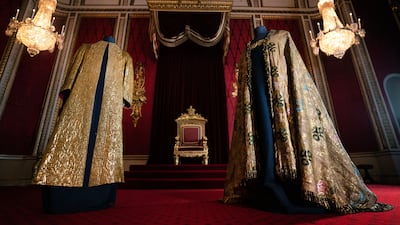
The Supertunica, left, and the Imperial Mantle on display in the throne room at Buckingham Palace -
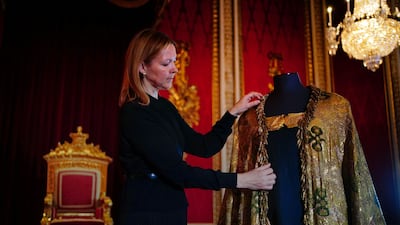
Caroline de Guitaut, deputy surveyor of the king's works of art at the Royal Collection Trust, adjusts the Imperial Mantle -
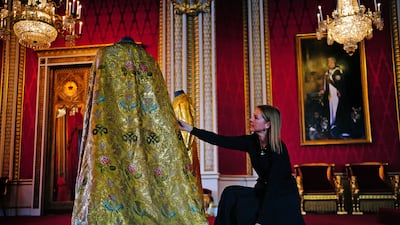
The garments will be worn by King Charles during his coronation at Westminster Abbey on May 6 -
The Imperial Mantle is a floor-length cloak that was made for King George IV in 1821 -
Weighing between 3kg and 4kg, the Imperial Mantle symbolises the divine nature of kingship -
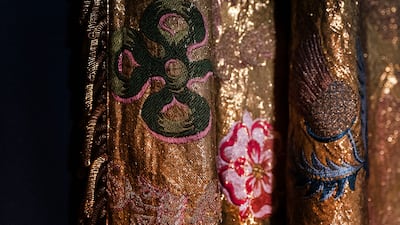
The Supertunica has been worn at every coronation since 1911, including by Queen Elizabeth II -
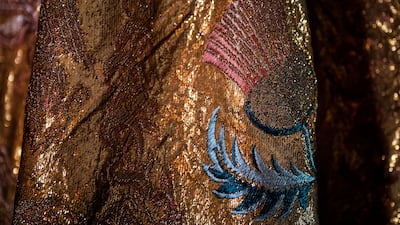
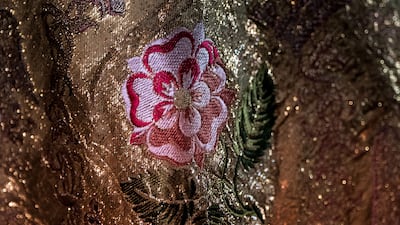
The Imperial Mantle is adorned with colourful motifs such as fleur-de-lis and imperial eagles -
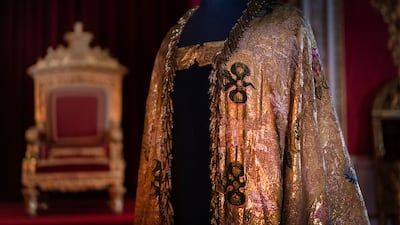
The historic coronation vestments have intricate gold embroidery -

The Coronation Gauntlet, a glove symbolising royal authority, features detailed embroidery of national emblems -
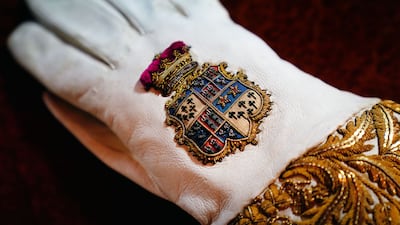
The Coronation Gauntlet showcases the elegance and tradition of the ceremony -
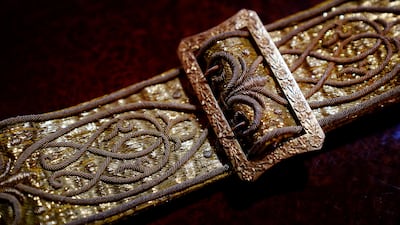
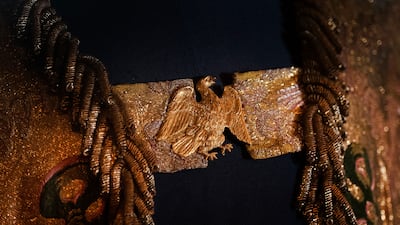
The Coronation Sword Belt is a symbol of the monarch's commitment to justice and the protection of his subjects


Emphasising religious significance
Jerusalem is highly significant for Christians.
As the site of several pivotal events in the life of Jesus Christ, including his crucifixion, the city is considered sacred.
By using chrism oil from Jerusalem, the coronation highlights the connection between the monarchy and the Christian faith.
Ensuring quality
The chrism oil is created using high-quality ingredients such as olive oil, balsam and myrrh.
These components are believed to have special properties that make them suitable for use in religious ceremonies, ensuring a fitting anointment for the king and Queen Consort Camilla.
Certifying authenticity
The Orthodox Patriarchate of Jerusalem certifies the chrism oil, guaranteeing its quality and adherence to the requirements of the church.
This certification adds an additional layer of authenticity to the anointment ceremony.
Strengthening personal connections
The use of olives harvested from the Mount of Olives, specifically from the Monastery of Mary Magdalene and the Monastery of the Ascension, adds a personal touch to the coronation oil.
As the Monastery of Mary Magdalene is the burial place of the king's grandmother, Princess Alice of Greece, the oil symbolises a family connection to the holy land.
The decision to use chrism oil from Jerusalem for the anointment reflects a deep respect for tradition, religious significance and personal connections.
Who is bringing the oil from Jerusalem?
The Most Reverend Hosam Elias Naoum has been tasked with bringing and presenting the oil to the king during the coronation service.
Born in Haifa in 1974, Archbishop Naoum serves as the 15th Anglican bishop in Jerusalem, having been consecrated as bishop coadjutor of the Episcopal Diocese of Jerusalem in June 2020 and installed as diocesan on May 13, 2021.
Raised in Shefa-Amr in Galilee, Archbishop Naoum is married and has a son and two daughters: Wadie, Laurice and Krista.
As diocesan bishop, Archbishop Hosam oversees 28 parishes across five political regions, including Israel, Palestine, Jordan, Syria, and Lebanon.
He also serves as chairman of the board for over 30 institutions of education and health care throughout the diocese, with facilities such as schools, hospitals, clinics, rehabilitation and vocational training centres.
These institutions offer high-quality services and assistance to those unable to afford them, while bolstering the Christian presence in the region.

In a diverse diocese that spans multiple cultures, faiths, and ethnicities, Archbishop Naoum is a staunch advocate for peace and reconciliation.
Actively involved in various ecumenical and interfaith organisations, he works closely with the Archbishop of Canterbury on Anglican and interfaith issues.
As one of the 13 recognised heads of churches in Israel, Archbishop Naoum encourages church leaders to strengthen the Christian presence as a unifying and mediating force in a region beset by turmoil and unrest.

