


Iraqis deserved an apology that never came for decades of sanctions and war unleashed on the country, not least the fact Britain and America have never given a clear reason for the 2003 invasion, the former head of the International Atomic Energy Agency has said.
Speaking at Chatham House, former director general of the IAEA Mohamed ElBaradei said it was chilling to think that the two allies were able to recklessly churn out unfounded claims of Iraq possessing weapons of mass destruction to try to justify their war — and get away with it when the reason proved to be unfounded.
The event marked the 20th invasion of the Iraq war at which Mr ElBaradei bemoaned the lack of justice for the Iraqi victims.
“It is scary, frankly, that after 20 years as we are sitting here today, no one can pin down exactly the reason why this war took place,” Mr ElBaradei said.
“Was it regime change, democracies spreading, WMDs, Iraq oil, extremism [or] Al Qaeda?
“What is really concerning is that there has been zero accountability."
He said while the Chilcot report was “proper and eloquent” it stopped short of achieving justice for the Iraqi people.
“No one was really held accountable, no criminal charges were made,” Mr ElBaradei added.

A report by a committee of the US Senate identified numerous failures officials’ gathering and processing of intelligence in the lead up to the invasion.
But the probe stopped short of holding anyone to account, Mr ElBaradei said, and was simply “the end of the story”.
“Basically both sides [were] saying ‘oops, we made the mistake',” said Mr ElBaradei.
“But aside from the technical individual accountability — or absence of it — we haven't seen any effort to learn from the mistakes to avoid a repeat.”
Mr ElBaradei and Hans Blix, the former chairman of the Weapons of Mass Destruction Committee, were in charge of UN weapons inspections in Iraq in the lead up to the war.
George W Bush used the threat of Saddam Hussein using WMD against America and its allies as a pretext to invade Iraq. His claims, supported by Tony Blair, were later found to be untrue.
Mr ElBaradei noted comments made by Paul Wolfowitz, the then-US deputy defence secretary, in an interview with Vanity Fair, saying the claim was used by Bush administration officials “because it was the one reason everyone could agree on”.
Mr ElBaradei said while the claim was not a “serious pretext” for a foreign army to invade a sovereign nation, it provided a “rallying point for all these people who thought that after the end of the Soviet Union, this has to be sort of Pax Americana, if you like”.
The Egyptian diplomat said the lack of accountability in Washington and London is regrettable.
“It is very sad, speaking also here in England, that the UK was a major accomplice and enabler in all the planning, preparation and execution of this horrendous war,” Mr ElBaradei said.
'Like a bull in a china shop'
He said noted how the strategy employed by the US and Britain to attempt to use the UN and IAEA inspectors to legitimise their invasion plan “was bad for them and was bad for us”.
“From an international order perspective, and that's really what is more important to me, it was like a bull in a china shop — completely rogue behaviour,” Mr ElBaradei said.
“They violated every aspect of international order, they violated international law, they disregarded the Security Council, they disregarded international inspections.”
Fast forward to the present day, with a war raging in eastern Europe, Mr ElBaradei warned the West cannot claim to have learnt any valuable lessons from the Iraq War blunders.
“Then we haven't learnt anything,” added Mr ElBaradei.
“Unless we all know unless we own up to the horror, to the mistakes we made, then where we are going nowhere.”
The Iraq War, a timeline of events — in pictures
-

January 29, 2002: US President George Bush identifies Iraq, Iran and North Korea as part of an 'axis of evil' in his State of the Union address. 'States like these, and their terrorist allies, constitute an axis of evil, arming to threaten the peace of the world. By seeking weapons of mass destruction, these regimes pose a grave and growing danger,' he says. Getty -
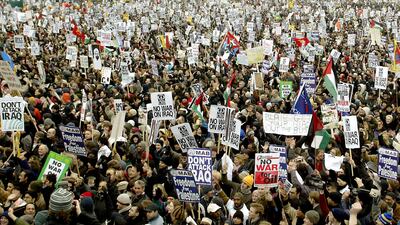
February 15, 2002: Thousands of people gather in Hyde Park in London after finishing a protest against war in Iraq. The march is believed to be the UK's biggest ever peace protest. Getty -
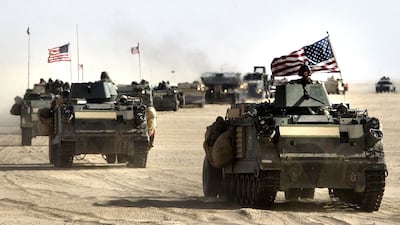
March 18, 2003: US and British forces move into position before a possible military strike near the Kuwait-Iraq border. A day prior, Mr Bush gave Iraqi President Saddam Hussein and his sons 48 hours to leave the country or face war. Getty -
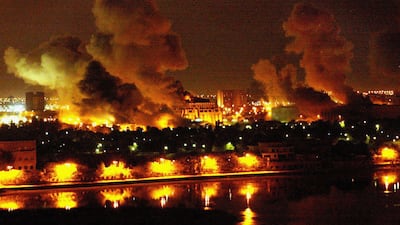
March 21, 2003: Fires burn in and around Saddam's Council of Ministers during the first wave of US-led coalition airstrikes on Iraq in Baghdad. 'These are the opening stages of what will be a broad and concerted campaign,' he says in an address. The attack begins with a massive air strike campaign named 'shock and awe'. Getty -
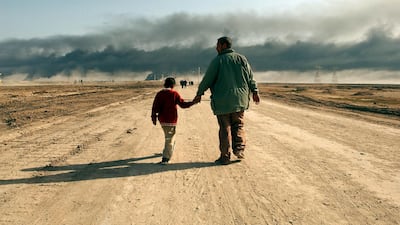
March 29, 2003: A man and child walk on a road near the entrance of the besieged city of Basra as oil fires burn in the distance. Baath Party loyalists take up positions in Basra, Iraq's second largest city, making it a target of the US-led war on Iraq. Getty -

April 9, 2003: Iraq’s capital, Baghdad, falls to US forces. Saddam’s regime loses control as American troops enter the city centre. On May 1, US President George W Bush prematurely declares the end of major combat in Iraq. Reuters -

August 30, 2003: A burnt-out car is removed from outside Najaf’s Imam Ali Mosque, the holiest Shiite shrine in Iraq, a day after 87 people were killed in a car bomb attack. The attack raises sectarian tension as thousands of Iraqi Shiites, some of them backed by Iran, demand the right to form militias. Reuters -

December 13, 2003: Ousted president Saddam Hussein is found by US troops in a cellar south of Tikrit, near his hometown. 'Ladies and gentlemen, we got him,' says US ambassador Paul Bremer, who was appointed to lead the Coalition Provisional Authority. AFP -

March 31, 2004: A car burns in the aftermath of an insurgent attack on Fallujah, in which four Blackwater private security contractors were killed and their mutilated, burnt bodies were left hanging from a bridge. Reuters -

May 3, 2004: Coffins of US military personnel killed in Iraq are prepared to be offloaded at Dover Air Force Base in Delaware. Days later, Al Qaeda beheaded US businessman Nicholas Berg and recorded his killing. Reuters -
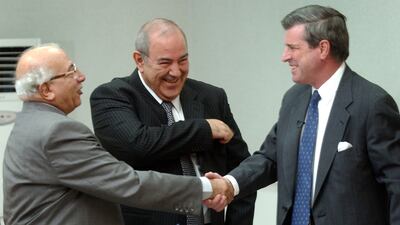
June 28, 2004: US administrator in Iraq Paul Bremer (R), Iraqi Prime Minister Ayad Allawi (C) and the country's most senior judge Midhat Mahmoud (L) smile as the US transfers sovereignty to Iraq in Baghdad. Mr Allawi calls the event 'a historic day' and says that Iraq was 'capable of controlling the security situation'. Reuters -
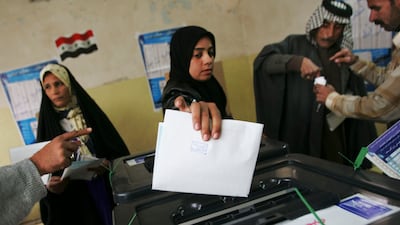
January 30, 2005: Iraqis vote in the first parliamentary elections of the post-Saddam era. Sunnis largely boycott the vote, while most Shiite parties coalesce into a sectarian bloc, cementing divisions within the country. Getty -
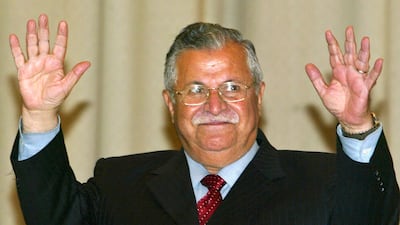
April 7, 2005: Veteran Kurdish leader Jalal Talabani raises his hands after being sworn in as Iraq's first democratically elected president. Later that month, Shiite Islamist Ibrahim Al Jaafari takes office as prime minister, hailing from the exiled Dawa Party. Getty -
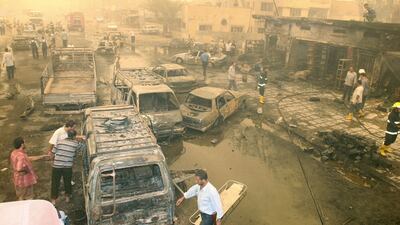
July 24, 2005: Burnt-out vehicles at the scene of a lorry bombing outside a police station that killed 22 people in south-east Baghdad. The explosion also injured 25 people, destroyed 22 cars and 10 shops. AFP -

October 19, 2005: Saddam’s trial begins. Prosecutors focus on a massacre in the village of Dujail, 100 kilometres north of Baghdad, where about 150 people, including children, were killed following an assassination attempt against the former dictator. Many other charges relate to a genocidal campaign against Kurds during the 1980s, during which Saddam ordered a chemical attack on the town of Halabja, killing up to 5,000 people. Getty -
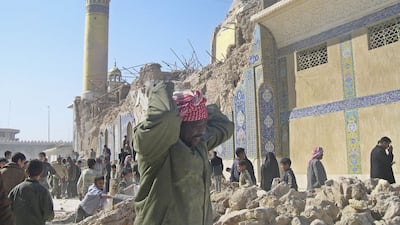
February 23, 2006: Iraqis clean up debris after an Al Qaeda bombing at Al Askariya holy Shiite shrine in Samarra, Iraq. Shiite police and militia members — in many cases indistinguishable — responded by rampaging through Sunni-majority areas, in an onslaught that coalition forces appeared powerless to halt. Getty -
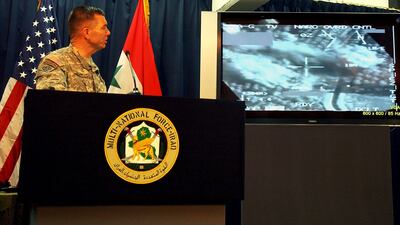
June 8, 2006: Maj Gen Bill Caldwell speaks during a press conference as satellite images are shown of a US air strike that killed the leader of Al Qaeda in Iraq, Abu Musab Al Zarqawi, in a joint US-Iraqi raid. Getty -
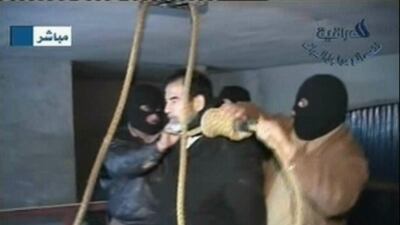
December 30, 2006: Saddam is executed by hanging. The execution and taunting of Saddam before his death is secretly filmed by a witness, stirring further tension within Iraq. Getty -
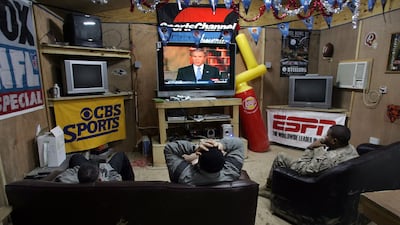
January 11, 2007: US officers watch Mr Bush's speech announcing that another 20,000 soldiers will be sent to Iraq, at Camp Ramadi in Iraq's violent Anbar province. The approach becomes known as the 'Surge,' and envisages a closer partnership between US and Iraqi forces and tribes, as well as American forces being stationed closer to Iraqi communities. Getty -
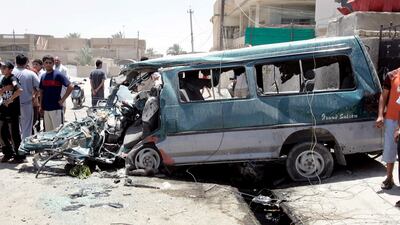
July 12, 2007: Two Reuters photographers and five civilians are killed by a US Apache helicopter in Baghdad. US video footage of the incident would later be released by Wikileaks. EPA -

December 14, 2008: Mr Bush makes his final visit to Iraq to sign a co-operation agreement between Iraq and the US known as the Strategic Framework Agreement. At a press conference with Nouri Al Maliki, Munthadar Al Zaidi, a journalist, throws his shoes at Mr Bush. Mr Al Zaidi is severely beaten and jailed for six months. Reuters -
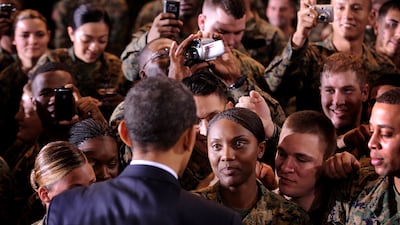
February 27, 2009: US President Barack Obama announces Washington’s decision to withdraw most American troops by August 31, 2010. Mr Obama says 50,000 troops will remain for smaller missions and to train Iraqi soldiers. EPA -
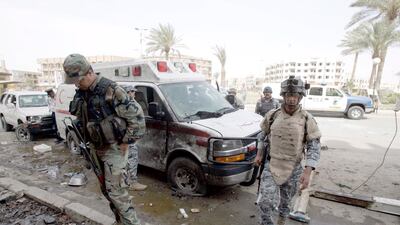
April 23: At least 80 people are killed in three suicide bombings in Baghdad, making it the biggest daily death toll since early 2008. A woman standing in a group of other women and children receiving aid reportedly set off one of the bombs. EPA -
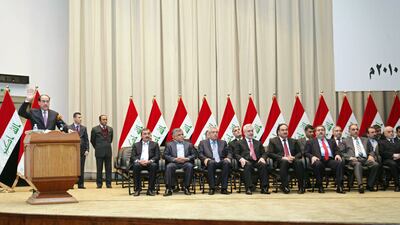
December 21, 2010: Iraqi Prime Minister Mr Al Maliki (L) and members of his newly formed cabinet attend a voting session at the Iraqi Parliament in Baghdad, Iraq. The new government was unanimously approved, ending nine months of deadlock. Getty -
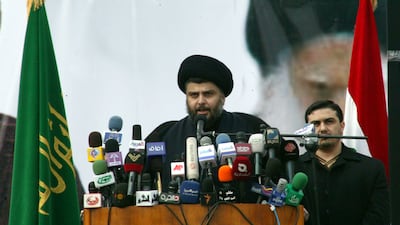
JANUARY 8, 2011: Populist Shiite cleric Moqtada Sadr returns to Iraq after four years of self-imposed exile in Iran. In his first public statement, he urges his followers to resist the 'occupiers' of Iraq. EPA -
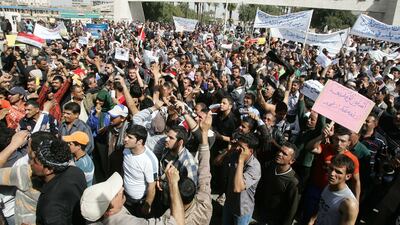
February 25, 2011: A 'day of rage' is declared as tens of thousands of Iraqis protest against Mr Al Maliki’s government. At least 23 people are killed and hundreds injured in a sign of Mr Al Maliki’s growing authoritarianism. Getty -
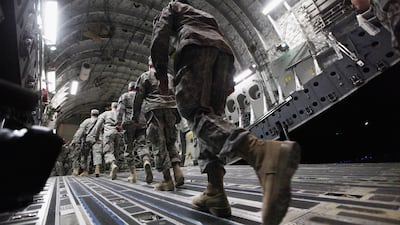
December 17, 2011: The last of the US Troop Brigade board a plane to depart Iraq at Camp Adder, now known as Imam Ali Base, near Nasiriyah, Iraq. Two days prior, the US military formally declared the end of the Iraq War in a ceremony in Baghdad. Getty -
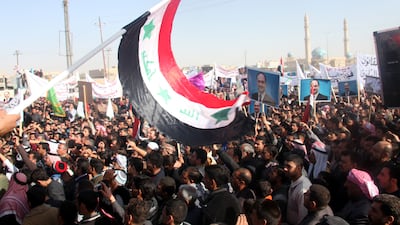
December 23, 2012: Protests against harsh security crackdowns break out in Fallujah, Ramadi and Tikrit. Sunni protesters say men are being arbitrarily jailed without evidence while the government holds back pensions for former army officers. The demonstrations last until December 2013 when the Iraqi army tries to break up protest camps. EPA -

July 22, 2013: Mourners pray at the coffin of a victim killed during an attack on a prison in Taji, during a funeral at the Imam Ali shrine in Najaf. Reuters -

December 22, 2013: Funeral proceedings for a major general of the Iraqi army’s 7th division in Anbar. The division's leadership were killed when a house they are raiding explodes after being rigged with bombs. The mixed Sunni-Shiite group is seen as one of the last non-sectarian units in the Iraqi army. Reuters -

June 11, 2014: ISIS fighters stand guard at a checkpoint in the northern Iraqi city of Mosul. Days prior, the militants seized Iraq's second biggest city of Mosul as well as Tikrit, hometown of former dictator Saddam Hussein, and other towns and cities north of Baghdad. Reuters -
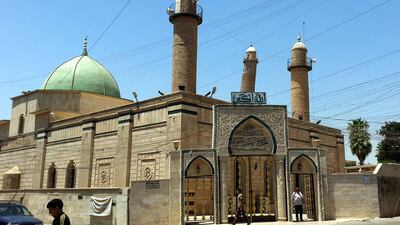
July 9, 2014: Al Nuri Mosque in Mosul before it was destroyed by ISIS militants during their retreat three years later. On June 29, Abu Bakr Al Baghdadi, leader of ISIS, appeared for the first time in public at the mosque to declare the caliphate. EPA -

October 18, 2014: Smoke rises over Syrian town of Kobani after an air strike. Three days prior, Washington launched a campaign called Operation Inherent Resolve. Over the next year, the US military conducts more than 8,000 air strikes in Iraq and Syria. Reuters -
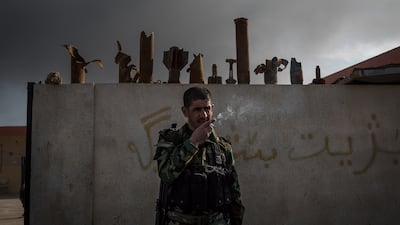
November 13, 2015: Kurdish forces seized Sinjar from ISIS after a prolonged siege, in the largest urban battle undertaken by the Kurdish Peshmerga. Getty -
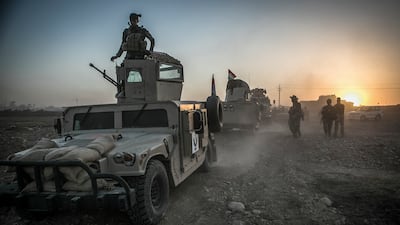
October 16, 2006: Iraq launches US-backed campaign to liberate Mosul from ISIS. EPA -
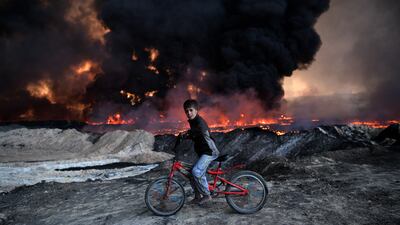
October 21, 2016: Fire at an oil field that was set on fire by retreating ISIS fighters before the Mosul offensive in Qayyarah, Iraq. Getty -
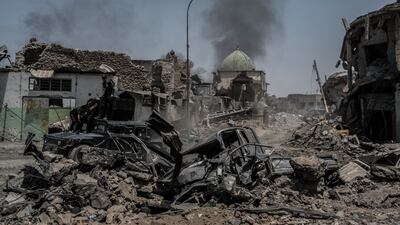
July 2, 2017: While retreating from Mosul, ISIS destroys Al Nuri mosque. Iraqi forces encounter stiff resistance from ISIS with improvised explosive devices, car bombs, suicide bombers, heavy mortar fire and snipers hampering their advance. Getty -
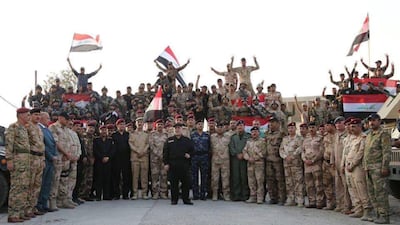
July 9, 2017: Iraqi Prime Minister Haider Al Abadi declares victory over ISIS in Mosul. In December, he declares full victory over ISIS. AFP



