


The UK needs a “grand strategy” to counter Russia’s destabilising influence across the world, senior Tory MP Sir Bernard Jenkin told the Commons on Thursday.
Ukraine needs to gain the upper hand against Russia's invasion, which can be achieved by resupplying the country with arms more quickly, MPs were told.
Mr Jenkin, MP for Harwich and North Essex, said Russia’s global plans stood on a “knife edge”, as he opened a debate on the Kremlin’s strategy and the threat posed by President Vladimir Putin.
Looking ahead to a year which he suggested would be “crucial” for Ukraine, he said: “It would be an epic tragedy if we now allowed Russia the time to mass their forces so their brutal war of attrition could become overwhelming.
“It is crucial for the West to increase the tempo of its supply of weapons systems to Ukraine, so that Ukraine rather than Russia can be the first to develop the mobile formations necessary to break the current battlefield deadlock.”
Mr Jenkin said the UK needed its own grand strategy to face down Russia, telling MPs: “Without the right apparatus in government and the right culture in government, we will always be behind the curve of events as we seem to be now, mis-appreciating what is really happening.
“We need to find the right answers to the new evolving threats the UK and the whole of the free world must confront before it is too late.”
Drones and weapons supplied to Ukraine - in pictures
-
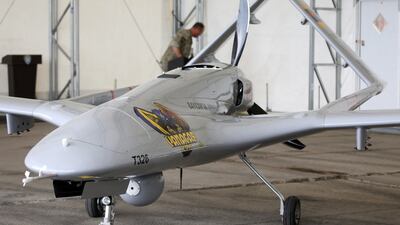
Turkeysold its Bayraktar TB2 armed drones to Ukraine. They can fly at an altitude of 7,500 metres and swoop down to attack targets. AFP -

The US also gave 700 of its Switchblade kamikaze drones. AP -
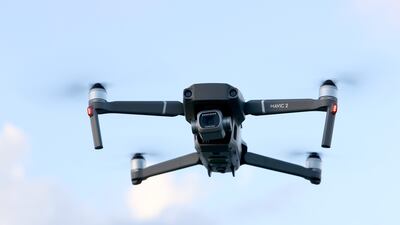
Cheap commercial drones like the DJI Mavic series have been modified in Ukraine. AFP -
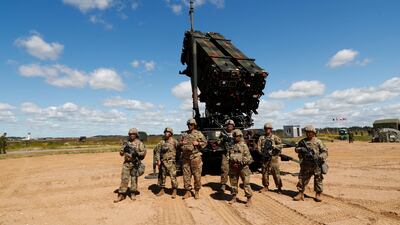
Germany will follow the US in providing a Patriot missile defence system, pictured above, to Ukraine. Reuters -
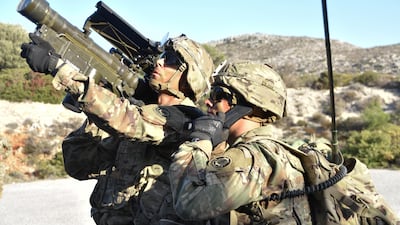
FIM-92 Stinger rockets have been donated to help Ukrainian infantry engage aircraft and drones. The shoulder-launched missiles can shoot down aircraft. Photo: US Army -
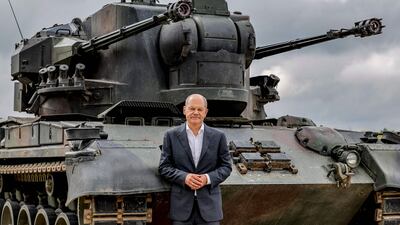
Germany donated 25 Flakpanzer Gepard all-weather-capable self-propelled anti-aircraft gun. AFP -
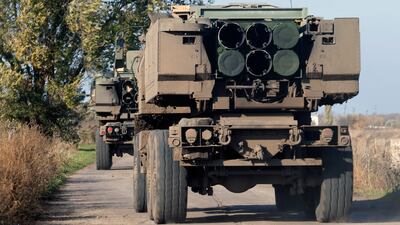
The High-Mobility Artillery Rocket System, or Himars, can simultaneously launch several precision-guided missiles. The US has given Ukraine projectiles with a range of about 130 kilometres. EPA -
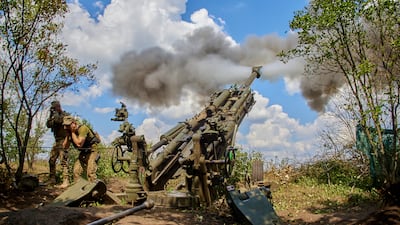
M777 howitzers and about 300,000 shells have been donated to give Ukraine an accurate artillery platform with a range of 50 kilometres. EPA -
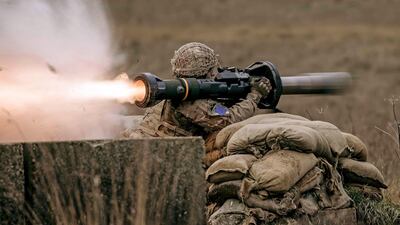
Ukraine has been sent at least 5,000 of the anti-tank weapons known as NLAWs. These shoulder-launched rockets have proved deadly in the field. PA -
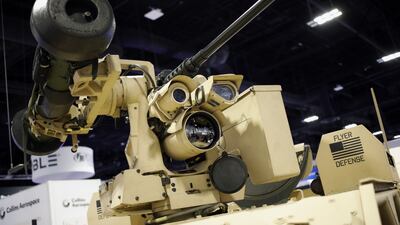
Ukrainian troops have also received thousands of Javelin anti-tank missiles. Bloomberg -
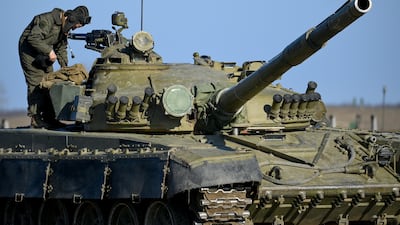
Poland and the Czech Republic sent Russian-made T72 tanks, which Ukraine has used for decades, to ease integration and cut down training time. EPA -
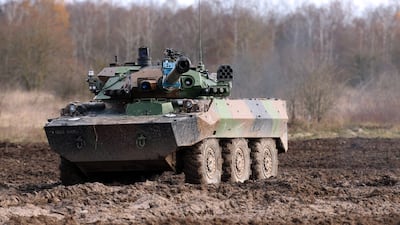
France as announced its plan to give AMX-10 RC “scout tanks” to Ukraine. "This is the first time that western-made armoured vehicles are being delivered in support of the Ukrainian army," a French official said. AFP -
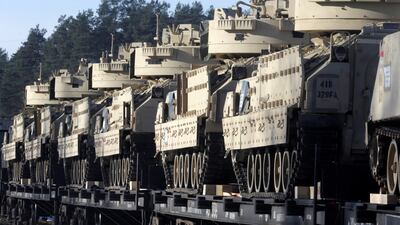
Shortly after the French, the US said it would send Bradley fighting vehicles to provide "a level of firepower and armour that would bring advantages on the battlefield”. Reuters -

The UK sent their phased-out Saxon armoured vehicles. They found new life protecting infantry units in transit and dealing with tough off-road conditions. Getty Images -
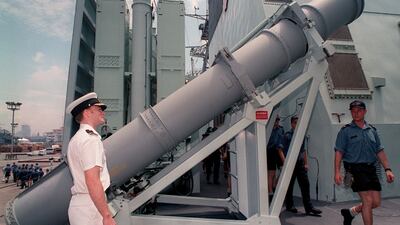
Denmark has supplied Harpoon anti-ship launchers to help Ukraine defend its coasts. AFP -

The US sent 20 Soviet and Russian made Mi-17 helicopters to Ukraine that had initially been bought for the Afghan government in 2010. AP -
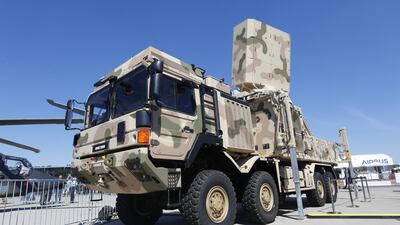
Germany has also supplied its latest version of the IRIS-T air defence system designed to shoot down missiles at altitudes up to 20 kilometres. Getty Images -
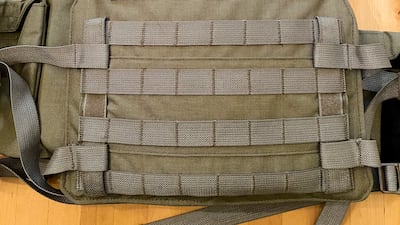
Ukraine has also been given thousands of small arms, bullet proof vests, medical kits, litres of fuel, granades and other weapons systems. Reuters


Tory defence select committee chairman Tobias Ellwood, meanwhile, claimed that the UK was “ill-prepared” for future threats from Moscow.
“We are heading into another Cold War, more dangerous than the last," he said. "And it saddens me to say this, but we are ill-prepared militarily for the threats that are coming over the horizon, particularly when it comes to the British Army.
“Three critical components of quantity and quality that contribute to our land warfare capability, and indeed more widely to the full spectrum of armed warfare, are the tank, the armoured fighting vehicle and the recce vehicle.
“Our tank, the Challenger 2, was introduced 25 years ago. Back then we had over 900, today we’ve cut our main battle tank numbers to just 148. These will now finally gain an upgrade, but that won’t be complete until 2030.
“Our armoured fighting vehicle, the Warrior, was introduced 30 years ago, a competent but now dated workhorse … all 700 are being axed, replaced by the Boxer, a wheeled not tracked vehicle, and we’re choosing the variant that has no turret, so no serious firepower."
Mr Ellwood went on to describe the relative suitability of recce vehicle, the Scimitar.
“This was introduced over 50 years ago," he said. "It should have been replaced by the Ajax three years ago, but a litany of procurement problems means it’s still unclear when this may or may not happen."
Russia and Ukraine conflict latest - in pictures
-
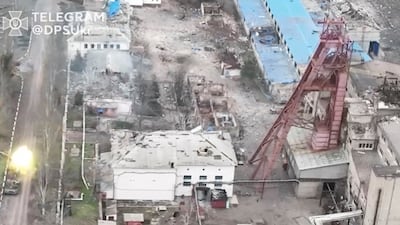
A tank, seen left, fires a round in Soledar, a town in the Donetsk region of eastern Ukraine. Reuters -
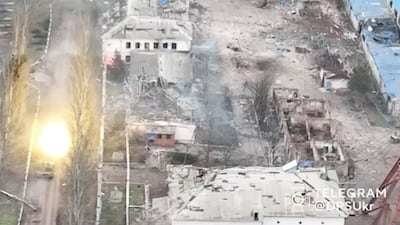
Tank fire in Soledar, Donetsk. Reuters -
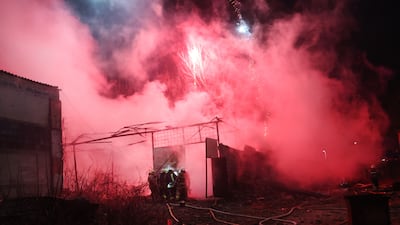
Firefighters work to put out a blaze at a Kharkiv fireworks storage site after it was struck by a Russian missile. Getty -
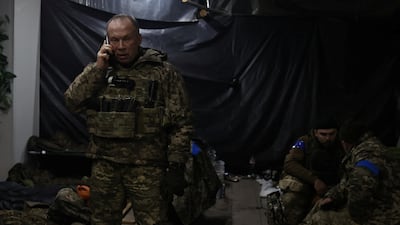
Col Gen Oleksandr Syrskyi, commander of Ukraine's ground forces, visits his troops on the frontline in Soledar, Donetsk. Reuters -
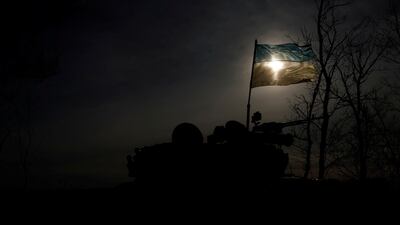
A Ukrainian flag attached to a tank flutters in the wind in Bakhmut. Reuters -
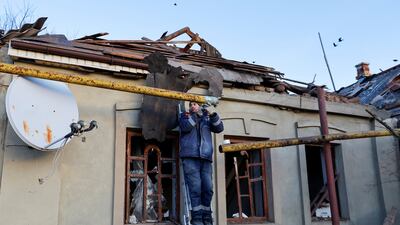
A specialist from an emergency crew works on a residential building in Donetsk that was damaged in recent shelling. Reuters -
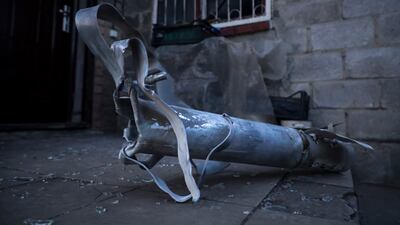
A missile fragment left by shelling in Russian-controlled Donetsk. AP -
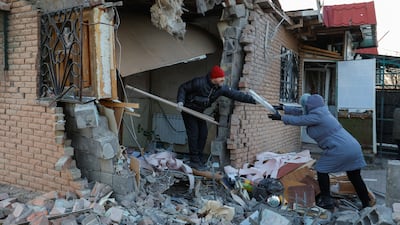
Residents remove debris and carry their belongings out of a building destroyed by recent shelling in Donetsk, Russian-controlled Ukraine. Reuters -
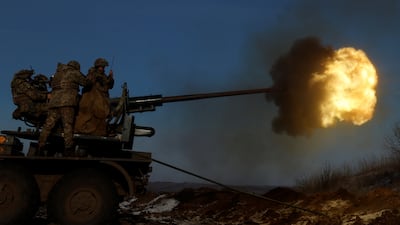
Ukrainian forces fire an anti-aircraft weapon as Russia's attack on the frontline city of Bakhmut continues. Reuters -
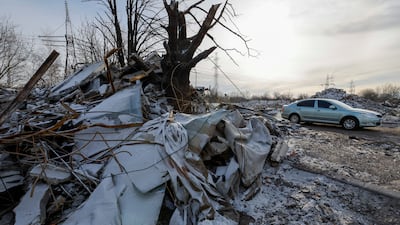
A car drives past a destroyed building purported to have been used as temporary accommodation for Russian soldiers, dozens of whom were killed in a Ukrainian missile strike in Makiivka, Russian-controlled Ukraine. Reuters -
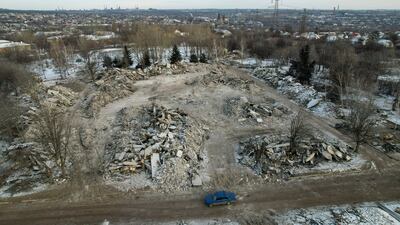
The site of a temporary barracks for Russian soldiers in Makiivka, which was destroyed in a Ukrainian missile attack. Reuters -
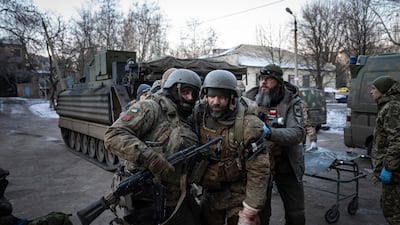
A Ukrainian serviceman carries his injured comrade from the battlefield to a hospital in the Donetsk region. AP -
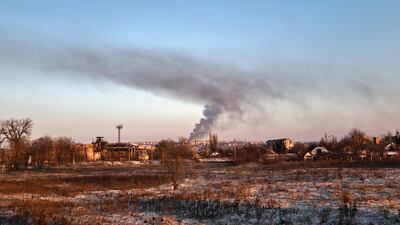
Smoke rises after shelling in Soledar, the site of heavy battles with Russian forces in the Donetsk region. AP


The former defence minister also suggested “a major Ukrainian armaments factory” should be established in eastern Poland.
“Gifting kit is the right call now, absolutely, but is not sustainable in the long term, so let Ukraine develop its own equipment,” he said.
Conservative former minister Mark Francois insisted the integrated review of defence and security published in spring 2021 had “clearly been overtaken by events”, stressing “the Russian invasion of Ukraine is a total game-changer in security terms”.
“Suffice to say that we now need to rethink our whole approach towards a shooting war with Russia, potentially, even some time this year and not in 10 years’ time," he added.
“That means having armed forces which are highly trained, brilliantly equipped and backed up with a clear political intent to use them if required.
“That means not just increasing our defence spending, though we must, but also our preparedness to fight tonight, with minimum further strategic or even operational warning.”
Everything you need to know about the Challenger 2 tank being sent to Ukraine - video
Responding to Mr Jenkin, parliamentary undersecretary Leo Docherty said: “He pointed out that we need to increase the tempo of our support to Ukraine, of course we would support that.
“He suggested that we were being too timid and too slow in terms of our support. Frankly, I would refute that, because I think our actions over the last year have shown, especially with our leadership on provision of lethal aid, that we have led the way and others have followed."
On the question of strategy, he said: “I think Putin’s failure to deliver his own policy in Ukraine has showed the failure of his strategy, and our success in supporting our Ukrainian friends has show the success of our collective strategy.
“We will continue to look at all options with regards to frozen Russian assets and their possible use in supporting Ukrainian reconstruction."

