UK Prime Minister Rishi Sunak said on Saturday he was determined to ease the pressure on Britain's health service as patients struggle for help.
Mr Sunak hosted health bosses at Downing Street for a “recovery forum” as strikes, staff shortages and long waits for ambulances push the system to breaking point.
The crisis has brought reports of patients being treated in cupboards, hospitals running out of oxygen canisters and staff breaking down in tears.
Critics called the discussions a talking shop that would fail to ease the pressures on frontline services after “years of inaction”, even as Mr Sunak demanded “bold and radical” action.
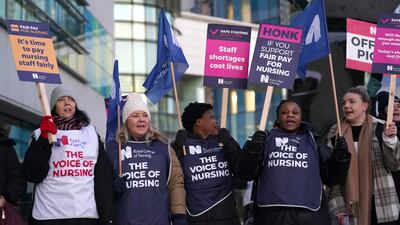
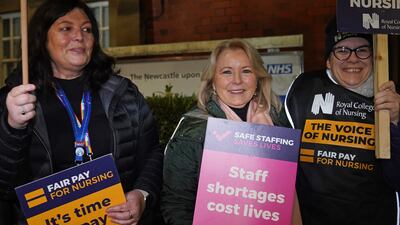
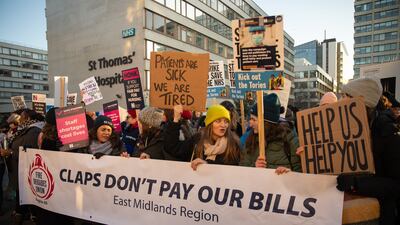
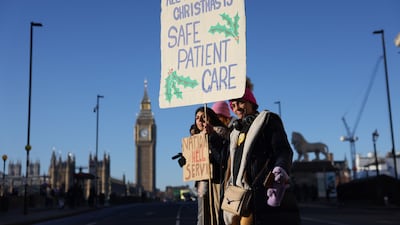
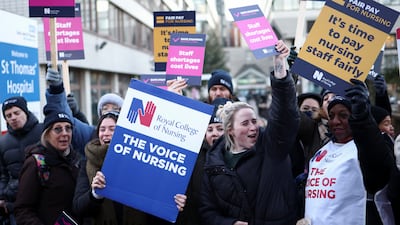
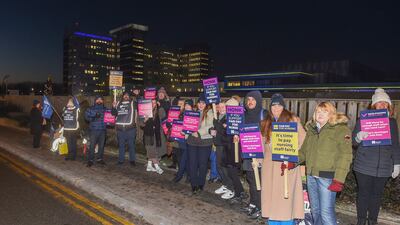
Health workers, including nurses and ambulance crew, are in dispute over pay and conditions that have led to a number of strike days over winter.
Seasonal flu and Covid-19 outbreaks are adding to the pressure on the state-funded NHS.
Cutting waiting lists was one of five pledges made by Mr Sunak aimed at turning around the Conservative Party's dire poll ratings.
Mr Sunak told health and social care leaders he recognised the “tough time” they had experienced over the past couple of years.
“During the pandemic we had to bring boldness and radicalism to how we did things in order to get through,” he said.
“I think we need that same bold and radical approach now because a business-as-usual mindset won’t fix the challenges we face.”
Consultant physician James Dunbar, who attended the meeting, said he was “confident that action will be taken” but not optimistic the crisis would be dealt with before spring.
“These are difficult problems to fix though, so I think it’s unlikely we’ll have it sorted by the end of this winter,” he said.
Downing Street has committed to publishing recovery plans to improve ambulance and A&E waiting times “in the coming weeks”.
Health Secretary Steve Barclay said those at the meeting looked at potential solutions such as virtual wards, whereby patients are monitored remotely.
“Innovation is crucial to solving the challenges facing the NHS,” he said.
Mr Sunak's office said the meeting brought together local NHS bosses, clinical experts and other organisations providing health and social care.
The British Medical Association, the trade union for doctors, was not invited to participate.
“It tells you everything you need to know about this government’s approach that the only people not invited to an NHS recovery forum are the NHS workforce,” its chief, Prof Philip Banfield, said.
“He [the Prime Minister] needs to sit down with us to discuss pay — and he needs to do it now.”
Prof Banfield said Mr Sunak needed to negotiate with striking health workers because “any recovery plan is dead on arrival unless it addresses the workforce crisis crushing our health service”.
Ambulance workers and nurses went on strike last month, and junior doctors will vote on protest action from Monday.
Mr Sunak is threatening to bring in anti-strike legislation requiring minimum service levels in health, education and transport.
The NHS Confederation, a body of health organisations, has accused the government of presiding over “years of inaction and managed decline”.
“NHS leaders will welcome the prime minister’s focus on helping to solve the challenges. But the reality is that there are no silver bullets here,” chief executive Matthew Taylor said.
“There is a widening gap between the NHS’s capacity and the demand it is facing on a daily basis. We cannot afford to go in to another winter with the NHS in such a fragile state.”
A government press release published after Mr Sunak's speech on Wednesday said NHS waiting lists would start to come down in March.
But that part of the pledge appeared to be quickly dropped, with the wording changed to remove any timetable.

Who's who in Yemen conflict
Houthis: Iran-backed rebels who occupy Sanaa and run unrecognised government
Yemeni government: Exiled government in Aden led by eight-member Presidential Leadership Council
Southern Transitional Council: Faction in Yemeni government that seeks autonomy for the south
Habrish 'rebels': Tribal-backed forces feuding with STC over control of oil in government territory
Essentials
The flights
Emirates, Etihad and Malaysia Airlines all fly direct from the UAE to Kuala Lumpur and on to Penang from about Dh2,300 return, including taxes.
Where to stay
In Kuala Lumpur, Element is a recently opened, futuristic hotel high up in a Norman Foster-designed skyscraper. Rooms cost from Dh400 per night, including taxes. Hotel Stripes, also in KL, is a great value design hotel, with an infinity rooftop pool. Rooms cost from Dh310, including taxes.
In Penang, Ren i Tang is a boutique b&b in what was once an ancient Chinese Medicine Hall in the centre of Little India. Rooms cost from Dh220, including taxes.
23 Love Lane in Penang is a luxury boutique heritage hotel in a converted mansion, with private tropical gardens. Rooms cost from Dh400, including taxes.
In Langkawi, Temple Tree is a unique architectural villa hotel consisting of antique houses from all across Malaysia. Rooms cost from Dh350, including taxes.
The specs
Engine: 2.0-litre 4cyl turbo
Power: 261hp at 5,500rpm
Torque: 405Nm at 1,750-3,500rpm
Transmission: 9-speed auto
Fuel consumption: 6.9L/100km
On sale: Now
Price: From Dh117,059
TCL INFO
Teams:
Punjabi Legends Owners: Inzamam-ul-Haq and Intizar-ul-Haq; Key player: Misbah-ul-Haq
Pakhtoons Owners: Habib Khan and Tajuddin Khan; Key player: Shahid Afridi
Maratha Arabians Owners: Sohail Khan, Ali Tumbi, Parvez Khan; Key player: Virender Sehwag
Bangla Tigers Owners: Shirajuddin Alam, Yasin Choudhary, Neelesh Bhatnager, Anis and Rizwan Sajan; Key player: TBC
Colombo Lions Owners: Sri Lanka Cricket; Key player: TBC
Kerala Kings Owners: Hussain Adam Ali and Shafi Ul Mulk; Key player: Eoin Morgan
Venue Sharjah Cricket Stadium
Format 10 overs per side, matches last for 90 minutes
When December 14-17
Timeline
2012-2015
The company offers payments/bribes to win key contracts in the Middle East
May 2017
The UK SFO officially opens investigation into Petrofac’s use of agents, corruption, and potential bribery to secure contracts
September 2021
Petrofac pleads guilty to seven counts of failing to prevent bribery under the UK Bribery Act
October 2021
Court fines Petrofac £77 million for bribery. Former executive receives a two-year suspended sentence
December 2024
Petrofac enters into comprehensive restructuring to strengthen the financial position of the group
May 2025
The High Court of England and Wales approves the company’s restructuring plan
July 2025
The Court of Appeal issues a judgment challenging parts of the restructuring plan
August 2025
Petrofac issues a business update to execute the restructuring and confirms it will appeal the Court of Appeal decision
October 2025
Petrofac loses a major TenneT offshore wind contract worth €13 billion. Holding company files for administration in the UK. Petrofac delisted from the London Stock Exchange
November 2025
180 Petrofac employees laid off in the UAE
The specs
AT4 Ultimate, as tested
Engine: 6.2-litre V8
Power: 420hp
Torque: 623Nm
Transmission: 10-speed automatic
Price: From Dh330,800 (Elevation: Dh236,400; AT4: Dh286,800; Denali: Dh345,800)
On sale: Now
How to watch Ireland v Pakistan in UAE
When: The one-off Test starts on Friday, May 11
What time: Each day’s play is scheduled to start at 2pm UAE time.
TV: The match will be broadcast on OSN Sports Cricket HD. Subscribers to the channel can also stream the action live on OSN Play.
ENGLAND SQUAD
Joe Root (captain), Dom Sibley, Rory Burns, Dan Lawrence, Ben Stokes, Ollie Pope, Ben Foakes (wicketkeeper), Moeen Ali, Olly Stone, Chris Woakes, Jack Leach, Stuart Broad
Groom and Two Brides
Director: Elie Semaan
Starring: Abdullah Boushehri, Laila Abdallah, Lulwa Almulla
Rating: 3/5
Benefits of first-time home buyers' scheme
- Priority access to new homes from participating developers
- Discounts on sales price of off-plan units
- Flexible payment plans from developers
- Mortgages with better interest rates, faster approval times and reduced fees
- DLD registration fee can be paid through banks or credit cards at zero interest rates
UAE currency: the story behind the money in your pockets
UAE tour of Zimbabwe
All matches in Bulawayo
Friday, Sept 26 – UAE won by 36 runs
Sunday, Sept 28 – Second ODI
Tuesday, Sept 30 – Third ODI
Thursday, Oct 2 – Fourth ODI
Sunday, Oct 5 – First T20I
Monday, Oct 6 – Second T20I
Mercer, the investment consulting arm of US services company Marsh & McLennan, expects its wealth division to at least double its assets under management (AUM) in the Middle East as wealth in the region continues to grow despite economic headwinds, a company official said.
Mercer Wealth, which globally has $160 billion in AUM, plans to boost its AUM in the region to $2-$3bn in the next 2-3 years from the present $1bn, said Yasir AbuShaban, a Dubai-based principal with Mercer Wealth.
“Within the next two to three years, we are looking at reaching $2 to $3 billion as a conservative estimate and we do see an opportunity to do so,” said Mr AbuShaban.
Mercer does not directly make investments, but allocates clients’ money they have discretion to, to professional asset managers. They also provide advice to clients.
“We have buying power. We can negotiate on their (client’s) behalf with asset managers to provide them lower fees than they otherwise would have to get on their own,” he added.
Mercer Wealth’s clients include sovereign wealth funds, family offices, and insurance companies among others.
From its office in Dubai, Mercer also looks after Africa, India and Turkey, where they also see opportunity for growth.
Wealth creation in Middle East and Africa (MEA) grew 8.5 per cent to $8.1 trillion last year from $7.5tn in 2015, higher than last year’s global average of 6 per cent and the second-highest growth in a region after Asia-Pacific which grew 9.9 per cent, according to consultancy Boston Consulting Group (BCG). In the region, where wealth grew just 1.9 per cent in 2015 compared with 2014, a pickup in oil prices has helped in wealth generation.
BCG is forecasting MEA wealth will rise to $12tn by 2021, growing at an annual average of 8 per cent.
Drivers of wealth generation in the region will be split evenly between new wealth creation and growth of performance of existing assets, according to BCG.
Another general trend in the region is clients’ looking for a comprehensive approach to investing, according to Mr AbuShaban.
“Institutional investors or some of the families are seeing a slowdown in the available capital they have to invest and in that sense they are looking at optimizing the way they manage their portfolios and making sure they are not investing haphazardly and different parts of their investment are working together,” said Mr AbuShaban.
Some clients also have a higher appetite for risk, given the low interest-rate environment that does not provide enough yield for some institutional investors. These clients are keen to invest in illiquid assets, such as private equity and infrastructure.
“What we have seen is a desire for higher returns in what has been a low-return environment specifically in various fixed income or bonds,” he said.
“In this environment, we have seen a de facto increase in the risk that clients are taking in things like illiquid investments, private equity investments, infrastructure and private debt, those kind of investments were higher illiquidity results in incrementally higher returns.”
The Abu Dhabi Investment Authority, one of the largest sovereign wealth funds, said in its 2016 report that has gradually increased its exposure in direct private equity and private credit transactions, mainly in Asian markets and especially in China and India. The authority’s private equity department focused on structured equities owing to “their defensive characteristics.”
Milestones on the road to union
1970
October 26: Bahrain withdraws from a proposal to create a federation of nine with the seven Trucial States and Qatar.
December: Ahmed Al Suwaidi visits New York to discuss potential UN membership.
1971
March 1: Alex Douglas Hume, Conservative foreign secretary confirms that Britain will leave the Gulf and “strongly supports” the creation of a Union of Arab Emirates.
July 12: Historic meeting at which Sheikh Zayed and Sheikh Rashid make a binding agreement to create what will become the UAE.
July 18: It is announced that the UAE will be formed from six emirates, with a proposed constitution signed. RAK is not yet part of the agreement.
August 6: The fifth anniversary of Sheikh Zayed becoming Ruler of Abu Dhabi, with official celebrations deferred until later in the year.
August 15: Bahrain becomes independent.
September 3: Qatar becomes independent.
November 23-25: Meeting with Sheikh Zayed and Sheikh Rashid and senior British officials to fix December 2 as date of creation of the UAE.
November 29: At 5.30pm Iranian forces seize the Greater and Lesser Tunbs by force.
November 30: Despite a power sharing agreement, Tehran takes full control of Abu Musa.
November 31: UK officials visit all six participating Emirates to formally end the Trucial States treaties
December 2: 11am, Dubai. New Supreme Council formally elects Sheikh Zayed as President. Treaty of Friendship signed with the UK. 11.30am. Flag raising ceremony at Union House and Al Manhal Palace in Abu Dhabi witnessed by Sheikh Khalifa, then Crown Prince of Abu Dhabi.
December 6: Arab League formally admits the UAE. The first British Ambassador presents his credentials to Sheikh Zayed.
December 9: UAE joins the United Nations.