


The UK and South Africa on Wednesday agreed to closer collaboration to tackle pandemics and develop medicine.
Health and education institutions will begin research in nine projects, from health systems and financing to mental health and surgery.
The agreement was struck during South African President Cyril Ramaphosa’s state visit to Britain, the first hosted by King Charles III as Britain's monarch.
It includes more UK funding to support genome sequencing to improve antimicrobial resistance monitoring in Africa.
More than 17,000 genomes have been sequenced to date in South Africa with UK support.
The additional funding will enable more rapid detection of diseases in at least 18 African countries, which could help to prevent pandemics.
The UK and South Africa are also working together to protect health systems from the increasing threat of climate change.
“Strengthening the partnership between the UK and South Africa is not only crucial in improving health and patient outcomes in both countries, but it is also vital to add to the global resilience of our health systems," said Steve Barclay, UK Health and Social Care Secretary.
“Through this partnership, we will reinforce our shared commitment to ensuring the world is better prepared for pandemics through joint research and building capability for disease surveillance.
King Charles III welcomes South Africa's President Cyril Ramaphosa to the UK — in pictures
-
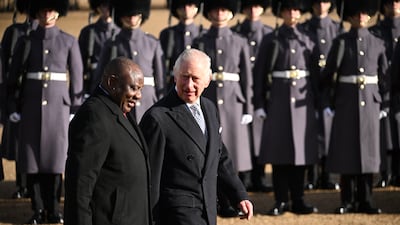
Britain's King Charles III and President of South Africa, Cyril Ramaphosa, attending a welcoming ceremony at Horse Guards Parade in central London on Tuesday. Getty Images -
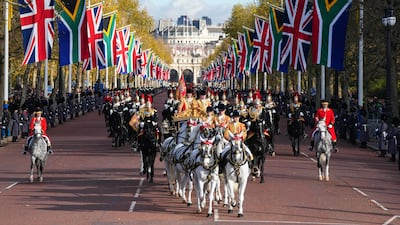
The state carriage proceeds along The Mall towards Buckingham Palace in the first state visit hosted by the UK with King Charles as monarch. Getty Images -
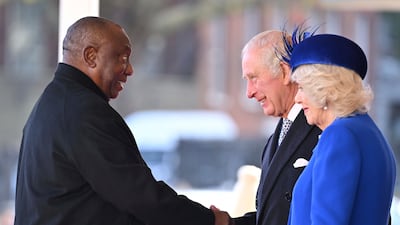
Cyril Ramaphosa shakes hands with King Charles and Queen Consort Camilla. AP -
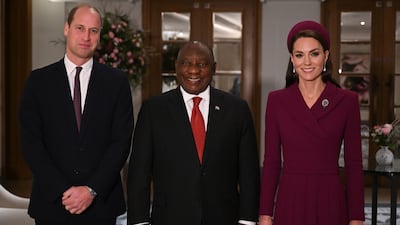
Cyril Ramaphosa is greeted by Prince William and his wife, Catherine, Princess of Wales, at the Corinthia Hotel in London. PA -
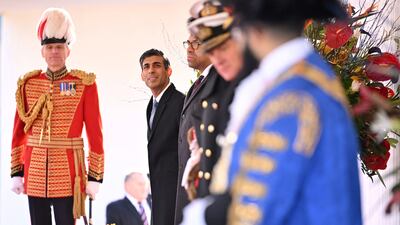
British Prime Minister Rishi Sunak attends the parade, part of the welcome ceremony. Reuters -

Members of the Coldstream Guards march to Buckingham Palace. AP -
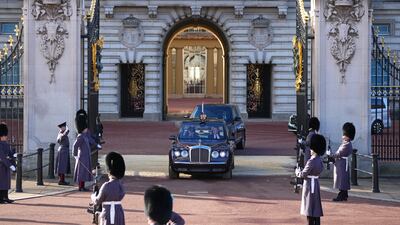
King Charles and the queen consort leaving Buckingham Palace in the royal entourage. Getty Images -
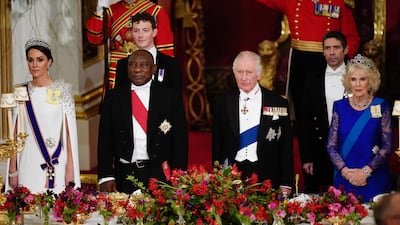
Catherine, Princess of Wales, Cyril Ramaphosa, King Charles and Camilla, Queen Consort during the State Banquet at Buckingham Palace. Getty -
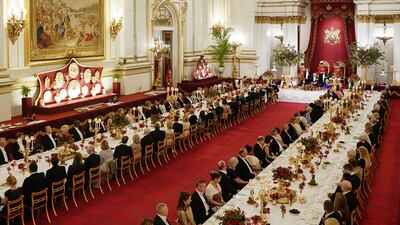
The State Banquet at Buckingham Palace. Getty -
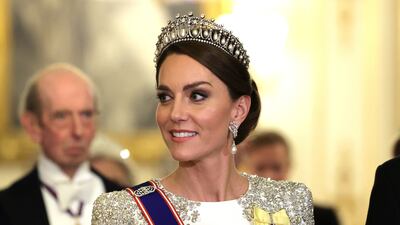
The Princess of Wales arrives at Buckingham Palace. PA -
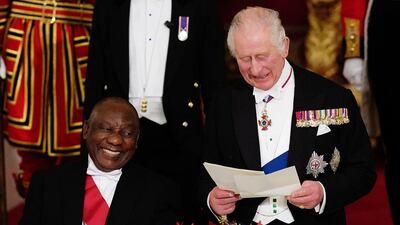
King Charles makes a speech during the State Banquet. Reuters -
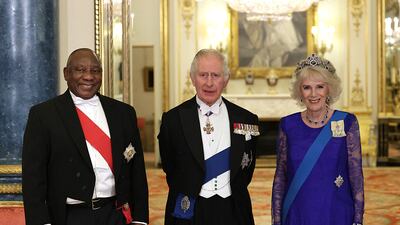
Cyril Ramaphosa, King Charles and Camilla, Queen Consort pose for a photograph during the State Banquet. AFP


“It was excellent to meet President Ramaphosa at the Francis Crick Institute, where staff showcased the best of innovative research technology the UK has to offer."
Prince Edward, Earl of Wessex, and Therese Coffey, Secretary of State for the Department for Environment, Food & Rural Affairs, on Wednesday accompanied Mr Ramaphosa to the Royal Botanical Gardens at Kew, where a partnership with South African institutions is helping to preserve biodiversity and address climate change.
“It is vital for countries to work together to tackle global challenges like climate change and pandemic preparedness," Foreign Secretary James Cleverly said.
“This will benefit us all. The UK and South Africa have shown global leadership in joining to protect people by preventing the spread of dangerous diseases and by working to halt climate change, including through the ground-breaking Just Energy Transition Partnership to help countries move away from using fossil fuels.”
Mr Ramaphosa's trip is the first state visit to the UK for more than three years due to the coronavirus pandemic.

