Boris Johnson could make a return to high office one day despite being forced from power, Lord Lister suggested. Reuters

Don't write off Boris Johnson, says PM's former aide


Soraya Ebrahimi
  • English
  • Arabic

Boris Johnson should not be written off, a former close aide to the departing British prime minister said on Sunday.

Lord Edward Lister suggested Mr Johnson could make a return to high office one day despite being forced from power.

Following months of scandal, Mr Johnson was forced to announce his resignation in July.

He will hand over power on Tuesday after the governing Conservative Party names its new leader on Monday.

Liz Truss, the current foreign secretary, is widely expected to win the leadership contest and succeed Mr Johnson, taking on challenges including what is forecast to be a long recession, double-digit inflation and industrial unrest.

Asked whether Mr Johnson could return to power, Lord Lister, who has been a close adviser for years and was briefly chief of staff at Downing Street in 2020-21, told Sky News: “Well, maybe in the future, I'd never say never on anything with Boris Johnson — anything is possible.

“He is going to be watching all this and if something happens in the future, as you said, if the ball comes loose in the scrum, then anything could happen. I am not going to predict. All I am saying is I would never write him off.”

Boris Johnson's final week in office — in pictures

  • Britain's Prime Minister Boris Johnson poses with Sea Cadets during a visit to BAE systems in Barrow-in-Furness. PA
    Britain's Prime Minister Boris Johnson poses with Sea Cadets during a visit to BAE systems in Barrow-in-Furness. PA
  • Mr Johnson views an armed response vehicle during a visit with members of Thames Valley Police at Milton Keynes Police Station. Getty Images
    Mr Johnson views an armed response vehicle during a visit with members of Thames Valley Police at Milton Keynes Police Station. Getty Images
  • Mr Johnson and Britain's Home Secretary Priti Patel meet newly-recruited officers at Milton Keynes Police Station. AFP
    Mr Johnson and Britain's Home Secretary Priti Patel meet newly-recruited officers at Milton Keynes Police Station. AFP
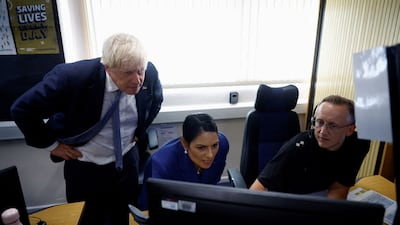
  • Mr Johnson and Ms Patel are shown the Critical Incident Desk during their visit with members of Thames Valley Police. AFP
    Mr Johnson and Ms Patel are shown the Critical Incident Desk during their visit with members of Thames Valley Police. AFP
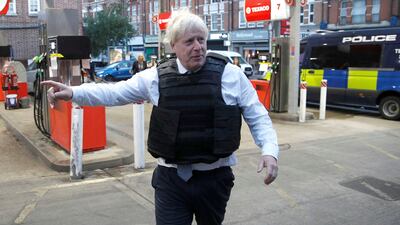
  • Mr Johnson on the scene following a drugs-related raid by Metropolitan Police officers in West Norwood, London. AP
    Mr Johnson on the scene following a drugs-related raid by Metropolitan Police officers in West Norwood, London. AP
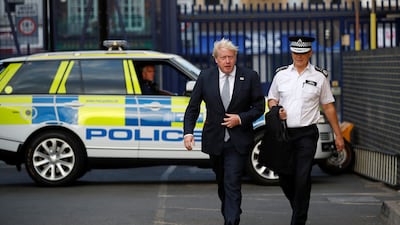
  • Mr Johnson with Stephen House, acting commissioner of the Metropolitan Police service, during a visit to a police station in London. Getty Images
    Mr Johnson with Stephen House, acting commissioner of the Metropolitan Police service, during a visit to a police station in London. Getty Images
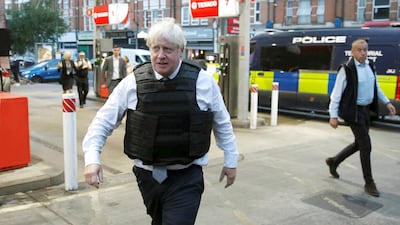
  • Mr Johnson leaves the area following the raid in West Norwood. AP
    Mr Johnson leaves the area following the raid in West Norwood. AP
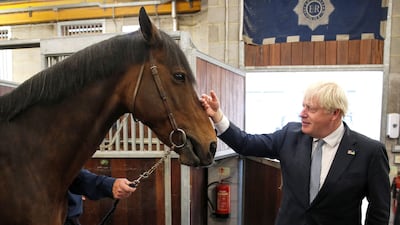
  • Mr Johnson meets Vimala, a police horse, during a visit to a Metropolitan Police station in London. AFP
    Mr Johnson meets Vimala, a police horse, during a visit to a Metropolitan Police station in London. AFP
  • Mr Johnson gives a thumbs-up during a visit to Henbury Farm in north Dorset, where Wessex Internet are laying fibre optics. Getty Images
    Mr Johnson gives a thumbs-up during a visit to Henbury Farm in north Dorset, where Wessex Internet are laying fibre optics. Getty Images
  • Mr Johnson and Culture Secretary Nadine Dorries in a mole plough during the visit to Henbury Farm. Getty Images
    Mr Johnson and Culture Secretary Nadine Dorries in a mole plough during the visit to Henbury Farm. Getty Images
  • Mr Johnson and Ms Dorries sit in the cabin of the plough. PA
    Mr Johnson and Ms Dorries sit in the cabin of the plough. PA

Mr Johnson, 58, who has been in office since July 2019, has said he will continue as a member of parliament after he steps down, promising loyalty to his successor. But many will be watching to see whether he will cause problems for the new prime minister by trying to assert his will.

Asked at a news conference last week what kind of former prime minister he would be, Mr Johnson said: “Only time will tell … My intention and what I certainly will do is give my full and unqualified support to whoever takes over from me and otherwise, really to get on with life.”

Mr Johnson's advisers have been guarded over his plans, saying little more than he will continue his duties as an MP and will no longer be “public property”.

Boris Johnson's final PMQs: Most memorable moments — video

But he faces an investigation into whether he misled parliament with his comments on “partygate”Covid-19 lockdown-breaking events at his Downing Street office and residence.

That could mean more details from the sometimes alcohol-fuelled Downing Street parties — potentially a thorn in the side for the new prime minister, who will want to try to restore trust in the office.


Tamkeen's offering
  • Option 1: 70% in year 1, 50% in year 2, 30% in year 3
  • Option 2: 50% across three years
  • Option 3: 30% across five years 
Iftar programme at the Sheikh Mohammed Centre for Cultural Understanding

Established in 1998, the Sheikh Mohammed Centre for Cultural Understanding was created with a vision to teach residents about the traditions and customs of the UAE. Its motto is ‘open doors, open minds’. All year-round, visitors can sign up for a traditional Emirati breakfast, lunch or dinner meal, as well as a range of walking tours, including ones to sites such as the Jumeirah Mosque or Al Fahidi Historical Neighbourhood.

Every year during Ramadan, an iftar programme is rolled out. This allows guests to break their fast with the centre’s presenters, visit a nearby mosque and observe their guides while they pray. These events last for about two hours and are open to the public, or can be booked for a private event.

Until the end of Ramadan, the iftar events take place from 7pm until 9pm, from Saturday to Thursday. Advanced booking is required.

For more details, email openminds@cultures.ae or visit www.cultures.ae


High profile Al Shabab attacks
  • 2010: A restaurant attack in Kampala Uganda kills 74 people watching a Fifa World Cup final football match.
  • 2013: The Westgate shopping mall attack, 62 civilians, five Kenyan soldiers and four gunmen are killed.
  • 2014: A series of bombings and shootings across Kenya sees scores of civilians killed.
  • 2015: Four gunmen attack Garissa University College in northeastern Kenya and take over 700 students hostage, killing those who identified as Christian; 148 die and 79 more are injured.
  • 2016: An attack on a Kenyan military base in El Adde Somalia kills 180 soldiers.
  • 2017: A suicide truck bombing outside the Safari Hotel in Mogadishu kills 587 people and destroys several city blocks, making it the deadliest attack by the group and the worst in Somalia’s history.

Mercer, the investment consulting arm of US services company Marsh & McLennan, expects its wealth division to at least double its assets under management (AUM) in the Middle East as wealth in the region continues to grow despite economic headwinds, a company official said.

Mercer Wealth, which globally has $160 billion in AUM, plans to boost its AUM in the region to $2-$3bn in the next 2-3 years from the present $1bn, said Yasir AbuShaban, a Dubai-based principal with Mercer Wealth.

Within the next two to three years, we are looking at reaching $2 to $3 billion as a conservative estimate and we do see an opportunity to do so,” said Mr AbuShaban.

Mercer does not directly make investments, but allocates clients’ money they have discretion to, to professional asset managers. They also provide advice to clients.

“We have buying power. We can negotiate on their (client’s) behalf with asset managers to provide them lower fees than they otherwise would have to get on their own,” he added.

Mercer Wealth’s clients include sovereign wealth funds, family offices, and insurance companies among others.

From its office in Dubai, Mercer also looks after Africa, India and Turkey, where they also see opportunity for growth.

Wealth creation in Middle East and Africa (MEA) grew 8.5 per cent to $8.1 trillion last year from $7.5tn in 2015, higher than last year’s global average of 6 per cent and the second-highest growth in a region after Asia-Pacific which grew 9.9 per cent, according to consultancy Boston Consulting Group (BCG). In the region, where wealth grew just 1.9 per cent in 2015 compared with 2014, a pickup in oil prices has helped in wealth generation.

BCG is forecasting MEA wealth will rise to $12tn by 2021, growing at an annual average of 8 per cent.

Drivers of wealth generation in the region will be split evenly between new wealth creation and growth of performance of existing assets, according to BCG.

Another general trend in the region is clients’ looking for a comprehensive approach to investing, according to Mr AbuShaban.

“Institutional investors or some of the families are seeing a slowdown in the available capital they have to invest and in that sense they are looking at optimizing the way they manage their portfolios and making sure they are not investing haphazardly and different parts of their investment are working together,” said Mr AbuShaban.

Some clients also have a higher appetite for risk, given the low interest-rate environment that does not provide enough yield for some institutional investors. These clients are keen to invest in illiquid assets, such as private equity and infrastructure.

“What we have seen is a desire for higher returns in what has been a low-return environment specifically in various fixed income or bonds,” he said.

“In this environment, we have seen a de facto increase in the risk that clients are taking in things like illiquid investments, private equity investments, infrastructure and private debt, those kind of investments were higher illiquidity results in incrementally higher returns.”

The Abu Dhabi Investment Authority, one of the largest sovereign wealth funds, said in its 2016 report that has gradually increased its exposure in direct private equity and private credit transactions, mainly in Asian markets and especially in China and India. The authority’s private equity department focused on structured equities owing to “their defensive characteristics.”

((Disclaimer))

The Liechtensteinische Landesbank AG (“Bank”) assumes no liability or guarantee for the accuracy, balance, or completeness of the information in this publication. The content may change at any time due to given circumstances, and the Liechtensteinische Landesbank AG is under no obligation to update information once it has been published. This publication is intended for information purposes only and does not constitute an offer, a recommendation or an invitation by, or on behalf of, Liechtensteinische Landesbank (DIFC Branch), Liechtensteinische Landesbank AG, or any of its group affiliates to make any investments or obtain services. This publication has not been reviewed, disapproved or approved by the United Arab Emirates (“UAE”) Central Bank, Dubai Financial Services Authority (“DFSA”) or any other relevant licensing authorities in the UAE. It may not be relied upon by or distributed to retail clients. Liechtensteinische Landesbank (DIFC Branch) is regulated by the DFSA and this advertorial is intended for Professional Clients (as defined by the DFSA) who have sufficient financial experience and understanding of financial markets, products or transactions and any associated risks.

Sweet%20Tooth
%3Cp%3E%3Cstrong%3ECreator%3A%20%3C%2Fstrong%3EJim%20Mickle%3Cbr%3E%3Cstrong%3EStarring%3A%20%3C%2Fstrong%3EChristian%20Convery%2C%20Nonso%20Anozie%2C%20Adeel%20Akhtar%2C%20Stefania%20LaVie%20Owen%3Cbr%3E%3Cstrong%3ERating%3A%20%3C%2Fstrong%3E2.5%2F5%3C%2Fp%3E%0A
How to wear a kandura

Dos

  • Wear the right fabric for the right season and occasion 
  • Always ask for the dress code if you don’t know
  • Wear a white kandura, white ghutra / shemagh (headwear) and black shoes for work 
  • Wear 100 per cent cotton under the kandura as most fabrics are polyester

Don’ts 

  • Wear hamdania for work, always wear a ghutra and agal 
  • Buy a kandura only based on how it feels; ask questions about the fabric and understand what you are buying
Updated: September 04, 2022, 7:17 PM