• Members of the fire brigade help ferry local residents in Holloway, north London, after a water main burst causing flooding up to 1.2 metres deep. PA
    Members of the fire brigade help ferry local residents in Holloway, north London, after a water main burst causing flooding up to 1.2 metres deep. PA
  • A motorcyclist negotiates substantial flooding on roads close to the Emirates Stadium, the home of Arsenal Football Club. Getty Images
    A motorcyclist negotiates substantial flooding on roads close to the Emirates Stadium, the home of Arsenal Football Club. Getty Images
  • Emergency services were called to the scene in Holloway in the north London borough of Islington just after 7am. Getty Images
    Emergency services were called to the scene in Holloway in the north London borough of Islington just after 7am. Getty Images
  • Ten fire engines and about 70 firefighters help at the scene. PA
    Ten fire engines and about 70 firefighters help at the scene. PA
  • Multiple road closures are in place in the area. PA
    Multiple road closures are in place in the area. PA
  • Thames Water officials work in Holloway. PA
    Thames Water officials work in Holloway. PA
  • A car makes its way through the flood waters. Getty Images
    A car makes its way through the flood waters. Getty Images

Hornsey Road flood: burst pipe in Islington causes chaos in north London


  • English
  • Arabic

A large area of north London had little or no water on Monday morning as a burst pipe near Arsenal's Emirates Stadium saw water gush through the streets, at the same time as millions of people in the UK face hosepipe bans due to water scarcity.

Six postcodes in the boroughs of Islington and Hackney had no or very low water supply, the area's supplier Thames Water said on its webpage.

Eight fire engines and about 60 firefighters were called to the scene at Hornsey Road and Tollington Road in Islington at just after 7am, London Fire Brigade said.

“There are multiple road closures in place while crews work to make the scene safe. People are urged to avoid the area.

“The Brigade's 999 control officers have taken 12 calls to the incident.”

Businesses of varying sizes were affected.

Arsenal's club's offices were without water following the leak, and a pub on Tollington Road said it was worried about its supplies.

“It happened about 7am and within minutes there was flooding like a tsunami!”, said a staff member at The Tollington pub, which is located close to the burst pipe. “We have got one eye on our cellar as that would get hit first.”

Many parts of the UK are living with hosepipe bans, and more areas including London are expected to be affected soon.

Temperatures in Britain are expected to soar again this week to highs around 35°C, with millions of households not allowed to water their gardens.

The UK’s major utilities are already facing criticism for the amount of water that leaks out of pipes. About 2.4 billion litres are lost through leaks every day, the Times newspaper reported last month, enough to meet the needs of nearly 16 million people, roughly a quarter of the UK population.

Outside the capital, Southern Water enforced the first hosepipe ban in Hampshire and the Isle of Wight. If residents want to irrigate their gardens, they need to use conservative methods such as watering cans or potentially face a fine of up to £1,000 ($1,206). South East Water will impose a similar ban on its customers in Kent and Sussex from August 12.

Essex County Fire and Rescue Service is urging people not to light barbecues or bonfires, or let off fireworks or sky lanterns, after a large fire which damaged gardens, sheds and trees was started by a chiminea.

Area manager Neil Fenwick said: “While summer weather usually provides the perfect opportunity to host a barbecue or gather around a chiminea in the evening, we're strongly discouraging people from having any kinds of fires at the moment.

“The ground across Essex is extremely dry, allowing fires to spread easily and quickly. This is true for gardens as well as fields and heathland.

“Please help us to help you. Please don't have barbecues or bonfires. Please don't use fireworks or set off sky lanterns.”

The Country Land and Business Association (CLA), which represents 28,000 farmers and landowners in England and Wales, has called on all retailers to follow the lead of Marks & Spencer and ban the sale of disposable barbecues across the UK this summer.

The organisation's president, Mark Tufnell, said: “The CLA is demanding that retailers immediately ban the sale of disposable barbecues across the UK this summer in a move to curb fires spreading in the countryside which cause great damage to rural communities and businesses and jeopardise the safety of all those in the surrounding areas.

“During this period of prolonged lack of rainfall, record temperatures during heatwaves and wildfires damaging the countryside, policies such as this which can mitigate potential further fire damage are sensible and necessary.

“We warmly welcome people to the countryside as they seek to enjoy the glorious weather.

“But we ask them to help us protect farmland and natural habitats by not lighting barbecues, fires and other potentially hazardous materials such as sky lanterns.”

UK drought — in pictures

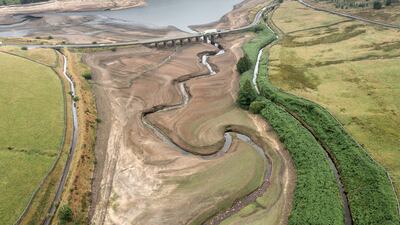
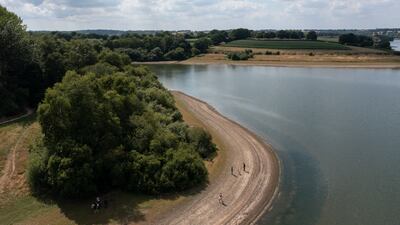
  • The bed of the Woodhead reservoir as water levels sink in Glossop. There was a record-breaking heatwave in July, which was the driest July in records dating back to 1836 for south-east and central southern England. Getty Images
    The bed of the Woodhead reservoir as water levels sink in Glossop. There was a record-breaking heatwave in July, which was the driest July in records dating back to 1836 for south-east and central southern England. Getty Images
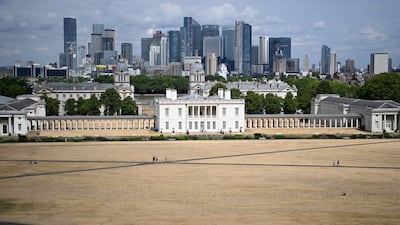
  • The parched grass lands of Greenwich Park in London. The country is facing its driest summer since 1976. EPA
    The parched grass lands of Greenwich Park in London. The country is facing its driest summer since 1976. EPA
  • Bewl Water Reservoir near Lamberhurst in Kent, which is currently measured at 67 per cent of its capacity as the dry weather continues. PA
    Bewl Water Reservoir near Lamberhurst in Kent, which is currently measured at 67 per cent of its capacity as the dry weather continues. PA
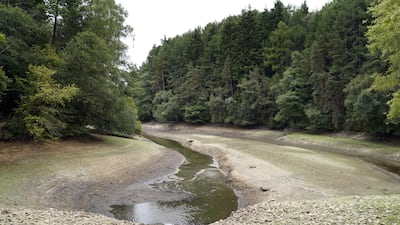
  • A man walks along a dry bank of a tributary to the Dowry Reservoir close to Oldham. PA
    A man walks along a dry bank of a tributary to the Dowry Reservoir close to Oldham. PA
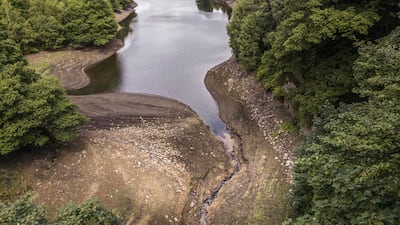
  • Ardingly reservoir in West Sussex, owned and managed by South East Water, the water supplier for Kent and Sussex, which is restricting the use of hosepipes and sprinklers. PA
    Ardingly reservoir in West Sussex, owned and managed by South East Water, the water supplier for Kent and Sussex, which is restricting the use of hosepipes and sprinklers. PA
  • Low water levels at Holme Styes reservoir in Holmfirth, West Yorkshire. PA
    Low water levels at Holme Styes reservoir in Holmfirth, West Yorkshire. PA
  • A parched Parliament Square in London. EPA
    A parched Parliament Square in London. EPA
  • Low water levels at Bewl Water reservoir in Lamberhurst. Getty Images
    Low water levels at Bewl Water reservoir in Lamberhurst. Getty Images
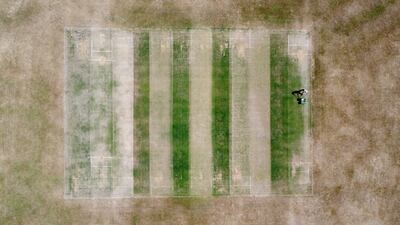
  • A groundsman at Boughton and Eastwell Cricket Club in Ashford, Kent, prepares the wickets for matches. PA
    A groundsman at Boughton and Eastwell Cricket Club in Ashford, Kent, prepares the wickets for matches. PA

Met Office spokesman Grahame Madge said: “We're expecting the heat to build towards the end of the week, and expecting temperatures of 34°C or 35°C across parts of southern England.

“After that the heatwave will start to subside.”

He said the heat would be slipping away eastward by the end of this week, bringing fresher conditions.

But it was not yet clear from the forecasts whether there would be any “meaningful” rain to relieve dry areas next week, he said.

In England, July was the driest July since 1935, with average precipitation at just 23.1mm, while south-east and central southern England had an average of only 5mm of rain and East Anglia had 5.4mm, provisional figures from the UK's Met Office show.

Some of Britain's reservoirs and rivers have been running perilously low as a result.

But rain in north-west Britain in the last week or so has meant river flows are in the normal range or above normal, or even exceptionally high in the case of Cumbria.

Lucy Barker, a hydrological analyst at UKCEH, said: “Current forecasts suggest that dry and warm weather will continue for southern Britain through the first half of August, and hydrological forecasts suggest below normal river flows in southern Britain are likely to persist over the next few months, with exceptionally low flows likely in many catchments.

“Groundwater levels and reservoir stocks are likely to continue to decline in these areas.

“We would expect to see continued impacts on agriculture and the environment in addition to further pressures on water supplies, with the possibility of further restrictions.”


Company%C2%A0profile
%3Cp%3E%3Cstrong%3EName%3A%20%3C%2Fstrong%3EPyppl%3C%2Fp%3E%0A%3Cp%3E%3Cstrong%3EEstablished%3A%20%3C%2Fstrong%3E2017%3C%2Fp%3E%0A%3Cp%3E%3Cstrong%3EFounders%3A%20%3C%2Fstrong%3EAntti%20Arponen%20and%20Phil%20Reynolds%26nbsp%3B%3C%2Fp%3E%0A%3Cp%3E%3Cstrong%3EBased%3A%3C%2Fstrong%3E%20UAE%3C%2Fp%3E%0A%3Cp%3E%3Cstrong%3ESector%3A%3C%2Fstrong%3E%20financial%20services%3C%2Fp%3E%0A%3Cp%3E%3Cstrong%3EInvestment%3A%3C%2Fstrong%3E%20%2418.5%20million%3C%2Fp%3E%0A%3Cp%3E%3Cstrong%3EEmployees%3A%3C%2Fstrong%3E%20150%3C%2Fp%3E%0A%3Cp%3E%3Cstrong%3EFunding%20stage%3A%3C%2Fstrong%3E%20series%20A%2C%20closed%20in%202021%3C%2Fp%3E%0A%3Cp%3E%3Cstrong%3EInvestors%3A%3C%2Fstrong%3E%20venture%20capital%20companies%2C%20international%20funds%2C%20family%20offices%2C%20high-net-worth%20individuals%3C%2Fp%3E%0A
Conflict, drought, famine

Estimates of the number of deaths caused by the famine range from 400,000 to 1 million, according to a document prepared for the UK House of Lords in 2024.
It has been claimed that the policies of the Ethiopian government, which took control after deposing Emperor Haile Selassie in a military-led revolution in 1974, contributed to the scale of the famine.
Dr Miriam Bradley, senior lecturer in humanitarian studies at the University of Manchester, has argued that, by the early 1980s, “several government policies combined to cause, rather than prevent, a famine which lasted from 1983 to 1985. Mengistu’s government imposed Stalinist-model agricultural policies involving forced collectivisation and villagisation [relocation of communities into planned villages].
The West became aware of the catastrophe through a series of BBC News reports by journalist Michael Buerk in October 1984 describing a “biblical famine” and containing graphic images of thousands of people, including children, facing starvation.

Band Aid

Bob Geldof, singer with the Irish rock group The Boomtown Rats, formed Band Aid in response to the horrific images shown in the news broadcasts.
With Midge Ure of the band Ultravox, he wrote the hit charity single Do They Know it’s Christmas in December 1984, featuring a string of high-profile musicians.
Following the single’s success, the idea to stage a rock concert evolved.
Live Aid was a series of simultaneous concerts that took place at Wembley Stadium in London, John F Kennedy Stadium in Philadelphia, the US, and at various other venues across the world.
The combined event was broadcast to an estimated worldwide audience of 1.5 billion.

Expert input

If you had all the money in the world, what’s the one sneaker you would buy or create?

“There are a few shoes that have ‘grail’ status for me. But the one I have always wanted is the Nike x Patta x Parra Air Max 1 - Cherrywood. To get a pair in my size brand new is would cost me between Dh8,000 and Dh 10,000.” Jack Brett

“If I had all the money, I would approach Nike and ask them to do my own Air Force 1, that’s one of my dreams.” Yaseen Benchouche

“There’s nothing out there yet that I’d pay an insane amount for, but I’d love to create my own shoe with Tinker Hatfield and Jordan.” Joshua Cox

“I think I’d buy a defunct footwear brand; I’d like the challenge of reinterpreting a brand’s history and changing options.” Kris Balerite

 “I’d stir up a creative collaboration with designers Martin Margiela of the mixed patchwork sneakers, and Yohji Yamamoto.” Hussain Moloobhoy

“If I had all the money in the world, I’d live somewhere where I’d never have to wear shoes again.” Raj Malhotra

Aggro%20Dr1ft
%3Cp%3EDirector%3A%20Harmony%20Korine%3Cbr%3EStars%3A%20Jordi%20Molla%2C%20Travis%20Scott%3Cbr%3ERating%3A%202%2F5%3C%2Fp%3E%0A
Ten tax points to be aware of in 2026

1. Domestic VAT refund amendments: request your refund within five years

If a business does not apply for the refund on time, they lose their credit.

2. E-invoicing in the UAE

Businesses should continue preparing for the implementation of e-invoicing in the UAE, with 2026 a preparation and transition period ahead of phased mandatory adoption. 

3. More tax audits

Tax authorities are increasingly using data already available across multiple filings to identify audit risks. 

4. More beneficial VAT and excise tax penalty regime

Tax disputes are expected to become more frequent and more structured, with clearer administrative objection and appeal processes. The UAE has adopted a new penalty regime for VAT and excise disputes, which now mirrors the penalty regime for corporate tax.

5. Greater emphasis on statutory audit

There is a greater need for the accuracy of financial statements. The International Financial Reporting Standards standards need to be strictly adhered to and, as a result, the quality of the audits will need to increase.

6. Further transfer pricing enforcement

Transfer pricing enforcement, which refers to the practice of establishing prices for internal transactions between related entities, is expected to broaden in scope. The UAE will shortly open the possibility to negotiate advance pricing agreements, or essentially rulings for transfer pricing purposes. 

7. Limited time periods for audits

Recent amendments also introduce a default five-year limitation period for tax audits and assessments, subject to specific statutory exceptions. While the standard audit and assessment period is five years, this may be extended to up to 15 years in cases involving fraud or tax evasion. 

8. Pillar 2 implementation 

Many multinational groups will begin to feel the practical effect of the Domestic Minimum Top-Up Tax (DMTT), the UAE's implementation of the OECD’s global minimum tax under Pillar 2. While the rules apply for financial years starting on or after January 1, 2025, it is 2026 that marks the transition to an operational phase.

9. Reduced compliance obligations for imported goods and services

Businesses that apply the reverse-charge mechanism for VAT purposes in the UAE may benefit from reduced compliance obligations. 

10. Substance and CbC reporting focus

Tax authorities are expected to continue strengthening the enforcement of economic substance and Country-by-Country (CbC) reporting frameworks. In the UAE, these regimes are increasingly being used as risk-assessment tools, providing tax authorities with a comprehensive view of multinational groups’ global footprints and enabling them to assess whether profits are aligned with real economic activity. 

Contributed by Thomas Vanhee and Hend Rashwan, Aurifer

War 2

Director: Ayan Mukerji

Stars: Hrithik Roshan, NTR, Kiara Advani, Ashutosh Rana

Rating: 2/5

Updated: August 08, 2022, 2:17 PM