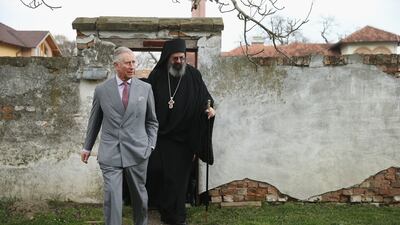
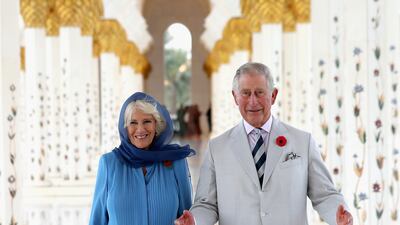
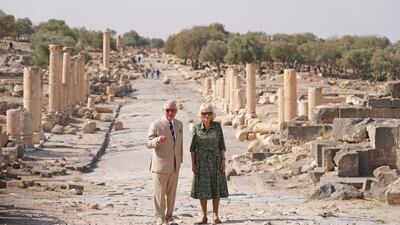
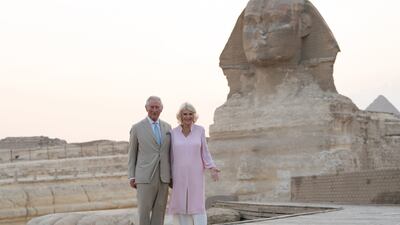
Prince Charles lamented the atrocities committed during the Rwandan genocide as he was told about the murder of children during the violence.
He is in Rwanda for the much-awaited Commonwealth Heads of Government Meeting (Chogm) that was postponed by the pandemic.
He will represent Queen Elizabeth II, head of the Commonwealth, when prime ministers and presidents gather for the global summit.
The trip is the first by a UK royal to Rwanda – one of a minority of the world’s nations the queen has not visited.
The prince and his wife Camilla, the Duchess of Cambridge, toured the Kigali Genocide Memorial and were shown the personal testimonies of families who donated pictures of smiling children and listed touching personal details about their loved ones.
The royal couple signed a note of remembrance to accompany a wreath of white flowers.
The couple read intently the descriptions of the youngsters murdered during the 1994 genocide. Prince Charles reacted by saying: “Terrible, happens all too often”, while his wife expressed shock at “what humans can do to humans”.
Prince Charles and British Prime Minister Boris Johnson will attend a meeting later this week in Kigali of 54 Commonwealth countries, which could be awkward for the two of them.
A newspaper reported that the prince had privately described a UK government deal with Rwanda to deport illegal arrivals as appalling. The remarks potentially brought the monarchy into dispute with the government, but also could have offended Rwanda, which is hosting the Commonwealth Summit for the first time since it joined in 2009.
While the prince has repeatedly called for humanitarian treatment of refugees, the British prime minister has stuck by his government's deportation policy, despite a last-minute intervention by the European Court of Human Rights grounding the inaugural flight last week.
Ahead of Chogm the prince hailed the potential of the Commonwealth to make a difference on issues like climate change or providing opportunities for young people.
He said: “Taking shared responsibility to solve problems like these means the Commonwealth has the potential to make a profound difference in the lives of its citizens – and, in so doing, to be an unparalleled force for good in our world.”
During their first day of engagements, the duchess bonded with one survivor of the genocide during her visit when she was hugged by Uzamukunda Walida, who was gang raped but now openly discusses her experience.
In 1994, hundreds of thousands of members of the Tutsi community were slaughtered in Rwanda by ethnic Hutu extremists.
The remains of an estimated 250,000 victims are buried in the grounds of the memorial. In its education centre the couple laid a wreath with a handwritten card from Prince Charles which said: “In everlasting remembrance of those who died in the genocide against the Tutsi.”
As the couple toured the centre they were taken to a room where hundreds of pictures of victims were on display and spent several minutes looking at the faces of those killed by their countrymen and women.
The royal couple were joined by Freddy Mutanguha, executive director of the Aegis Trust, a UK-based organisation working to prevent genocide worldwide, which manages the memorial.
He survived the genocide and told the couple: “If I count my extended family I lost 80 members.” The duchess was taken aback, repeating the number 80.
Mr Mutanguha told them how he still hears the voices in his nightmares of the people who attacked his mother.
When Prince Charles and Camilla toured a series of rooms dedicated to the child victims they read the description of 12-year-old Francine, who was hacked to death with a machete, which listed her favourite things — from swimming to eating egg and chips.
Later the couple sat down for an informal chat with a small group of women survivors of the atrocities. The couple greeted the group warmly and the duchess was embraced by one of the women.
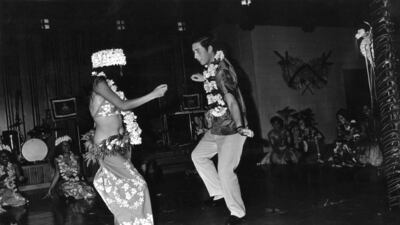
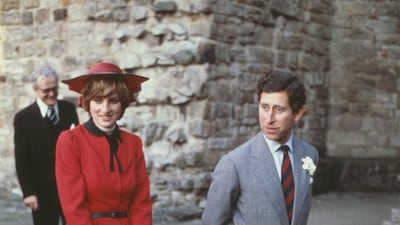
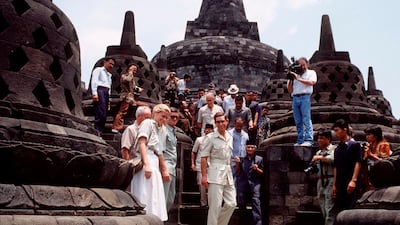
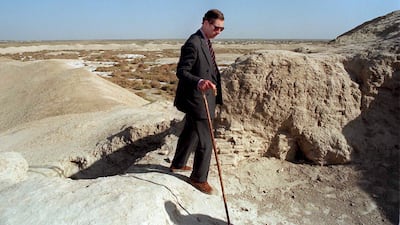
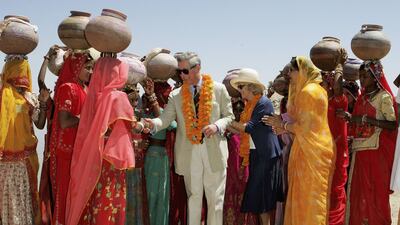
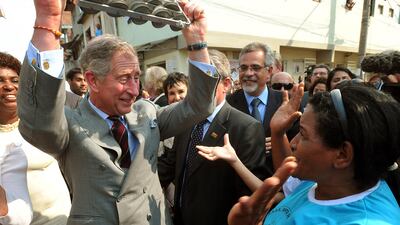
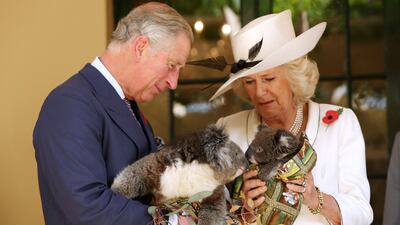
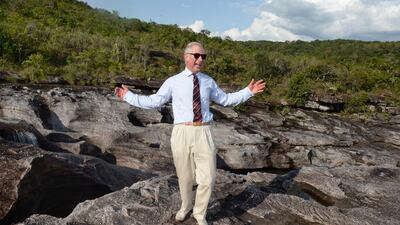
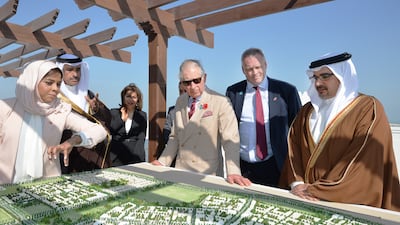
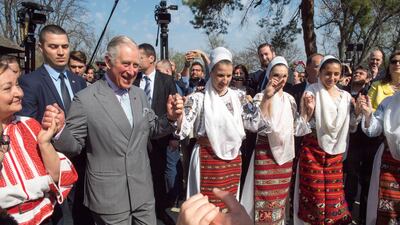
In pictures - Prince Charles's global tours
Student Of The Year 2
Director: Punit Malhotra
Stars: Tiger Shroff, Tara Sutaria, Ananya Pandey, Aditya Seal
1.5 stars
Five expert hiking tips
- Always check the weather forecast before setting off
- Make sure you have plenty of water
- Set off early to avoid sudden weather changes in the afternoon
- Wear appropriate clothing and footwear
- Take your litter home with you
Tamkeen's offering
- Option 1: 70% in year 1, 50% in year 2, 30% in year 3
- Option 2: 50% across three years
- Option 3: 30% across five years
The National in Davos
We are bringing you the inside story from the World Economic Forum's Annual Meeting in Davos, a gathering of hundreds of world leaders, top executives and billionaires.
More from Rashmee Roshan Lall
Some of Darwish's last words
"They see their tomorrows slipping out of their reach. And though it seems to them that everything outside this reality is heaven, yet they do not want to go to that heaven. They stay, because they are afflicted with hope." - Mahmoud Darwish, to attendees of the Palestine Festival of Literature, 2008
His life in brief: Born in a village near Galilee, he lived in exile for most of his life and started writing poetry after high school. He was arrested several times by Israel for what were deemed to be inciteful poems. Most of his work focused on the love and yearning for his homeland, and he was regarded the Palestinian poet of resistance. Over the course of his life, he published more than 30 poetry collections and books of prose, with his work translated into more than 20 languages. Many of his poems were set to music by Arab composers, most significantly Marcel Khalife. Darwish died on August 9, 2008 after undergoing heart surgery in the United States. He was later buried in Ramallah where a shrine was erected in his honour.
US tops drug cost charts
The study of 13 essential drugs showed costs in the United States were about 300 per cent higher than the global average, followed by Germany at 126 per cent and 122 per cent in the UAE.
Thailand, Kenya and Malaysia were rated as nations with the lowest costs, about 90 per cent cheaper.
In the case of insulin, diabetic patients in the US paid five and a half times the global average, while in the UAE the costs are about 50 per cent higher than the median price of branded and generic drugs.
Some of the costliest drugs worldwide include Lipitor for high cholesterol.
The study’s price index placed the US at an exorbitant 2,170 per cent higher for Lipitor than the average global price and the UAE at the eighth spot globally with costs 252 per cent higher.
High blood pressure medication Zestril was also more than 2,680 per cent higher in the US and the UAE price was 187 per cent higher than the global price.
Your rights as an employee
The government has taken an increasingly tough line against companies that fail to pay employees on time. Three years ago, the Cabinet passed a decree allowing the government to halt the granting of work permits to companies with wage backlogs.
The new measures passed by the Cabinet in 2016 were an update to the Wage Protection System, which is in place to track whether a company pays its employees on time or not.
If wages are 10 days late, the new measures kick in and the company is alerted it is in breach of labour rules. If wages remain unpaid for a total of 16 days, the authorities can cancel work permits, effectively shutting off operations. Fines of up to Dh5,000 per unpaid employee follow after 60 days.
Despite those measures, late payments remain an issue, particularly in the construction sector. Smaller contractors, such as electrical, plumbing and fit-out businesses, often blame the bigger companies that hire them for wages being late.
The authorities have urged employees to report their companies at the labour ministry or Tawafuq service centres — there are 15 in Abu Dhabi.
Other IPL batting records
Most sixes: 292 – Chris Gayle
Most fours: 491 – Gautam Gambhir
Highest individual score: 175 not out – Chris Gayle (for Royal Challengers Bangalore against Pune Warriors in 2013)
Highest strike-rate: 177.29 – Andre Russell
Highest strike-rate in an innings: 422.22 – Chris Morris (for Delhi Daredevils against Rising Pune Supergiant in 2017)
Highest average: 52.16 – Vijay Shankar
Most centuries: 6 – Chris Gayle
Most fifties: 36 – Gautam Gambhir
Fastest hundred (balls faced): 30 – Chris Gayle (for Royal Challengers Bangalore against Pune Warriors in 2013)
Fastest fifty (balls faced): 14 – Lokesh Rahul (for Kings XI Punjab against Delhi Daredevils in 2018)
Killing of Qassem Suleimani
Specs – Taycan 4S
Engine: Electric
Transmission: 2-speed auto
Power: 571bhp
Torque: 650Nm
Price: Dh431,800
Specs – Panamera
Engine: 3-litre V6 with 100kW electric motor
Transmission: 2-speed auto
Power: 455bhp
Torque: 700Nm
Price: from Dh431,800
UAE currency: the story behind the money in your pockets
WITHIN%20SAND
%3Cp%3EDirector%3A%20Moe%20Alatawi%3C%2Fp%3E%0A%3Cp%3EStarring%3A%20Ra%E2%80%99ed%20Alshammari%2C%20Adwa%20Fahd%2C%20Muhand%20Alsaleh%3C%2Fp%3E%0A%3Cp%3ERating%3A%203%2F5%3C%2Fp%3E%0A
Mercer, the investment consulting arm of US services company Marsh & McLennan, expects its wealth division to at least double its assets under management (AUM) in the Middle East as wealth in the region continues to grow despite economic headwinds, a company official said.
Mercer Wealth, which globally has $160 billion in AUM, plans to boost its AUM in the region to $2-$3bn in the next 2-3 years from the present $1bn, said Yasir AbuShaban, a Dubai-based principal with Mercer Wealth.
“Within the next two to three years, we are looking at reaching $2 to $3 billion as a conservative estimate and we do see an opportunity to do so,” said Mr AbuShaban.
Mercer does not directly make investments, but allocates clients’ money they have discretion to, to professional asset managers. They also provide advice to clients.
“We have buying power. We can negotiate on their (client’s) behalf with asset managers to provide them lower fees than they otherwise would have to get on their own,” he added.
Mercer Wealth’s clients include sovereign wealth funds, family offices, and insurance companies among others.
From its office in Dubai, Mercer also looks after Africa, India and Turkey, where they also see opportunity for growth.
Wealth creation in Middle East and Africa (MEA) grew 8.5 per cent to $8.1 trillion last year from $7.5tn in 2015, higher than last year’s global average of 6 per cent and the second-highest growth in a region after Asia-Pacific which grew 9.9 per cent, according to consultancy Boston Consulting Group (BCG). In the region, where wealth grew just 1.9 per cent in 2015 compared with 2014, a pickup in oil prices has helped in wealth generation.
BCG is forecasting MEA wealth will rise to $12tn by 2021, growing at an annual average of 8 per cent.
Drivers of wealth generation in the region will be split evenly between new wealth creation and growth of performance of existing assets, according to BCG.
Another general trend in the region is clients’ looking for a comprehensive approach to investing, according to Mr AbuShaban.
“Institutional investors or some of the families are seeing a slowdown in the available capital they have to invest and in that sense they are looking at optimizing the way they manage their portfolios and making sure they are not investing haphazardly and different parts of their investment are working together,” said Mr AbuShaban.
Some clients also have a higher appetite for risk, given the low interest-rate environment that does not provide enough yield for some institutional investors. These clients are keen to invest in illiquid assets, such as private equity and infrastructure.
“What we have seen is a desire for higher returns in what has been a low-return environment specifically in various fixed income or bonds,” he said.
“In this environment, we have seen a de facto increase in the risk that clients are taking in things like illiquid investments, private equity investments, infrastructure and private debt, those kind of investments were higher illiquidity results in incrementally higher returns.”
The Abu Dhabi Investment Authority, one of the largest sovereign wealth funds, said in its 2016 report that has gradually increased its exposure in direct private equity and private credit transactions, mainly in Asian markets and especially in China and India. The authority’s private equity department focused on structured equities owing to “their defensive characteristics.”