


Climate change could lead to widespread mortgage failures and uninsurable homes, and cost financial sector companies billions of pounds in reduced profits, Bank of England research published on Tuesday found.
In a worst-case scenario test run by the BoE, up to 45 per cent of UK mortgages could fail in places exposed to climate change, while finance sector companies would see a 15 per cent drag on annual profits.
The bank tested three scenarios for an economy tackling climate change by heading towards net zero emissions in 30 years — early coordinated action, late disorderly action and no action.
“Climate change will inevitably drive losses for banks and insurers, even in a scenario where governments around the world take swift and early action,” said Sam Woods, chief executive of the BoE’s Prudential Regulation Authority, which oversees banks and insurers.
The BoE found climate risks will become a persistent drag on banks’ and insurers’ profitability — particularly if they do not manage them effectively.
“While they vary across firms and scenarios, overall loss rates are equivalent to an average drag on annual profits of around 10-15 per cent,” Mr Woods said. “These are big numbers, and the limits of the exercise mean the actual impact could well be larger.”
Ratings body Fitch said the report would cause a readjustment in prices set by banks and insurers. “The severe design of the BoE test brings forward the full climatic effects of each scenario as an instantaneous shock, which makes it likely that some insurers will breach their solvency ratios,” it said. “In practice, we expect insurers to reprice their business and to steer their investment portfolios towards lower-risk sectors to reflect changing circumstances, and we believe they would be fairly resilient to the BoE scenarios if such management actions were taken into account.”
-
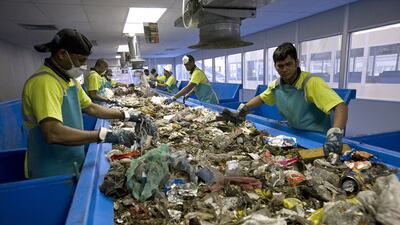
Workers sift through the rubbish from the Sharjah landfill to separate the recyclables. Jeff Topping / The National -

The UAE aims to recycle or reuse 75 per cent of municipal solid waste by the end of 2021. Silvia Razgova / The National -

Organisers and volunteers fill bags with used water bottles, old cans, bits of wood and a huge haul of plastic rubbish as they work their way along Hameem Beach in Al Dhafra. Delores Johnson / The National -
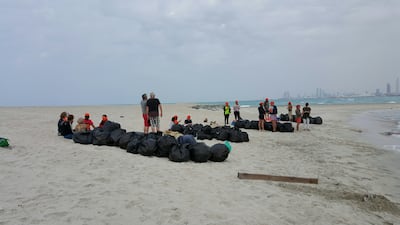
Every year the Netherlands embassy in Abu Dhabi, together with the Consulate General in Dubai, organises a teambuilding event. This was a beach clean-up in which 100 bags of rubbish were filled. Photo: Embassy of the Netherlands in Abu Dhabi -
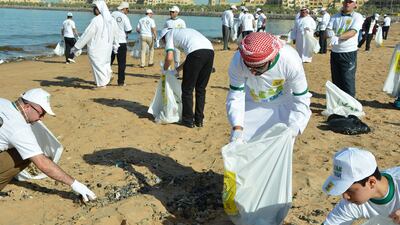
Two tonnes of waste were collected by hundreds of volunteers for the 14th Clean Up UAE by the Emirates Environmental Group. The National -

More from Clean Up UAE. Photo: Emirates Environmental Group -
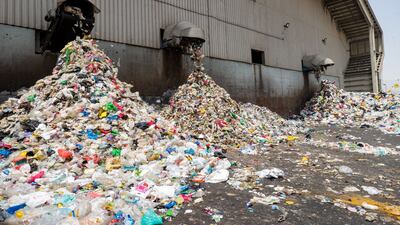
Solid waste bound for landfill at the Bee'ah waste management complex in Sharjah. The UAE is building one of the world’s largest waste-to-energy plants to process its growing amount of rubbish. Christopher Pike / Bloomberg -
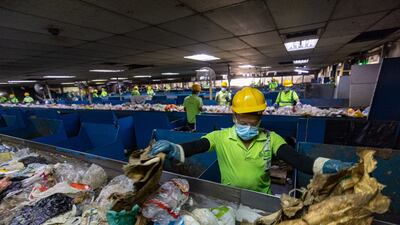
Workers sort solid waste material at the Bee'ah waste management complex in Sharjah. Christopher Pike / Bloomberg


While the sector would reel in the worst-case scenario, the effects of no action are also felt by people and individual homeowners.
“We would see a reduction in access to lending and insurance for so-called ‘climate vulnerable’ sectors and households … Homes at risk of flooding would likely become prohibitively expensive to insure or borrow against,” Mr Woods said.
“Like so many of the impacts of climate change, this cost would be borne unequally: 45 per cent of the mortgage impairments in the scenario are accounted for by just 10 per cent of the country.
“And there is evidence that in areas particularly at risk of flooding, many homes could become uninsurable.”

In the worst-case scenario, where climate change is allowed to proceed unchecked, insurers would have to absorb £210 billion of costs.
Costs would also carry on rising beyond the 30 years of experiment whereas in the other two scenarios climate change expenses would be largely under control.
Losses were lowest if policymakers took “early action” to curtail climate change, boosting the cost of carbon emissions and resulting in a relatively small increase in global temperatures. Under that scenario, the hit to banks would be under £100 billion and insurers just over that level.
“Broadly speaking, the first two scenarios focus on risks from the transition to net zero, whereas the third one focuses on physical risks from climate change,” Mr Woods said. “The risks from climate change have been managed by the end of the first two scenarios — whereas in the third they continue to build.”
With no action, costs are continuing
In the early action scenario, climate change is successfully limited to 1.8°C by the end of the 30 years’ test and then starts falling.
In the late action test, global warming was limited to 1.8°C by the end of the scenario but did not then fall.
In the no action test, global temperature levels continued to increase, reaching 3.3°C higher relative to pre-industrial levels by the end of the test.
“No action on climate delivers the worst outcome from our scenarios,” Mr Woods said.
“Under both the late action and early action scenarios, climate change has broadly been brought under control by the end of the 30-year period.
“By contrast, with no additional action the impacts will persist well beyond the 30 years of our scenario — incurring substantial economic costs not captured in these estimates.”
HSBC Holdings Plc, Barclays Plc, HSBC, Lloyds Banking Group and Nationwide Building Society were among the banks participating. Insurers included Aviva, Legal & General, Allianz, Direct Line and AIG. The BoE did not release the results for individual firms.
The projections also suggest banks and insurers will pass a significant portion of the cost to their customers.

