


British Airways has offered £1,000 “welcome bonuses” to cabin crew with security clearances after staff shortages led to delays, cancellations and queues of frustrated passengers at airports.
Airlines and airports have been struggling with staffing problems caused by coronavirus related sicknesses and an increase rise in passenger numbers.
In a new recruitment campaign, it is offering cash incentives to cabin crew “who hold a current Heathrow or Stansted airside ID”.
“For candidates who are successfully offered a role through this campaign, we’re offering a welcome bonus of £1,000 — paid in two instalments — £500 after your first three months, £500 after six months in role,” the advertisement said.
Carriers and airports are struggling to recruit more staff because of delays in processing security checks, which can take up to 15 weeks.
Heathrow Airport has advertised for 12,000 more staff as passengers have faced long delays and chaos over the Easter holidays. It has also drafted in staff from across the UK to ease the backlog.
Travel industry analysts expect the situation will get worse at the height of the Easter getaway as thousands head to airports on Good Friday.
More than 20,000 people have been affected by cancellations so far, British Airways and easyJet have accounted for three-quarters of all flights affected last week.
British Airways has stipulated that recruits must be able to start work before the summer to be eligible for the cash incentive.
“Applicants with a notice period or other circumstances which prevents them from being able to commence training before July 2022 may not be eligible for the welcome bonus,” it said.
The staffing crisis arose after thousands of airline staff were put out of work during the pandemic.
Now, the rapid rise in travel volumes has put pressure on airports and the carriers that use them to prepare for operations after two years of stop-and-start business.
Good Friday is likely to be the busiest day of Easter, with 2,430 flights scheduled to leave the UK and more than 9,000 to fly over the bank holiday weekend.
-
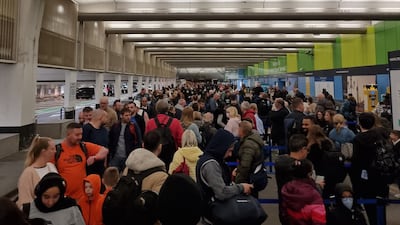
Queues at Manchester Airport on Thursday morning. Bosses at Heathrow and Manchester airports are braced for a nightmare weekend as staff shortages look likely to hamper what is expected to be the travel industry’s busiest day of the year to date. Photo: Richard James -
A busy Manchester Airport on Tuesday morning. Photo: Megan Thwaites / Twitter -
Long queues of passengers snaked around Heathrow Airport in London. Photo: Jessica Oliver / Twitter -
Manchester Airport, as seen on Monday morning, is hit by setbacks as the busy holiday season kicks off. Photo: Gareth Melling's Twitter -
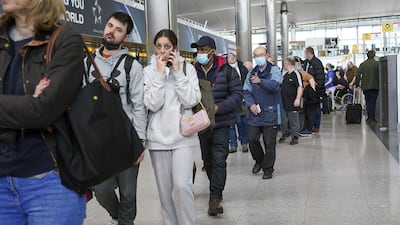
People queuing to go through security at Heathrow Terminal 2. PA -
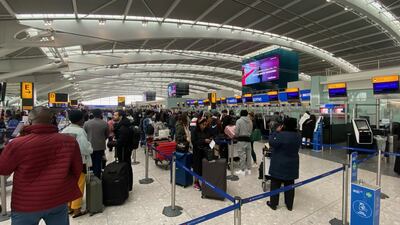
People queue to check-in at Heathrow Terminal 5. PA -
One passenger at the airport said it took two hours to clear check-in at Manchester Airport. Photo: Luke Maher's Twitter -
Queues at Manchester Airport's Terminal 2. Photo: @LancsHT/Twitter -
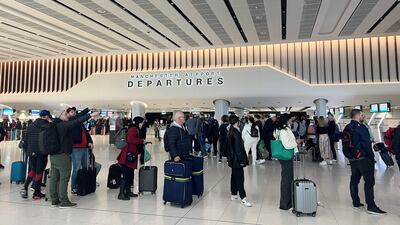
Passengers queue for security screening in the departures area of Terminal 2 at Manchester Airport. Reuters -
Heathrow Airport's Terminal 2 is crammed with people Photo: Twitter -
One passenger said it took three and a half hours to check in a single suitcase. Photo: Martin Duggan's Twitter -
Passengers wait at border control of Heathrow Terminal 2. Photo: Martin Duggan's Twitter -
A packed Heathrow Terminal 2 check-in hall. Photo: Twitter -
Passengers shared photos showing corridors packed with people. Photo: Twitter -
Arrivals queue at Heathrow Airport. Photo: Sven Kili's Twitter


Heathrow said it expects summer travel season 2022 at its peak to approach 2019 levels.
EasyJet's chief executive Johan Lundgren said the airline is waiting for the Department for Transport to give permission for about 100 members of staff to start work.
EasyJet has cancelled hundreds of flights in recent days, mainly on routes serving Gatwick Airport in West Sussex.
Mr Lundgren said this was primarily the result of high levels of coronavirus-related staff absences but also blamed the time it takes for the government to vet recruits.

“There’s a backlog there and we’re waiting currently for about 100 cabin crew to get their IDs,” he said.
“There’s a three-week delay on that. That has had an impact. If that would have been on time, we would have seen less cancellations.”
The government denied there are delays.
“There are absolutely no delays to security vetting of applicants,” it said.
“It is wrong to suggest otherwise, and we are prioritising vetting applications from the aviation industry.
“It is for the aviation industry to manage resourcing at airports and staff absences, especially at busy times of the year.”
British Airways through the years – in pictures
-

British Airways has been flying for over 100 years. It was founded as Aircraft Transport and Travel Limited in 1919. All photos: Getty Images -
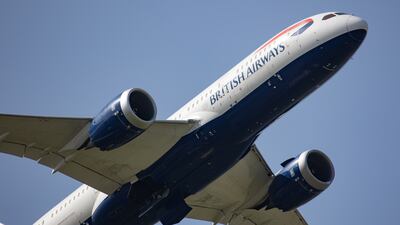
A British Airways Boeing 787 Dreamliner aircraft taking off in 2021 -
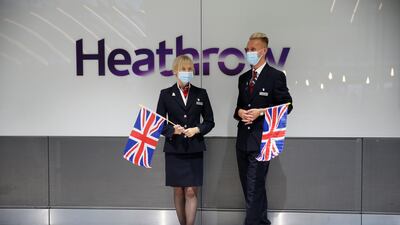
British Airways employees welcome Olympians returning from the Tokyo Olympics at Heathrow Airport in August 2021 -
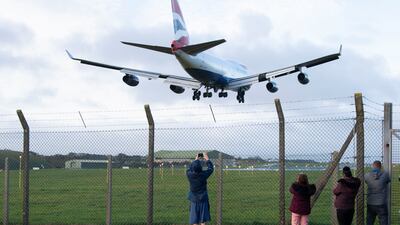
A British Airways Boeing 747-400 aircraft arrives at St Athan Airport in Wales in 2020, after setting off for its last flight -
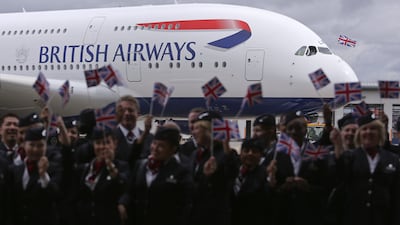
A British Union flag flies from the cockpit of a new Airbus A380 aircraft after landing at Heathrow Airport in 2013 -
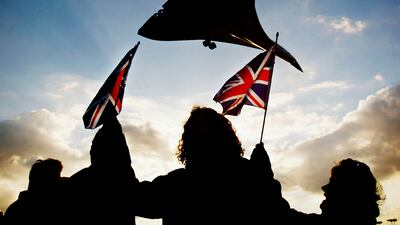
Spectators watch as the last Concorde lands at Heathrow Airport in 2003 -

British Airways Concordes at Glasgow Airport in 1983 -
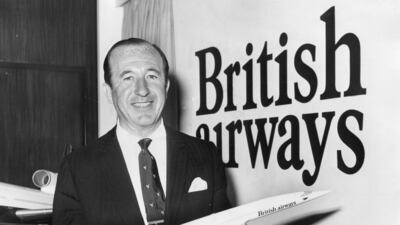
David Nicholson, the first chairman of British Airways after the merger of a number of UK airlines, proudly displays a model of the Concorde in 1973 -
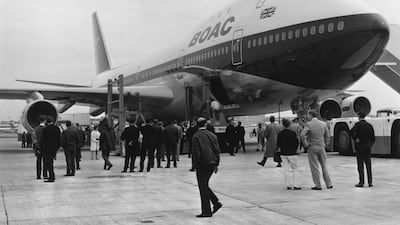
The first Boeing 747 to be operated by the British Overseas Airways Corporation arrives at Heathrow Airport in May 1970 -
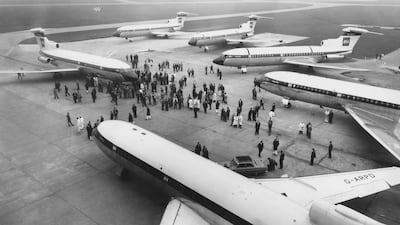
Hawker Siddeley HS 121 Trident 1C medium-range commercial jets for British European Airways at de Havillands Hatfield Aerodrome in 1963 -

A British Overseas Airways Corporation Comet III aircraft on display at Farnborough in 1954. The British Overseas Airways Corporation was formed in April 1940 -
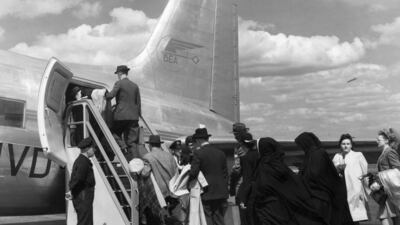
Passengers queuing to board a British European Airways Vickers Viking aircraft in 1950 -
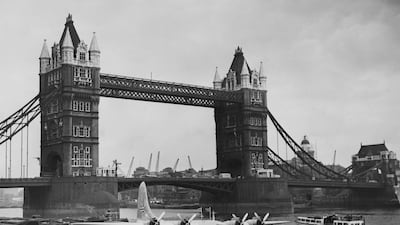
The British Overseas Airways Corporation Short Solent passenger flying boat docks at her new berth near Tower Bridge in London in 1949 -
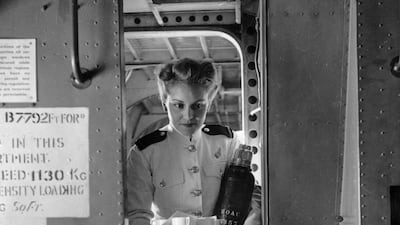
A British Overseas Airways Corporation air stewardess brings a tray of coffee to passengers during a Second World War flight in 1945 -
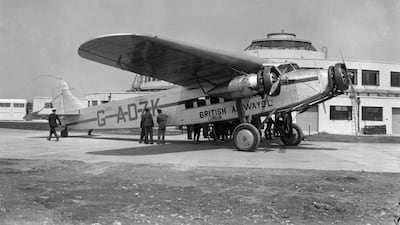
A British Airways passenger aircraft at Gatwick Airport in 1936 -
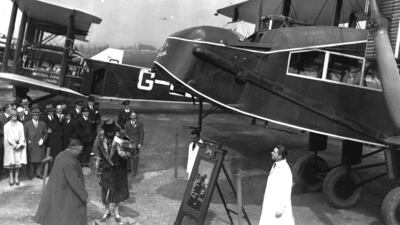
Four Handley Page W10 and one Handley Page W9 Hampstead aircraft operated by Imperial Airways are christened by Lady Maud Hoare, Viscountess Templewood, at Croydon Aerodrome in 1926. Imperial Airways was created in 1924



