


Police in Italy have seized a €600,000 ($668,470) armoured car belonging to Russian oligarch Alisher Usmanov.
The bulletproof black Mercedes Maybach S650 Guard VR10 was impounded by officers in Sardinia as they enforced EU sanctions.
The Uzbek-born mining magnate, who was once named as the richest person in the UK, has already lost a €17 million villa in Sardinia and six companies worth €66 million.
Mr Usmanov, whose net worth is an estimated $18.4 billion, bought the car, which is also designed to protect against gas attacks, in 2018.
The Italian press have hinted that the car may have been used to transport Russian President Vladimir Putin whilst on visits to Sardinia.
Earlier this month the UK sanctioned Mr Usmanov, citing his close links to Mr Putin, and froze his assets and imposed a travel ban.
"Our message to Putin and his allies has been clear from day one – invading Ukraine would have serious and crippling economic consequences," Britain's Foreign Secretary Liz Truss said.
"Sanctioning Usmanov sends a clear message that we will hit oligarchs and individuals closely associated with the Putin regime and his barbarous war. We won’t stop here. Our aim is to cripple the Russian economy and starve Putin’s war machine."

Mr Usmanov had significant interests in English football clubs Arsenal and Everton and he owns Beechwood House in Highgate, worth an estimated £48 million ($63.13 million), and the 16th-century Sutton Place estate in Surrey.
He is the founder of USM Holdings, which works in sectors including extractives and telecoms. The company sponsors Everton football club's training ground.
He paid the club £30 million in January 2020 to secure an exclusive option on naming rights for its proposed new stadium at Bramley-Moore Dock, which is scheduled to be completed by 2023.
The deal has been suspended with the club saying it was “shocked and saddened by the appalling events unfolding in Ukraine".
He previously owned a 30 per cent stake in Arsenal which he relinquished in 2018.
-

Two superyachts linked to Russian billionaire Roman Abramovich were spotted on the Turkish coast on Tuesday, 'Eclipse' and 'My Solaris'. Mr Abramovich is among several wealthy Russians added to an EU blacklist as governments act to seize their yachts and other luxury assets. AP -

'My Solaris', a superyacht linked to sanctioned Russian oligarch Roman Abramovich, is pictured in Bodrum, south-west Turkey. Reuters -
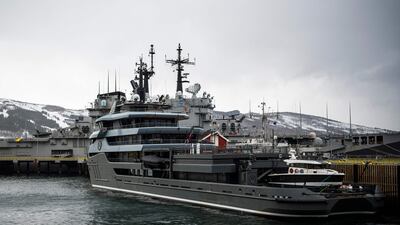
A 68-metre luxury yacht called 'Ragnar', owned by a former KGB officer Vladimir Strzhalkovsky, is pictured at the quay in Narvik, north Norway. AFP -
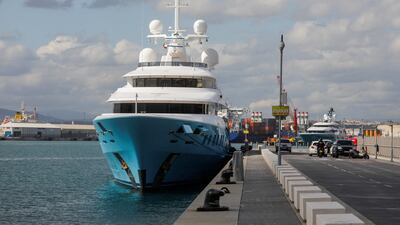
The 'Axioma' superyacht belonging to Russian oligarch Dmitrievich Pumpyansky at a port in Gibraltar. Reuters -

'Crescent', which is believed to belong to Russian oligarch Igor Sechin, is seen docked at Marina Port Tarraco in Tarragona, Spain. Reuters -
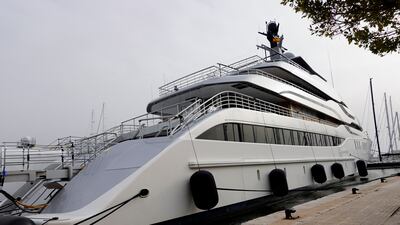
The yacht 'Tango', owned by Russian billionaire Viktor Vekselberg, at Palma de Mallorca Yacht Club on the Spanish island of Mallorca. Reuters -
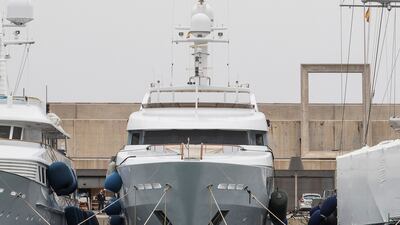
The 48m long, St Vincent and the Grenadines-flagged yacht 'Lady Anastasia', owned by Alexander Mijeev, moored at a dock in Mallorca. AFP -

Superyacht 'Valerie', linked to chief of Russian state aerospace and defence conglomerate Rostec Sergei Chemezov, at Barcelona Port in Spain. Reuters -
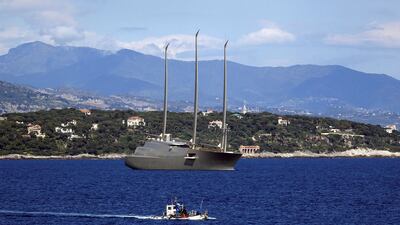
The 142.81m sail-assisted motor yacht 'Sailing Yacht A', owned by Russian tycoon Andrey Melnichenko, in front of Monaco harbour. Reuters -

'Dilbar', a luxury yacht owned by Russian billionaire Alisher Usmanov, sails in the Bosphorus in Istanbul, Turkey. Reuters -
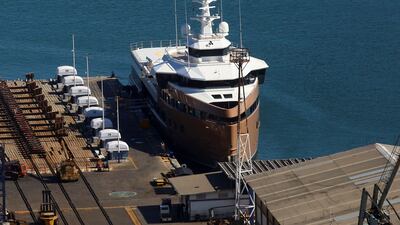
'La Datcha', owned by Russian businessman Oleg Tinkov, docked at the port in Ensenada, Mexico. Reuters -
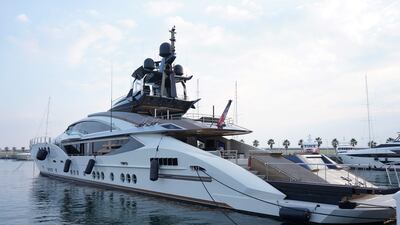
'Lady M', owned by Russian oligarch Alexei Mordashov, docked at Imperia's harbour. AFP -
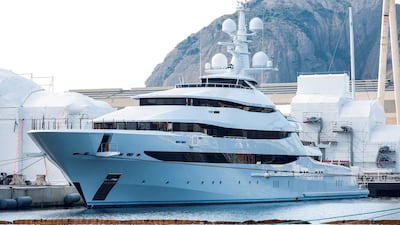
Superyatch 'Amore Vero,' which French authorities have said is linked to Rosneft's CEO Igor Sechin, is seen at La Ciotat Port near Marseille in France. Reuters -

'Quantum Blue', Russian billionaire Sergei Galitsky's yacht, docked in the port of Monaco. AFP -

The world's largest expedition yacht, 'Luna', owned by Roman Abramovich, at the port of Sibenik in Croatia. Shutterstock -
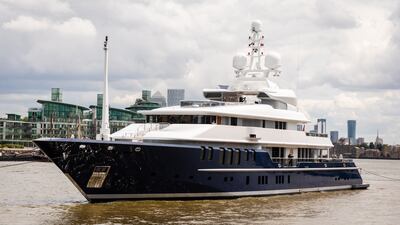
The luxury 68m superyacht 'Triple Seven,' owned by Alexander Abramov, on the River Thames in London. EPA


Earlier this month, Mr Usmanov’s $594m superyacht Dilbar, the world’s largest by volume, was seized by German authorities in Hamburg.
On Monday, the UK seized the first Russian-owned superyacht in its waters since announcing sanctions against more than 1,000 individuals and businesses.
The £38 million yacht, Phi, was first identified as belonging to a Russian oligarch on March 13, the government said.
The sanctions are aimed at helping to end the war in Ukraine.

