


Update: Top Russian airborne commander killed in Ukraine in further blow to Putin
A leading Russian battlefield commander has been killed and two Russian security officials have been placed under house arrest as reverses appear set to trigger a purge of intelligence officials.
The setbacks for Russia on Friday were capped by reports Maj Gen Andrei Kolesnikov, commander of the Russian 29th Army, had been killed in action. He is the third general to have died since the invasion, with security officials suggesting that more senior officers were going to the front line to give impetus to stalled attacks.
The development came alongside what could be the start of a purge in the Federal Security Service (FSB), with western security officials suggesting “significant changes” had begun following Russia’s intelligence failures in Ukraine.
Col Gen Sergei Beseda, head of the foreign intelligence branch of the FSB, the Fifth Service, was arrested alongside his deputy, Anatoly Bolyukh, a tweet from Andrey Soldatov, a well-regarded writer on the Russian security services, said.
The pair are understood to have provided key intelligence on Ukraine’s reaction to a Russian invasion and reportedly suggested the assault would be swift and successful.
If they have been detained, western security officials said it means President Vladimir Putin is “seriously concerned” about the flawed intelligence on Ukraine.
“Both men have played a major role in intelligence operations against Ukraine for several years and highly likely played a major role in the planning for the invasion of Ukraine,” a western official said in a press briefing.
“If the claims of arrest are correct, this would indicate that Putin is seriously concerned about the FSB, its role in the military campaign and there could be significant changes at senior levels in the FSB.”

It is claimed that Col Gen Beseda, 68, was arrested for providing flawed intelligence before the invasion and for the misuse of funds allocated to subversive operations.
The FSB’s Fifth Service is the organisation that gave Mr Putin information on the political situation in Ukraine, which may have suggested that the Kyiv government would rapidly collapse and be easily replaced with Russian puppets.
The officer’s unit is part of the Department of Operative Information (DOI) and is referred to officially as the Service of Operational Information and International Relations. It is effectively the FSB’s foreign intelligence branch that usually operates in countries along Russia’s borders.
Western officials say Mr Bolyukh was head of the DOI Directorate.
-
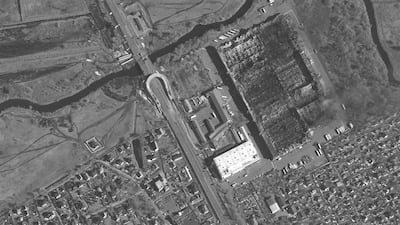
This satellite image provided by Maxar Technologies shows destroyed and burning warehouse buildings in Stoyanka, Ukraine, in the western Kyiv region, during the Russian invasion. AP -
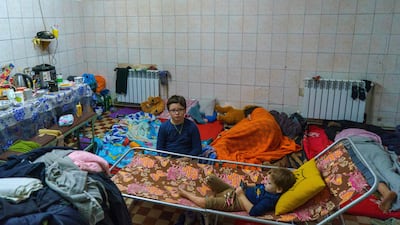
Children shelter in a metro station in Kharkiv. Moscow said on March 10, 2022, that it will open daily humanitarian corridors to allow civilians fleeing fighting in Ukraine to reach Russian territory, despite Kyiv insisting that no evacuation routes should lead to Russia. AFP -
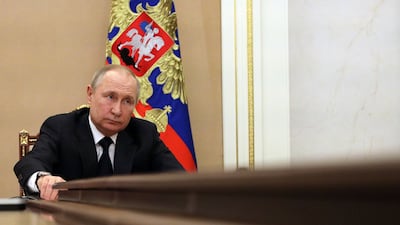
Russian President Vladimir Putin during a videoconference meeting with government members at the Kremlin in Moscow. The meeting focuses on minimising the effects of sanctions on the Russian economy. Russian troops entered Ukraine on February 24, prompting the country's president to declare martial law and triggering a series of severe economic sanctions imposed by western countries. EPA -
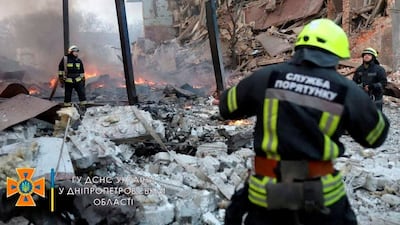
Rescuers work among remains of buildings damaged by an air strike in Dnipro, Ukraine, as Russia's attack on the country continues. Reuters -

Members of the National Guard of Ukraine, Oleksandr and Olena, listen to a priest at their wedding in Ukraine. Reuters -

People fleeing Russia's invasion of Ukraine warm up by a fire near the train station in Lviv, Ukraine. Reuters -
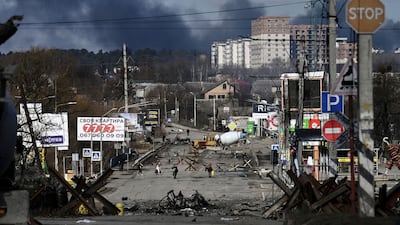
Russian forces rolled their armoured vehicles up to the northeastern edge of Kyiv, edging closer in their attempts to encircle the Ukrainian capital. AFP -
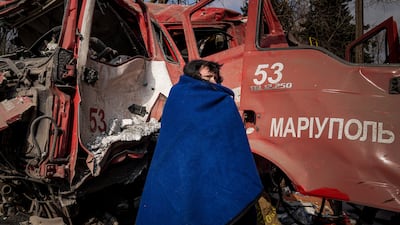
A woman covers herself with a blanket near a damaged fire truck after shelling in Mariupol, Ukraine. AP Photo -

A Ukrainian soldier hides from a helicopter air strike near Demydiv, Ukraine. Reuters -
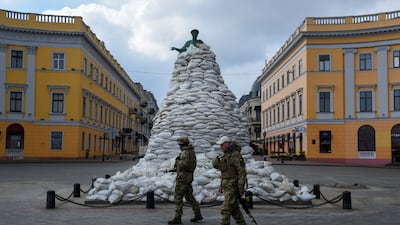
Ukrainian soldiers walk past a monument of the city founder Duke de Richelieu, covered with sand bags for protection, in Odessa, Ukraine. Reuters -
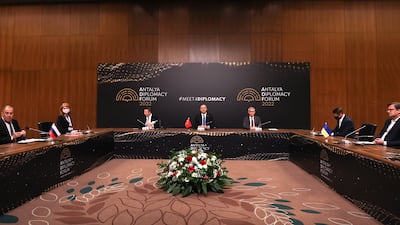
Russian Foreign Minister Sergey Lavrov, left, Turkish Foreign Minister Mevlut Cavusoglu, centre, and Ukranian Foreign Minister Dmytro Kuleba. EPA -
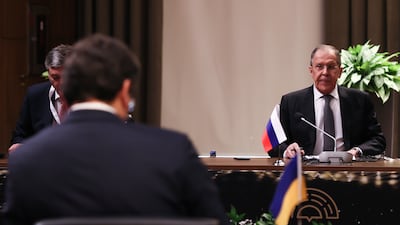
Russian Foreign Minister Sergey Lavrov in talks with Ukrainian counterpart Dmytro Kuleba during a tripartite meeting chaired by Turkish Foreign Minister Mevlut Cavusoglu, in Antalya, Turkey. AP -
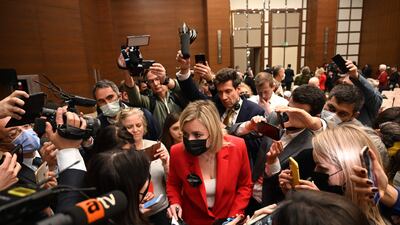
Russian Foreign Ministry spokeswoman Maria Zakharova speaks to the media as the foreign ministers of Ukraine, Russia and Turkey hold talks in Antalya, 15 days after Russia launched a military invasion on Ukraine. AFP -
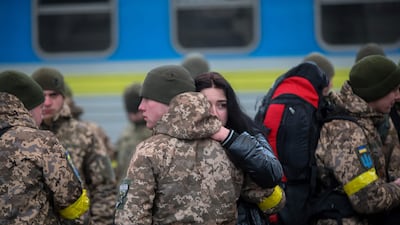
A Ukrainian serviceman says goodbye to his girlfriend before departing in the direction of Kyiv at the central train station in the western Ukrainian city of Lviv. AFP -
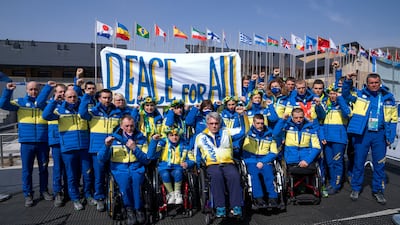
Valerii Sushkevych, president of the Ukraine National Paralympic Committee, and the Ukraine delegation raise their fists and pose with a banner at the Beijing 2022 Winter Paralympic Games. Reuters -

A member of the Ukrainian team cries during a moment of silence at the Zhangjiakou athletes village during the Beijing 2022 Winter Paralympic Games. AFP -
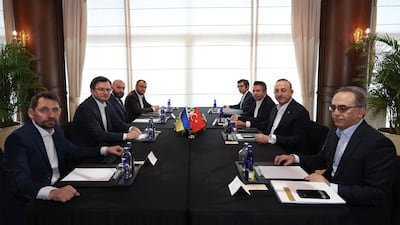
Turkish Foreign Minister Mevlut Cavusoglu, right, and Ukraine Foreign Minister Dmytro Kubela, second left, in Antalya, Turkey. AFP -
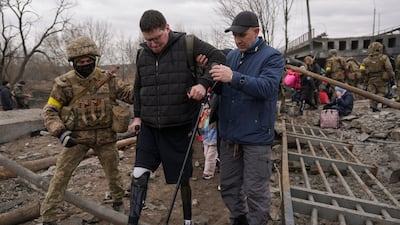
A man is supported after crossing the Irpin river while fleeing the town of Irpin, Ukraine. AP -
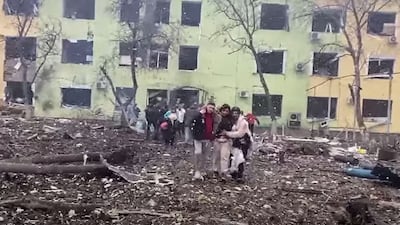
People are helped out of a damaged children's hospital following a Russian air strike in the southeastern city of Mariupol, Ukraine. AFP -

A man rides a bicycle in front of an apartment building that was damaged by shelling in Mariupol. AP -
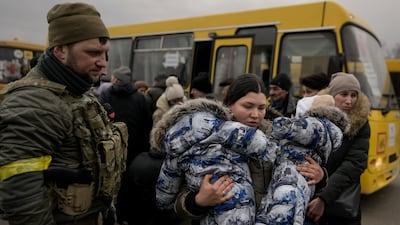
A woman carries two babies after arriving at a triage point in Kyiv, Ukraine. AP -
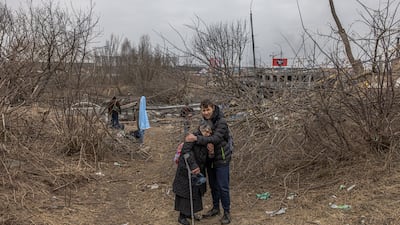
A man hugs an elderly woman after crossing a damaged bridge as they flee from the frontline town of Irpin, near the Ukrainian capital of Kyiv. EPA -
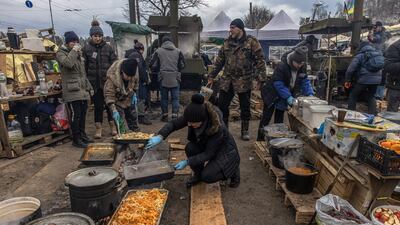
Local residents cook at a makeshift camp next to a checkpoint in Kyiv. EPA -
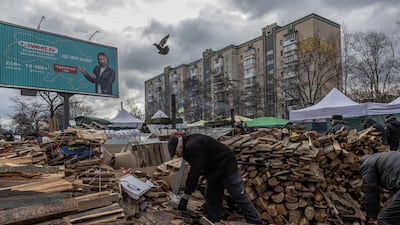
Ukrainian men chop wood at a makeshift camp next to a checkpoint in Kyiv. EPA -

A member of the Territorial Defence Forces learns how to use a Javelin missile during a training session in Kyiv. EPA -
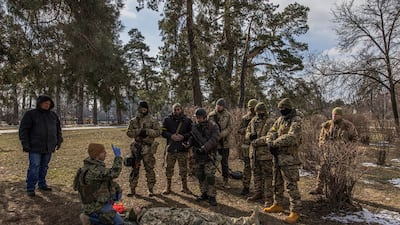
Members of the Territorial Defence Forces learn how to give first aid during the training session. EPA -
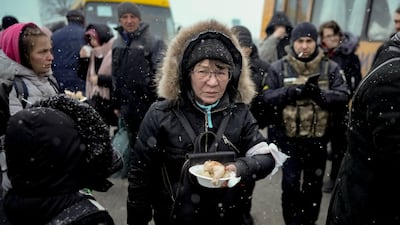
A woman rescued from the outskirts of Kyiv holds a plate of food after arriving at a triage point in the Ukrainian capital. AP -
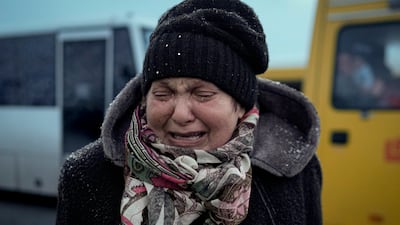
A woman cries after arriving at the triage point in Kyiv. AP -
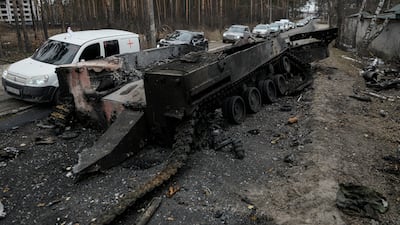
Civilian vehicles drive past a destroyed Russian tank as they leave Irpin. AP -
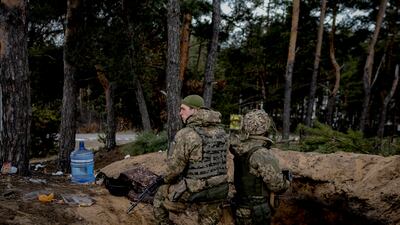
Ukrainian servicemen stand in a foxhole in Irpin. AP -
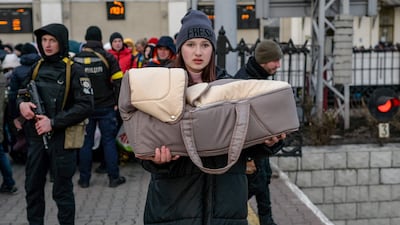
People gather on a platform to board a train leaving Odesa after the US said Russian troops are making preparations to attack the city. AFP -
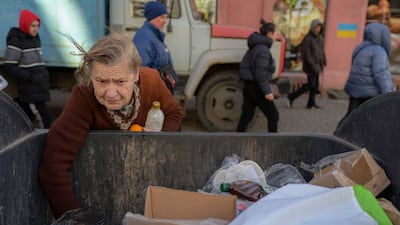
A Ukrainian woman looks for food in a bin in Odesa's city centre. AFP -
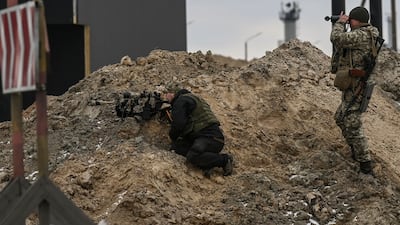
Ukrainian servicemen look towards Russian positions outside the city of Brovary, east of Kyiv. AFP -
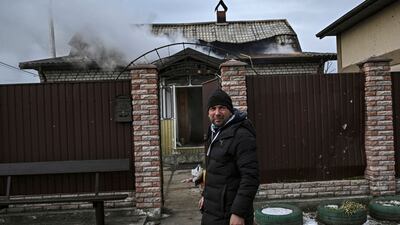
A man walks past a shelled house at the village of Velyka Dymerka, east of Kyiv. AFP -
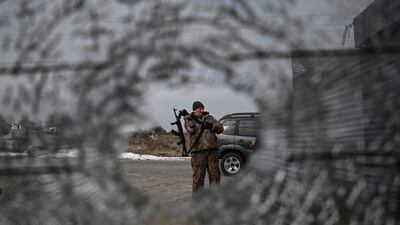
A Ukrainian serviceman stands at a check point in the vilage of Velyka Dymerka east of Kyiv. AFP -
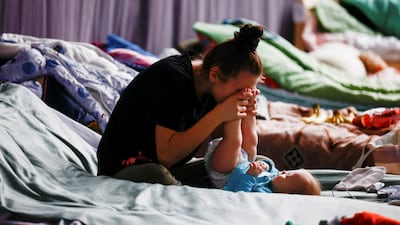
A Ukrainian woman plays with her child in a temporary refugee shelter in Przemysl, Poland. Reuters -

A woman waits outside a maternity and children's hospital damaged by shelling in Mariupol, Ukraine. AP -
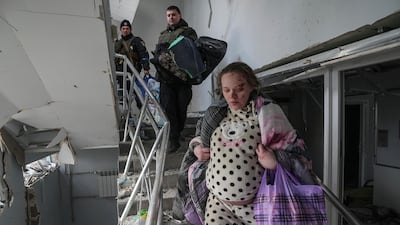
A pregnant woman leaves the hospital after she was wounded when it was bombed. AP -
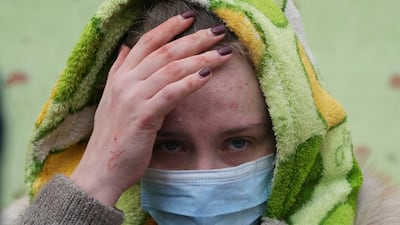
A woman waits outside the damaged hospital in Mariupol. AP -
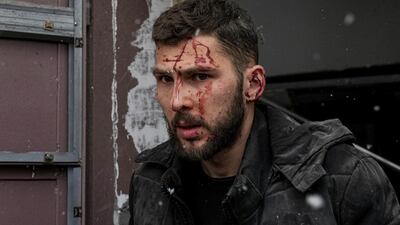
A man wounded by shelling in Mariupol. AP -
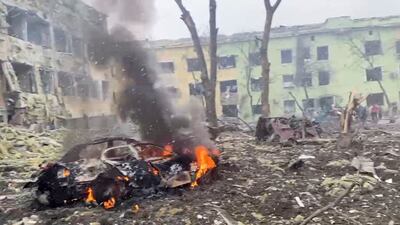
A car burns after the destruction of the children's hospital in Mariupol. Reuters -
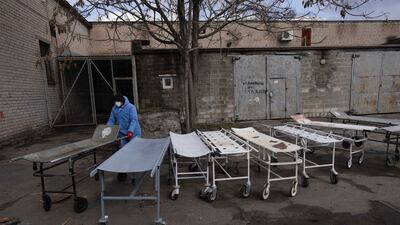
A mortuary worker wheels a stretcher used to move dead bodies before they are buried on the outskirts of Mariupol. AP


There are understood to be 20 generals of the same rank commanding divisions and other units in the Ukraine.
Losing 15 per cent of its most senior commanders two weeks into an invasion is highly unusual and is likely to have an impact on morale and well as operational co-ordination.
Western officials also agreed with the estimate that between 5,000 and 6,000 Russian soldiers had been killed since 24 February.
They added that there were now “significant morale issues in the Russian forces”, as combat in austere conditions stretches into its third week.

