Photo: PA
Photo: PA
Photo: PA
Photo: PA

UK government faces ‘burning deadline’ to keep energy bills down


Soraya Ebrahimi
  • English
  • Arabic

The UK government has a “burning deadline” in the next three weeks to decide how to offset a large rise in household energy bills, the boss of an energy company has said.

Bills could go up by more than 50 per cent for millions of customers, a rise that could cost average households about £700 per year.

“To some extent their burning deadline is the day that the new level of the price cap gets announced … because that’s when you would think that it becomes obvious they are going up,” said Good Energy boss Nigel Pocklington.

Estimates range but some believe the price cap could be raised to around £2,000 for the average household, from £1,277 today.

“You absolutely need to be concerned for vulnerable households and homes and families that will be put into fuel poverty,” Mr Pocklington said.

“There’s this odd fact of life around your energy bill. You can’t avoid it and yes, there’s a bit of difference in consumption between wealthier households and those that are less well off.

“But it’s not huge, and therefore it’s a form of strangely regressive taxation in some respects. The duke and the dustman, as they used to say, are paying the same per unit cost.”

The government has several options on how to offset the energy price rises and protect households across the country.

They range from cutting the 5 per cent VAT on energy bills – a £100 saving – getting rid of some levies on energy bills, and expanding the warm home discount.

Many energy companies have also suggested that if the government got banks to lend between £10 billion to £20 billion to energy companies, the firms could smooth the price rise.

They could use the loans to top up energy bills, and instead charge customers a little bit more over several years to recoup the cost.

But the idea has been criticised by some companies. Bills are likely to remain high for years, so the loans could take a long time to pay back, they say.

The idea’s critics include British Gas’s owner Centrica, which called it a “bailout” earlier this month.

However, Mr Pocklington said it was wrong to call the loans a bailout of energy companies, as they will need to be paid back.

The loans would be used to support customers, so their energy bills do not increase by more than 50 per cent from April.

He said the risk of bailing out energy companies that were badly run has subsided because most of those have gone out of business in recent months because of the crisis.

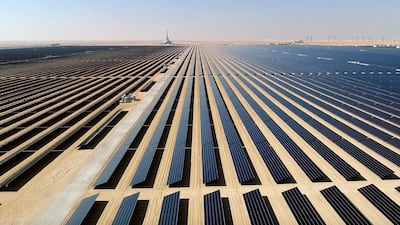
  • The Mohammed bin Rashid Al Maktoum Solar Park is located about 50 kilometres south of Dubai. AP
    The Mohammed bin Rashid Al Maktoum Solar Park is located about 50 kilometres south of Dubai. AP
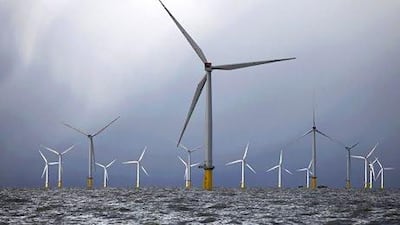
  • Masdar, the Abu Dhabi clean energy company, owns a one-fifth stake in London Array, the offshore wind farm in the Thames estuary. Chris Ratcliffe / Bloomberg News
    Masdar, the Abu Dhabi clean energy company, owns a one-fifth stake in London Array, the offshore wind farm in the Thames estuary. Chris Ratcliffe / Bloomberg News
  • A hydro plant in Himachal Pradesh, India. Photo: Abu Dhabi National Energy Company (TAQA)
    A hydro plant in Himachal Pradesh, India. Photo: Abu Dhabi National Energy Company (TAQA)
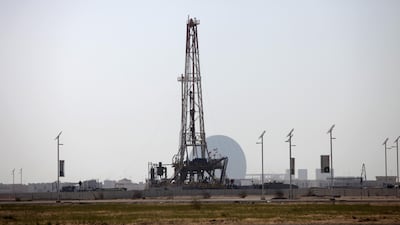
  • The Geothermal Pilot Project drills 4km beneath Masdar City in search of boiling temperatures to generate electricity and fuel the city's cooling system. Nicole Hill /The National
    The Geothermal Pilot Project drills 4km beneath Masdar City in search of boiling temperatures to generate electricity and fuel the city's cooling system. Nicole Hill /The National
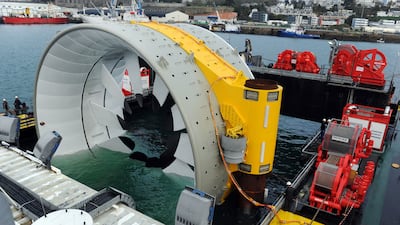
  • A hydroelectric motor at a tidal farm in the harbour of Brest, in western France. AFP
    A hydroelectric motor at a tidal farm in the harbour of Brest, in western France. AFP

“There is not a significant moral hazard here. I think anyone who’s still operating in this market is prudently run, and knows what they’re doing, otherwise they would have been knocked over by now.

“We all have the choice in front of us just to keep pushing our prices up to cover the cost of the wholesale market. And that’s the one lever we’ve got.

“No one can expect us not to do that unless there’s some sort of intervention to smooth out those increases.”


RESULTS

2.30pm Jaguar I-Pace – Conditions (PA) Dh80,000 (Dirt)
1,600m 

Winner Namrood, Antonio Fresu (jockey), Musabah Al Muhairi
(trainer) 

3.05pm Land Rover Defender – Maiden (TB) Dh82,500 (D)
1,400m 

Winner Shadzadi, Tadhg O’Shea, Bhupat Seemar 

3.40pm Jaguar F-Type – Maiden (TB) Dh82,500 (Turf) 1,600m 

Winner Tahdeed, Fernando Jara, Nicholas Bachalard 

4.15pm New Range Rover – Handicap (TB) Dh87,500 (D) 1,400m 

Winner Shanty Star, Richard Mullen, Rashed Bouresly 

4.50pm Land Rover – Handicap (TB) Dh95,000 (T) 2,400m 

Winner Autumn Pride, Bernardo Pinheiro, Helal Al Alawi 

5.25pm Al Tayer Motor – Handicap (TB) Dh95,000  T) 1,000m 

Winner Dahawi, Antonio Fresu, Musabah Al Muhairi 

6pm Jaguar F-Pace SVR – Handicap (TB) Dh87,500 (D) 1,600m 

Winner Scabbard, Sam Hitchcock, Doug Watson  

UAE SQUAD FOR ASIAN JIU-JITSU CHAMPIONSHIP

Men’s squad: Faisal Al Ketbi, Omar Al Fadhli, Zayed Al Kathiri, Thiab Al Nuaimi, Khaled Al Shehhi, Mohamed Ali Al Suwaidi, Farraj Khaled Al Awlaqi, Muhammad Al Ameri, Mahdi Al Awlaqi, Saeed Al Qubaisi, Abdullah Al Qubaisi and Hazaa Farhan

Women's squad: Hamda Al Shekheili, Shouq Al Dhanhani, Balqis Abdullah, Sharifa Al Namani, Asma Al Hosani, Maitha Sultan, Bashayer Al Matrooshi, Maha Al Hanaei, Shamma Al Kalbani, Haya Al Jahuri, Mahra Mahfouz, Marwa Al Hosani, Tasneem Al Jahoori and Maryam Al Amri

Groom and Two Brides

Director: Elie Semaan

Starring: Abdullah Boushehri, Laila Abdallah, Lulwa Almulla

Rating: 3/5

Who's who in Yemen conflict

Houthis: Iran-backed rebels who occupy Sanaa and run unrecognised government

Yemeni government: Exiled government in Aden led by eight-member Presidential Leadership Council

Southern Transitional Council: Faction in Yemeni government that seeks autonomy for the south

Habrish 'rebels': Tribal-backed forces feuding with STC over control of oil in government territory

Pharaoh's curse

British aristocrat Lord Carnarvon, who funded the expedition to find the Tutankhamun tomb, died in a Cairo hotel four months after the crypt was opened.
He had been in poor health for many years after a car crash, and a mosquito bite made worse by a shaving cut led to blood poisoning and pneumonia.
Reports at the time said Lord Carnarvon suffered from “pain as the inflammation affected the nasal passages and eyes”.
Decades later, scientists contended he had died of aspergillosis after inhaling spores of the fungus aspergillus in the tomb, which can lie dormant for months. The fact several others who entered were also found dead withiin a short time led to the myth of the curse.

Key findings of Jenkins report
  • Founder of the Muslim Brotherhood, Hassan al Banna, "accepted the political utility of violence"
  • Views of key Muslim Brotherhood ideologue, Sayyid Qutb, have “consistently been understood” as permitting “the use of extreme violence in the pursuit of the perfect Islamic society” and “never been institutionally disowned” by the movement.
  • Muslim Brotherhood at all levels has repeatedly defended Hamas attacks against Israel, including the use of suicide bombers and the killing of civilians.
  • Laying out the report in the House of Commons, David Cameron told MPs: "The main findings of the review support the conclusion that membership of, association with, or influence by the Muslim Brotherhood should be considered as a possible indicator of extremism."
Quick pearls of wisdom

Focus on gratitude: And do so deeply, he says. “Think of one to three things a day that you’re grateful for. It needs to be specific, too, don’t just say ‘air.’ Really think about it. If you’re grateful for, say, what your parents have done for you, that will motivate you to do more for the world.”

Know how to fight: Shetty married his wife, Radhi, three years ago (he met her in a meditation class before he went off and became a monk). He says they’ve had to learn to respect each other’s “fighting styles” – he’s a talk it-out-immediately person, while she needs space to think. “When you’re having an argument, remember, it’s not you against each other. It’s both of you against the problem. When you win, they lose. If you’re on a team you have to win together.” 

COMPANY%20PROFILE
%3Cp%3E%3Cstrong%3EName%3A%3C%2Fstrong%3E%20Carzaty%2C%20now%20Kavak%3Cbr%3E%3Cstrong%3EBased%3A%3C%2Fstrong%3E%20Dubai%3Cbr%3E%3Cstrong%3ELaunch%20year%3A%20%3C%2Fstrong%3ECarzaty%20launched%20in%202018%2C%20Kavak%20in%20the%20GCC%20launched%20in%202022%3Cbr%3E%3Cstrong%3ENumber%20of%20employees%3A%3C%2Fstrong%3E%20140%3Cbr%3E%3Cstrong%3ESector%3A%3C%2Fstrong%3E%20Automotive%3Cbr%3E%3Cstrong%3EFunding%3A%20%3C%2Fstrong%3ECarzaty%20raised%20%246m%20in%20equity%20and%20%244m%20in%20debt%3B%20Kavak%20plans%20%24130m%20investment%20in%20the%20GCC%3C%2Fp%3E%0A
Ten tax points to be aware of in 2026

1. Domestic VAT refund amendments: request your refund within five years

If a business does not apply for the refund on time, they lose their credit.

2. E-invoicing in the UAE

Businesses should continue preparing for the implementation of e-invoicing in the UAE, with 2026 a preparation and transition period ahead of phased mandatory adoption. 

3. More tax audits

Tax authorities are increasingly using data already available across multiple filings to identify audit risks. 

4. More beneficial VAT and excise tax penalty regime

Tax disputes are expected to become more frequent and more structured, with clearer administrative objection and appeal processes. The UAE has adopted a new penalty regime for VAT and excise disputes, which now mirrors the penalty regime for corporate tax.

5. Greater emphasis on statutory audit

There is a greater need for the accuracy of financial statements. The International Financial Reporting Standards standards need to be strictly adhered to and, as a result, the quality of the audits will need to increase.

6. Further transfer pricing enforcement

Transfer pricing enforcement, which refers to the practice of establishing prices for internal transactions between related entities, is expected to broaden in scope. The UAE will shortly open the possibility to negotiate advance pricing agreements, or essentially rulings for transfer pricing purposes. 

7. Limited time periods for audits

Recent amendments also introduce a default five-year limitation period for tax audits and assessments, subject to specific statutory exceptions. While the standard audit and assessment period is five years, this may be extended to up to 15 years in cases involving fraud or tax evasion. 

8. Pillar 2 implementation 

Many multinational groups will begin to feel the practical effect of the Domestic Minimum Top-Up Tax (DMTT), the UAE's implementation of the OECD’s global minimum tax under Pillar 2. While the rules apply for financial years starting on or after January 1, 2025, it is 2026 that marks the transition to an operational phase.

9. Reduced compliance obligations for imported goods and services

Businesses that apply the reverse-charge mechanism for VAT purposes in the UAE may benefit from reduced compliance obligations. 

10. Substance and CbC reporting focus

Tax authorities are expected to continue strengthening the enforcement of economic substance and Country-by-Country (CbC) reporting frameworks. In the UAE, these regimes are increasingly being used as risk-assessment tools, providing tax authorities with a comprehensive view of multinational groups’ global footprints and enabling them to assess whether profits are aligned with real economic activity. 

Contributed by Thomas Vanhee and Hend Rashwan, Aurifer

The specs: 2019 Aston Martin DBS Superleggera

Price, base: Dh1.2 million

Engine: 5.2-litre twin-turbo V12

Transmission: Eight-speed automatic

Power: 725hp @ 6,500pm

Torque: 900Nm @ 1,800rpm

Fuel economy, combined:  12.3L / 100km (estimate)

Updated: January 17, 2022, 4:53 AM