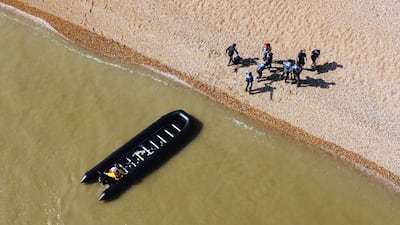
Hammad Al Shamari, from Kuwait, was jailed for two and a half years for unlawfully assisting immigration. Photo: Home Office

Kuwaiti migrant who became cross-Channel people smuggler jailed in UK


Neil Murphy
  • English
  • Arabic

A migrant who became a cross-Channel people smuggler while trying to reach Britain by piloting a boat has been jailed for two and half years by a UK court.

Hammad Al Shamari, from Kuwait, was arrested in March as he attempted to steer an overcrowded inflatable boat from the French coast towards Dover under the cover of darkness.

The vessel was intercepted by Border Force agents and found to have more than two dozen migrants on board, including five young boys and one girl.

Further inquiries identified Al Shamari as the pilot of the vessel and he was arrested.

Canterbury Crown Court later jailed Al Shamari for two and half years after he was found guilty of assisting unlawful immigration on November 26.

Last month, some 27 people died when a boat capsized in French waters as it attempted to reach British shores last month.

The victims are said to have included an expectant mother, children and a 24-year-old Kurdish woman from northern Iraq trying to reunite with her fiance.

  • A group of migrants arrive on Dungeness beach in Kent, south-east England. The week has seen a major increase in migrant numbers due to fair weather. Getty Images
    A group of migrants arrive on Dungeness beach in Kent, south-east England. The week has seen a major increase in migrant numbers due to fair weather. Getty Images
  • Migrants are escorted ashore in Kingsdown in Kent. An estimated 1,000 people made the crossing from France on Monday, September 6. AP Photo
    Migrants are escorted ashore in Kingsdown in Kent. An estimated 1,000 people made the crossing from France on Monday, September 6. AP Photo
  • Migrants are escorted to be processed after being picked up in Dungeness. The previous record was 828 migrants on August 21. AFP
    Migrants are escorted to be processed after being picked up in Dungeness. The previous record was 828 migrants on August 21. AFP
  • The stream of boats from mainland Europe is likely to continue throughout the week, as mild weather is forecast to continue. AFP
    The stream of boats from mainland Europe is likely to continue throughout the week, as mild weather is forecast to continue. AFP
  • The surge came as UK Prime Minister Boris Johnson urged France to do more to stem the flow of small boats making their way across the English Channel. AFP
    The surge came as UK Prime Minister Boris Johnson urged France to do more to stem the flow of small boats making their way across the English Channel. AFP
  • Migrants rescued from the English Channel by the Royal National Lifeboat Institution arrive at Dungeness. Reuters
    Migrants rescued from the English Channel by the Royal National Lifeboat Institution arrive at Dungeness. Reuters
  • A migrant man waits to be processed by the UK Border Force, after arriving on Dungeness beach. Getty Images
    A migrant man waits to be processed by the UK Border Force, after arriving on Dungeness beach. Getty Images
  • Migrants are escorted across the beach in Dungeness. AFP
    Migrants are escorted across the beach in Dungeness. AFP

It was the highest death toll on record in the current Channel migrant crisis.

On Wednesday, the government's flagship immigration legislation, the Nationality and Borders Bill, was passed by a majority of MPs.

If it is cleared by the House of Lords, it will potentially allow for offshore processing centres to be set up overseas, akin to policies used in Australia.

It also gives Border Force officers powers to turn migrants away from the UK while at sea, and makes it a criminal offence to knowingly arrive in the UK without permission — with the maximum sentence for those entering the country unlawfully rising from six months’ imprisonment to four years.


'O'
%3Cp%3E%3Cstrong%3EAuthor%3A%3C%2Fstrong%3E%20Zeina%20Hashem%20Beck%3Cbr%3E%3Cstrong%3EPages%3A%3C%2Fstrong%3E%20112%3Cbr%3E%3Cstrong%3EPublisher%3A%3C%2Fstrong%3E%20Penguin%20Books%3Cbr%3E%3Cstrong%3EAvailable%3A%3C%2Fstrong%3E%20Now%3C%2Fp%3E%0A
Ten tax points to be aware of in 2026

1. Domestic VAT refund amendments: request your refund within five years

If a business does not apply for the refund on time, they lose their credit.

2. E-invoicing in the UAE

Businesses should continue preparing for the implementation of e-invoicing in the UAE, with 2026 a preparation and transition period ahead of phased mandatory adoption. 

3. More tax audits

Tax authorities are increasingly using data already available across multiple filings to identify audit risks. 

4. More beneficial VAT and excise tax penalty regime

Tax disputes are expected to become more frequent and more structured, with clearer administrative objection and appeal processes. The UAE has adopted a new penalty regime for VAT and excise disputes, which now mirrors the penalty regime for corporate tax.

5. Greater emphasis on statutory audit

There is a greater need for the accuracy of financial statements. The International Financial Reporting Standards standards need to be strictly adhered to and, as a result, the quality of the audits will need to increase.

6. Further transfer pricing enforcement

Transfer pricing enforcement, which refers to the practice of establishing prices for internal transactions between related entities, is expected to broaden in scope. The UAE will shortly open the possibility to negotiate advance pricing agreements, or essentially rulings for transfer pricing purposes. 

7. Limited time periods for audits

Recent amendments also introduce a default five-year limitation period for tax audits and assessments, subject to specific statutory exceptions. While the standard audit and assessment period is five years, this may be extended to up to 15 years in cases involving fraud or tax evasion. 

8. Pillar 2 implementation 

Many multinational groups will begin to feel the practical effect of the Domestic Minimum Top-Up Tax (DMTT), the UAE's implementation of the OECD’s global minimum tax under Pillar 2. While the rules apply for financial years starting on or after January 1, 2025, it is 2026 that marks the transition to an operational phase.

9. Reduced compliance obligations for imported goods and services

Businesses that apply the reverse-charge mechanism for VAT purposes in the UAE may benefit from reduced compliance obligations. 

10. Substance and CbC reporting focus

Tax authorities are expected to continue strengthening the enforcement of economic substance and Country-by-Country (CbC) reporting frameworks. In the UAE, these regimes are increasingly being used as risk-assessment tools, providing tax authorities with a comprehensive view of multinational groups’ global footprints and enabling them to assess whether profits are aligned with real economic activity. 

Contributed by Thomas Vanhee and Hend Rashwan, Aurifer

Updated: December 09, 2021, 5:12 PM