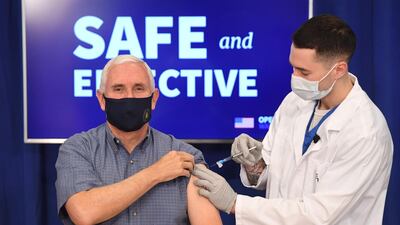
US Vice President Mike Pence receives the COVID-19 vaccine in the Eisenhower Executive Office Building in Washington, DC, December 18, 2020. / AFP / SAUL LOEB

US Vice President Mike Pence receives Pfizer’s Covid-19 vaccine


Bryant Harris
  • English
  • Arabic

Vice President Mike Pence became the highest-ranking US official to receive Pfizer’s Covid-19 vaccine on Friday.

Mr Pence received the vaccine in the Eisenhower Executive Office Building next to the White House alongside his wife, Karen Pence, and US Surgeon General Jerome Adams – all of whom wore masks.

Several US officials on President Donald Trump’s coronavirus task force, which Mr Pence oversees, watched the vice president receive his first dose of the vaccination: National Institute of Allergies and Infectious Diseases director Dr Anthony Fauci, Centres for Disease Control and Prevention director Robert Redfield and Centers for Medicare and Medicaid Services administrator Seema Verma.

Mr Pence called it a “truly inspiring day” after a medical technician administered the vaccine and told him to return for the second dose in 21 days.

The technician also noted that Mr Pence would receive documentation indicating that he had received the vaccine.

President-elect Joe Biden is expected to receive the vaccine on Monday, while Vice President-elect Kamala Harris is slated to receive it the week after.

While he received the vaccine, several screens stood over Mr Pence reading Operation Warp Speed, Mr Trump’s name for the US vaccine distribution plan. Another sign said “safe and effective,” hinting at the White House’s concern over the widespread anti-vaccination sentiment that has gripped large segments of the American public.

A Kaiser Family Foundation poll released on Tuesday found that 71 per cent of respondents would “definitely or probably” receive the vaccine, while more than a quarter of respondents indicated that they would not do so.

Vaccine scepticism was highest among members of Mr Pence’s own party, with 42 per cent of Republicans saying they would not take the vaccine.

Mr Trump, who has touted his administration’s efforts to promote a Covid-19 vaccine since the pandemic first hit the US, has so far not received the vaccine himself.

While the president contracted Covid-19 in October, public health officials have stated that individuals who have had the disease should still get the vaccine, as natural immunity may wane over time.

“The president, currently at this moment, has said he is absolutely open to taking the vaccine,” White House press secretary Kayleigh McEnany told reporters on Wednesday. “He’s been emphatic about that to me privately and to you all publicly. But he did recently recover from Covid.”

“He has continued protective effects of the monoclonal antibody cocktail that I mentioned, and he will receive the vaccine as soon as his medical team determines it’s best. But his priority is frontline workers, those in long-term care facilities, and he wants to make sure that the vulnerable get access first.”

Under the Trump administration's distribution plan, healthcare workers began receiving the vaccine this week.

Several states have also started to vaccinate residents at long-term care facilities, and many others will follow suit next week.


UAE currency: the story behind the money in your pockets

Mercer, the investment consulting arm of US services company Marsh & McLennan, expects its wealth division to at least double its assets under management (AUM) in the Middle East as wealth in the region continues to grow despite economic headwinds, a company official said.

Mercer Wealth, which globally has $160 billion in AUM, plans to boost its AUM in the region to $2-$3bn in the next 2-3 years from the present $1bn, said Yasir AbuShaban, a Dubai-based principal with Mercer Wealth.

Within the next two to three years, we are looking at reaching $2 to $3 billion as a conservative estimate and we do see an opportunity to do so,” said Mr AbuShaban.

Mercer does not directly make investments, but allocates clients’ money they have discretion to, to professional asset managers. They also provide advice to clients.

“We have buying power. We can negotiate on their (client’s) behalf with asset managers to provide them lower fees than they otherwise would have to get on their own,” he added.

Mercer Wealth’s clients include sovereign wealth funds, family offices, and insurance companies among others.

From its office in Dubai, Mercer also looks after Africa, India and Turkey, where they also see opportunity for growth.

Wealth creation in Middle East and Africa (MEA) grew 8.5 per cent to $8.1 trillion last year from $7.5tn in 2015, higher than last year’s global average of 6 per cent and the second-highest growth in a region after Asia-Pacific which grew 9.9 per cent, according to consultancy Boston Consulting Group (BCG). In the region, where wealth grew just 1.9 per cent in 2015 compared with 2014, a pickup in oil prices has helped in wealth generation.

BCG is forecasting MEA wealth will rise to $12tn by 2021, growing at an annual average of 8 per cent.

Drivers of wealth generation in the region will be split evenly between new wealth creation and growth of performance of existing assets, according to BCG.

Another general trend in the region is clients’ looking for a comprehensive approach to investing, according to Mr AbuShaban.

“Institutional investors or some of the families are seeing a slowdown in the available capital they have to invest and in that sense they are looking at optimizing the way they manage their portfolios and making sure they are not investing haphazardly and different parts of their investment are working together,” said Mr AbuShaban.

Some clients also have a higher appetite for risk, given the low interest-rate environment that does not provide enough yield for some institutional investors. These clients are keen to invest in illiquid assets, such as private equity and infrastructure.

“What we have seen is a desire for higher returns in what has been a low-return environment specifically in various fixed income or bonds,” he said.

“In this environment, we have seen a de facto increase in the risk that clients are taking in things like illiquid investments, private equity investments, infrastructure and private debt, those kind of investments were higher illiquidity results in incrementally higher returns.”

The Abu Dhabi Investment Authority, one of the largest sovereign wealth funds, said in its 2016 report that has gradually increased its exposure in direct private equity and private credit transactions, mainly in Asian markets and especially in China and India. The authority’s private equity department focused on structured equities owing to “their defensive characteristics.”

The Laughing Apple

Yusuf/Cat Stevens

(Verve Decca Crossover)