


US President Donald Trump returned to the White House on Monday after a three-night hospital stay for coronavirus treatment.
But a wave of infections has hit his staff with only four weeks of campaigning left before election day.
Wearing a white surgical mask, Mr Trump gave a thumbs-up and waved as he walked to the executive mansion from the helicopter that flew him back from the Walter Reed Military Medical Centre outside Washington.
He then walked up the staircase of the White House South Portico, removed his mask and posed for pictures, at times giving a thumbs-up and others a salute.

Leaving the military hospital earlier in the evening, he responded to a question about how many people were infected at the White House by saying: "Thank you very much."
Earlier on Monday Mr Trump had tweeted his planned departure:
He sparked an angry backlash from the medical community on Sunday after driving past his supporters in a limousine with Secret Service agents outside the hospital, near Washington.
Wearing a face mask, he gave a regal wave from inside his bulletproof vehicle during the short trip after a weekend of muddled messages from his doctors.
Mr Trump's doctors were sufficiently satisfied with his progress to suggest he might return to the White House on Monday, to continue his five-day course of remdesivir treatment and other therapy.
But experts said his outing on Sunday broke his government's public health guidelines requiring patients to isolate while they are in treatment and still contagious, and put his Secret Service guards at risk.
Mr Trump was unapologetic, tweeting:
Mr Trump, who has been repeatedly rebuked for flouting public health rules and spreading misinformation on the pandemic, said in a video on Twitter that he had "learnt a lot about Covid" by "really going to school" as he has battled the virus.
Health experts took to the airwaves and social media to criticise the "stunt", which they said showed he had learnt nothing at all.
"Every single person in the vehicle during that completely unnecessary presidential 'drive-by' just now has to be quarantined for 14 days," said James Phillips, chief of disaster medicine at George Washington University.
"They might get sick. They may die. For political theatre. Commanded by Trump to put their lives at risk for theatre. This is insanity."
Mr Trump announced by Twitter on Friday that he and first lady Melania had tested positive for the coronavirus.
That evening he travelled to the Walter Reed Military Medical Centre for treatment.
At a briefing by Mr Trump's medical team on Sunday, White House doctor Sean Conley said the president's oxygen levels were at 98 per cent.
On Friday morning, his levels eased to under 94 per cent, rose, and dipped again later in the day, when the decision was made to take him by helicopter to Walter Reed.
Dr Conley said the president had been treated on Saturday with the steroid dexamethasone, after the drops in oxygen saturation.
Dr Brian Garibaldi, a specialist in pulmonary critical care, said Mr Trump was not showing any side effects to the medication “that we can tell”.
-
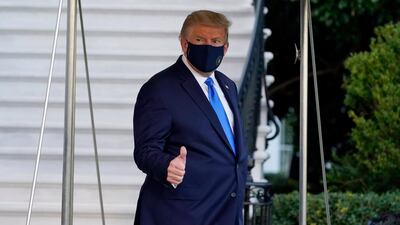
President Donald Trump gives a thumbs-up as he leaves the White House to go to Walter Reed National Military Medical Center. AP Photo -
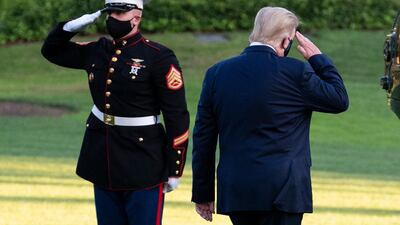
President Donald Trump salutes as he boards Marine One as he leaves the White House. AP Photo -
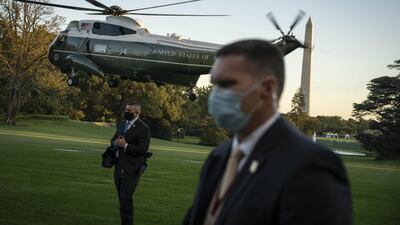
Members of the US Secret Service wear protective masks as Marine One, with U.S. President Donald Trump on board, departs the South Lawn of the White House. Bloomberg -
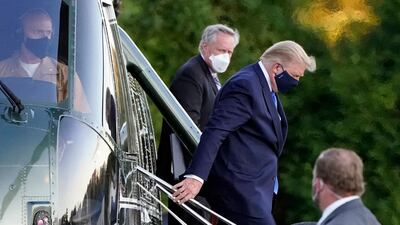
President Donald Trump arrives at Walter Reed National Military Medical Center. AP Photo -

US President Donald Trump waves from the presidential motorcade while arriving at the Walter Reed National Military Medical Center. Bloomberg -

President Donald Trump boards Marine One. AP Photo -
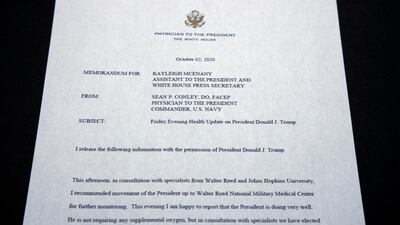
The memorandum from White House physician Sean Conley to White House press secretary Kayleigh McEnany with information about President Donald Trump being moved to Walter reed National Military Medical Center and the decision to initiate Remdesivir therapy. AP Photo -
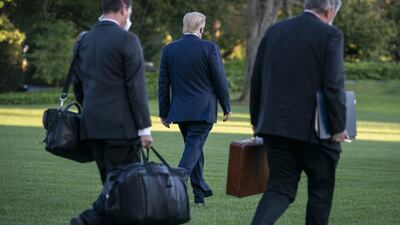
US President Donald Trump walks on the South Lawn of the White House before boarding Marine One. Bloomberg -
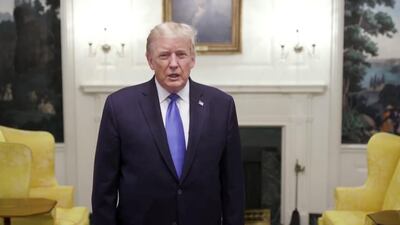
US President Donald Trump makes an announcement after he and First Lady Melania Trump tested positive for the coronavirus. Reuters -

Marine One helicopter, with President Donald Trump aboard, lifts off from the South Lawn of the White House. AP Photo -
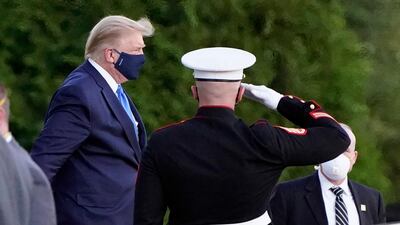
President Donald Trump arrives at Walter Reed National Military Medical Center. AP Photo -
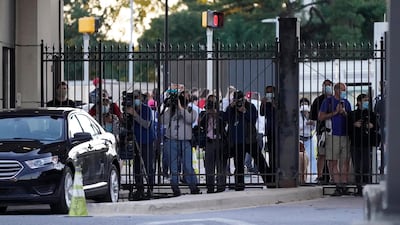
Members of the media and general public watch as President Donald Trump arrives at Walter Reed National Military Medical Center. AP Photo -
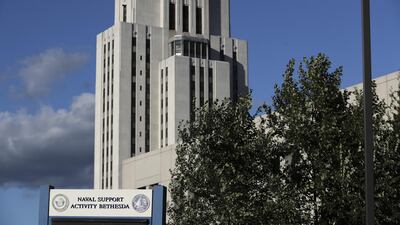
The Walter Reed National Military Medical Center in Bethesda, Maryland. Bloomberg


He said on Sunday that Mr Trump was “up and well” and the plan was to have him “out of bed” as much as possible.
Only hours earlier, National Security Adviser Robert O'Brien said Mr Trump would remain at Walter Reed "for a period of time" as doctors wanted to monitor him through day eight, on Thursday, of the virus.
"The doctors want to make sure that they're there for the president and he's getting the best treatment and he's doing well," Mr O'Brien told CBS News.
Mr Trump posted a video to Twitter late on Saturday in which he appeared relaxed in an open-collar shirt and blue suit jacket, telling viewers he would be "back soon", but acknowledging that the crucial coming days would be "the real test".
British Prime Minister Boris Johnson said on Sunday he was sure Mr Trump would be fine and was receiving the best possible care.
"The most important thing to do is to follow his doctors' advice," Mr Johnson told BBC TV. "He's got superb medical advice."
The prime minister tested positive for Covid-19 in late March and was admitted to hospital for a week, including three nights in intensive care.
He said he was fully recovered and was not suffering from "long Covid" symptoms.
Chinese President Xi Jinping also sent a message of sympathy to Mr and Mrs Trump.
“My wife, Peng Liyuan, and I express our sympathies to you and your wife and wish you a fast recovery,” state TV reported Mr Xi as saying.

