
Airport security on the Galapagos Islands found 185 tortoises in a suitcase being trafficked to Ecuador's mainland.
The tortoises were found during a routine check the Environment Ministry said, adding that police were investigating.
Trafficking animals off the famed Galapagos Islands is a crime punishable by up to three years in prison.
The islands have long been a protected wildlife area off the coast of Ecuador.
Environment Minister Marcelo Mata Guerrero condemned "these crimes against Ecuadorans' wild fauna and natural heritage".
The Galapagos Islands' star attraction are its giant tortoises, whose ancestors arrived on the volcanic islands between three to four million years ago.
It is believed ocean currents took them to the islands after which they developed into 15 separate species, three of which are extinct.
The archipelago was made famous by British geologist and naturalist Charles Darwin who developed his theory of natural selection after visiting the islands.
Giant tortoises on the Galapagos – in pictures
-

Park rangers taking the temperature of a San Cristobal island giant tortoise before been released, in Galapagos, Ecuador on September 28. Handout picture by Galapagos National Park / AFP -
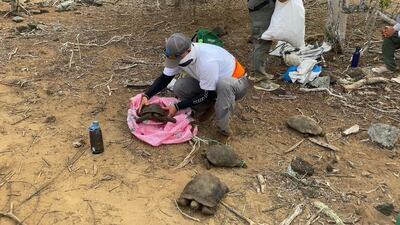
A group of park rangers release a San Cristobal island giant tortoise, in Galapagos, Ecuador on September 28, 2020. A group of 36 giant tortoises of an endangered species and born in captivity was repatriated to their habitat on San Cristobal Island, one of the main islands of the Ecuadorian archipelago of Galapagos. Handout picture by Galapagos National Park / AFP -
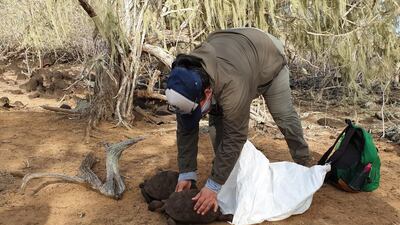
A San Cristobal island giant tortoise before been released, in Galapagos, Ecuador on September 28. Handout picture by Galapagos National Park / AFP -

San Cristobal island giant tortoises before been released, in Galapagos, Ecuador on September 28. Handout picture by Galapagos National Park / AFP -
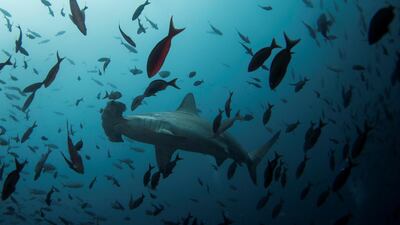
A hammerhead shark swims at Galapagos Marine Reserve, Ecuador, on August 19, 2013. Jorge Silva/ Reuters



