President Joe Biden declared that "America is on the move again" during his first address to a joint session of Congress, just before his 100th day in office.
"I stand here tonight – just one day shy of the 100th day of my administration – 100 days since I took the oath of office, lifted my hand off our family Bible, and inherited a nation in crisis," said Mr Biden.
"The worst pandemic in a century. The worst economic crisis since the Great Depression. The worst attack on our democracy since the Civil War. Now, after just 100 days, I can report to the nation: America is on the move again."
Mr Biden's address to Congress was a far more sombre affair than is usual, lacking the pomp and circumstance of his predecessors. Approximately 200 people, mostly members of Congress, plus a handful of representatives from other branches of government and family members, attended the socially distanced speech.
That is a far cry from the 1,600 officials, friends and guests who typically gather for a presidential speech.
Despite a dark year, Mr Biden offered a vision of hope and did not shy away from addressing the January 6 mob that stormed the very chamber where he delivered his address during a failed bid to overturn the 2020 election results.
"As we gather here tonight, the images of a violent mob assaulting this Capitol, desecrating our democracy, remain vivid in our minds," said Mr Biden. "Lives were put at risk. Lives were lost. Extraordinary courage was summoned."
"The insurrection was an existential crisis, a test of whether our democracy could survive. It did. But the struggle is far from over."
The president touted his administration's response to the Covid-19 pandemic, the fact that 220 million Americans have now received vaccinations and the economic stimulus package that the White House shepherded through Congress along party lines earlier this year.
But he made it clear that he's not stopping there, proposing a $1.8 trillion package for families and education.
Mr Biden framed the proposal – which together with an earlier infrastructure and jobs plan totals about $4tn, rivalling the federal budget – as necessary to compete with China as well as create engineering and construction jobs needed to build more energy-efficient buildings and homes.
"We’re in a competition with China and other countries to win the 21st century," said Mr Biden. "We have to do more than just build back. We have to build back better."
"There’s simply no reason why the blades for wind turbines can’t be built in Pittsburgh instead of Beijing."
Mr Biden described his proposal as "a blue-collar blueprint to build America" and vowed to pay for his spending proposals through tax increases on the ultra-wealthy.
"It recognises something I’ve always said: Wall Street didn’t build this country," he said.
"The middle class built this country. And unions built the middle class."
He announced that the effort to pass his jobs plan in Congress would be led by Vice President Kamala Harris, who sat beside him alongside House Speaker Nancy Pelosi – the first time in history two women occupied the places of honour in a presidential address to Congress.
"Madam Speaker, Madam Vice President," Mr Biden said at the start of his speech. "No president has ever said those words from this podium and it’s about time."
The president also laid out an expansive legislative wish list, calling on Congress to pass a $15 minimum wage, gun control legislation, immigration reform and a voting rights bill.
He also pleaded directly with members of Congress to pass legislation to curb police violence, highlighting frequent police killings of black citizens and years of entrenched racism while simultaneously praising law enforcement officers.
"We have all seen the knee of injustice on the neck of black America," said Mr Biden. "Now is our opportunity to make real progress."
"Most men and women in uniform wear their badge and serve their communities honourably. I know them. I know they want to help meet this moment as well. My fellow Americans, we have to come together to rebuild trust between law enforcement and the people they serve, to root out systemic racism in our criminal justice system."
Though his remarks were met with applause, Mr Biden has not begun his presidency unopposed.
Republican members of Congress have already rejected the $2tn-plus infrastructure plan as too large.
The Democratic president is hoping that his spending plans, which are largely popular with US voters, can sway Republicans in Congress to co-operate with the White House.
Mr Biden signalled an openness to bipartisan compromise on policing, speaking positively about negotiations on a reform bill in Congress and calling on members to pass the legislation before the one-year anniversary of George Floyd's murder next month.
Tim Scott of South Carolina, the only black Senate Republican who has worked on his own police reform legislation, gave the party's rebuttal to Mr Biden's speech.
While Mr Biden has exceeded his pledge to vaccinate 200 million Americans within his first 100 days, Mr Scott credited the Trump administration's investments in vaccine research and development.
"Thanks to Operation Warp Speed and the Trump administration, our country is flooded with safe and effective vaccines," said Mr Scott.
Mr Scott also criticised the Biden administration over continuing pandemic-related school closures.
"Locking vulnerable kids out of the classroom is locking adults out of their future," he said. "Our public schools should have reopened months ago.
"Science has shown for months that schools are safe. But too often, powerful grown-ups set science aside."
Mr Scott also attacked Mr Biden's infrastructure, family and education proposals as "a partisan wish list" while lambasting the president's proposed tax increase on high-income individuals and corporations.
"They won't even build bridges to build bridges," said Mr Scott. "Less than six per cent of the president's plan goes to roads and bridges.”
Mr Biden also discussed foreign affairs, touting his decision to withdraw US forces from Afghanistan before September 11.
-

US President Joe Biden addresses a joint session of Congress as President Kamala Harris and Speaker of the House Representative Nancy Pelosi applause at the US Capitol in Washington on April 28, 2021. Reuters -
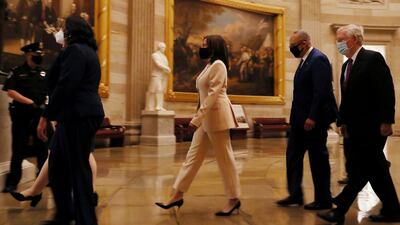
Harris leads a procession of senators through the Rotunda from the Senate Chamber to the House Chamber ahead of the first address by US President Joe Biden to a joint session of the US Congress at the US Capitol in Washington, on April 28, 2021. Reuters -
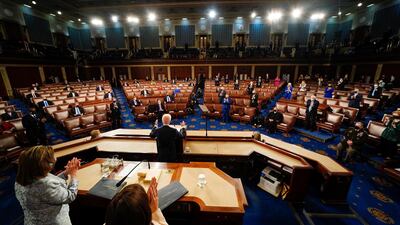
Biden's view as he addresses a joint session of Congress in Washington. Reuters -
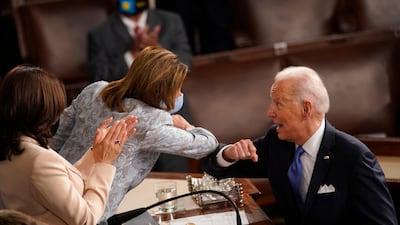
President Joe Biden elbow bumps House Speaker Nancy Pelosi of California, after speaking to a joint session of Congress Wednesday, April 28, 2021, in the House Chamber. AP -
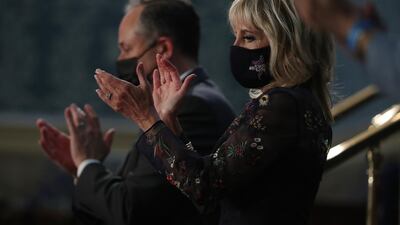
US First Lady Jill Biden and Second Gentleman Douglas Emhoff react as US President Joe Biden speaks during a joint session of Congress in Washington. Bloomberg -
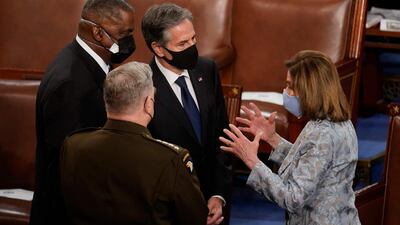
House Speaker Nancy Pelosi talks with Chairman of the Joint Chiefs of Staff General Mark Milley, Defense Secretary Lloyd Austin and Secretary of State Antony Blinken after President Joe Biden spoke to a joint session of Congress at the US Capitol in Washington, DC, on April 28, 2021. AFP -
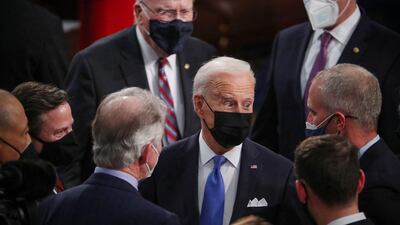
US President Joe Biden talks to members of Congress after he delivers his first address to a joint session of Congress at the US Capitol in Washington, DC, on April 28, 2021. AFP -

Customers at a bar sit as President Joe Biden is displayed on a television while speaking at the Capitol in Washington on April 28, 2021. Bloomberg


"We delivered justice to Osama bin Laden and we degraded the terrorist threat of Al Qaeda in Afghanistan," said Mr Biden. "After 20 years of American valour and sacrifice, it’s time to bring our troops home."
"Even as we do, we will maintain an over – the – horizon capability to suppress future threats to the homeland."
He vowed to continue missions against Al Qaeda and ISIS in "Yemen, Syria, Somalia, other places in Africa and the Middle East and beyond", but noted that US intelligence agencies assess that "the most lethal terrorist threat to the homeland today is from white supremacist terrorism".
He also denounced the Iran's and North Korea's nuclear programmes as "a serious threat to America’s security and world security", vowing to work "closely with our allies to address the threats posed by both of these countries through diplomacy and stern deterrence".
But he reserved most of his warnings for China and Russia, detailing stern conversations he has previously held with Presidents Xi Jinping and Vladimir Putin and reiterated his pledge to "stand up to unfair trade practices".
"In my discussion with President Xi, I told him that we welcome the competition, and that we are not looking for conflict," said Mr Biden. "But I made it absolutely clear that I will defend American interests across the board."
"I also told President Xi that we will maintain a strong military presence in the Indo – Pacific just as we do with Nato in Europe – not to start conflict, but to prevent conflict."
He also highlighted the sanctions he placed on Russia over election meddling and cyber attacks, but noted that the US still seeks room for co-operation with Moscow.
"With regard to Russia, I made very clear to President Putin that while we don’t seek escalation, their actions have consequences," said Mr Biden. "But we can also co-operate when it’s in our mutual interests, as we did when we extended the New START Treaty on nuclear arms – and as we’re working to do on the climate crisis."

