

Days after the Canadian province of Ontario declared a state of emergency over the lorry driver protests in the nation's capital Ottawa, Prime Minister Justin Trudeau has invoked the Emergencies Act, which gives the government broad powers to crack down on the demonstrations.
For more than two weeks, hundreds of lorry drivers and thousands of their supporters have “occupied” Ottawa, shaking many Canadians' faith in their governmental institutions.
The protests, which have cropped up in cities across Canada as well as at key border crossings with the US, are the biggest challenge that Mr Trudeau has faced in his more than six years in office.
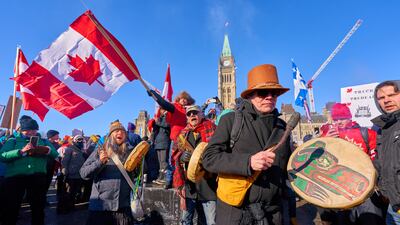
In downtown Ottawa, a large Canadian flag hangs suspended from a giant crane in the middle of the demonstration, while a row of beige Portaloos blocks the side entrance to the prime minister's office in a not-so-subtle example of protesters' opinion of Mr Trudeau.
“The Emergencies Act will be used to strengthen and support law enforcement agencies at all levels across the country,” Mr Trudeau said in televised announcement on Monday.
“This is about keeping Canadians safe, protecting people's jobs and restoring confidence in our institutions.”
The measure was passed in 1988 to replace the War Measures Act, famously used in 1970 by Mr Trudeau’s father, Pierre Elliot Trudeau, who was prime minister at the time, to combat the militant Quebec separatist group Front de Liberation du Quebec (FLQ).
When questioned by CBC journalist Tim Ralfe in 1970 on how far he would go to stop the separatist group and suspend civil liberties, the elder Mr Trudeau replied, “just watch me” — a line that became ingrained in the national consciousness.
The October Crisis, as it came to be known, began when members of the FLQ kidnapped provincial Deputy Premier Pierre Laporte and British diplomat James Cross. The group had become notorious over the preceding decade for hundreds of bombings that injured more than two dozen people.
Over the course of about two months, Canadian soldiers patrolled the streets of the French-speaking province of Quebec as they sought to restore order, arresting hundreds without charge.
The emergency ultimately ended, but not before the FLQ had murdered LaPorte. The British diplomat was released.

The elder Mr Trudeau’s use of military force remains a subject of great debate in Canada, with some saying it was an abuse of power while others argue it was a necessary evil.
“What he did was, in a sense, to crush the FLQ and it was never a factor after that,” said Andrew Cohen, a journalist and professor at Carleton University in Ottawa.
Mr Cohen recently wrote an opinion piece in The Globe and Mail in which he said the freedom convoy protests were the younger Mr Trudeau’s own October Crisis.
In his piece, Mr Cohen argued there are lessons the son can learn from the father, such as “the imperative of clarity, authority and principle".
Mr Cohen told The National it was “absolutely the right move” for Mr Trudeau to invoke the Emergencies Act.
-
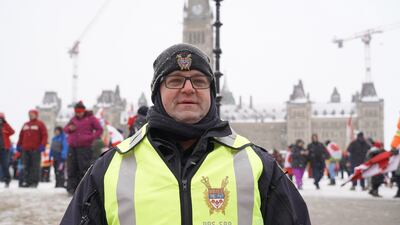
A police officer stands guard at Parliament Hill in Ottawa. Willy Lowry / The National. -
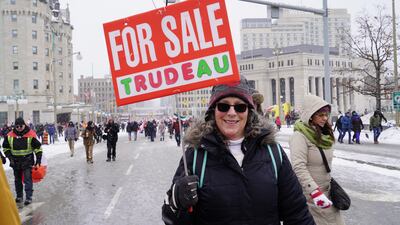
A woman carries a sign that says "For Sale: Trudeau." Willy Lowry / The National. -

A man holds a boombox and a Canadian flag. Willy Lowry / The National. -

Three men pose for a picture while attending the anti-vaccine protests in Ottawa. Willy Lowry / The National. -
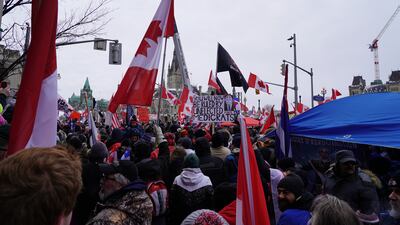
Thousands of people attend an anti-vaccine mandate protest in Ottawa on Saturday, February, 12. Willy Lowry / The National. -
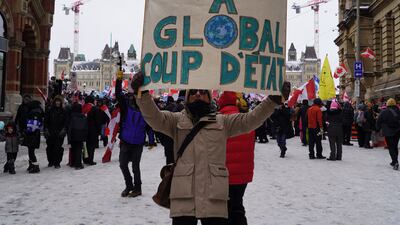
A man holds a sign reading "A global coup d'etat" at a protest in downtown Ottawa. Willy Lowry / The National. -

Two people pose for a picture while attending the anti-vaccine protest in Ottawa. Willy Lowry / The National. -

Thousands of people protest against government vaccine mandates in front of Peace Tower in Ottawa. Willy Lowry / The National. -
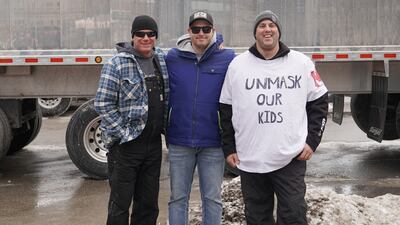
Mike Card, right, poses with two friends. They drove in from Sarnia, Ontario, to support the lorry drivers. Willy Lowry / The National -

A sign that reads 'my body, my choice' sits in front of the Canadian Parliament. Willy Lowry / The National -
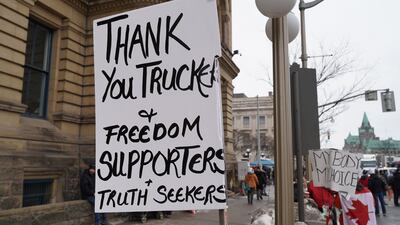
A sign thanking drivers hangs on Wellington Street in central Ottawa. Willy Lowry / The National -
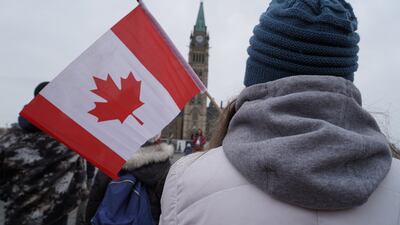
A woman waves a Canadian flag in front of Parliament. Willy Lowry / The National -
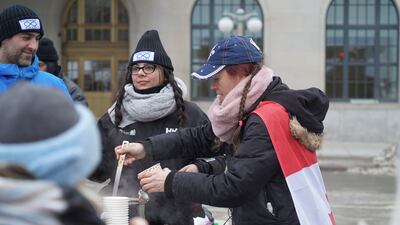
A woman hands out soup to protesters. Willy Lowry / The National -
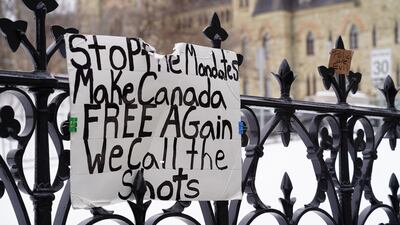
A sign calling for an end to mandates sits on the fence around the Canadian Parliament. Willy Lowry / The National -

Police officers stand guard at a city intersection in central Ottawa. Willy Lowry / The National -

A car is decorated with an anti-vaccine sign and both the American and Canadian flags. Willy Lowry / The National -
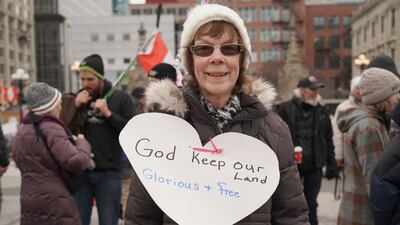
Donna Curry holds a sing saying 'God keep our land glorious and free' outside of Parliament. Willy Lowry / The National -
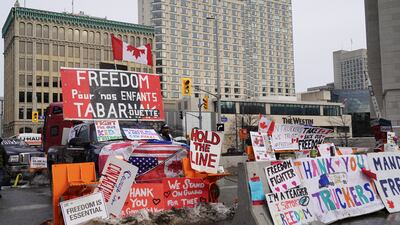
Ant-vaccine signs litter and block a city intersection in central Ottawa. Willy Lowry / The National -

Police cruisers block an intersection in central Ottawa. Willy Lowry / The National -
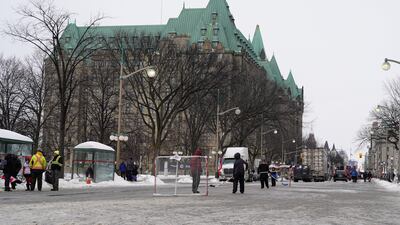
Children play hockey on the street in front of the Canadian Parliament. Willy Lowry / The National -

A man cracks an egg to help prepare food for the protesters. Willy Lowry / The National -
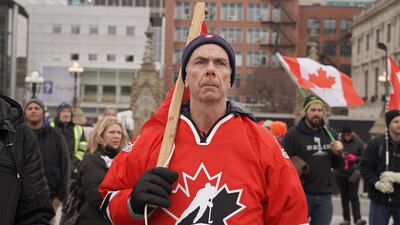
A protester wears a Hockey Canada jersey outside of Parliament. Willy Lowry / The National -

Two men pose outside of Parliament. Willy Lowry / The National -
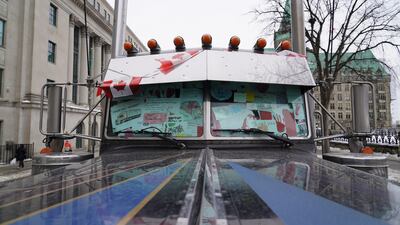
Signs fill the windshield of a parked lorry in central Ottawa. Willy Lowry / The National -
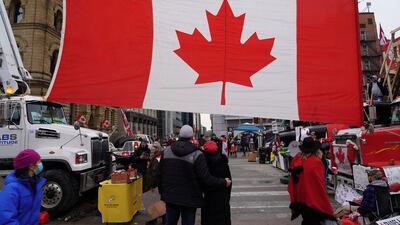
A giant Canadian flag hangs at an intersection near the Parliament. Willy Lowry / The National -
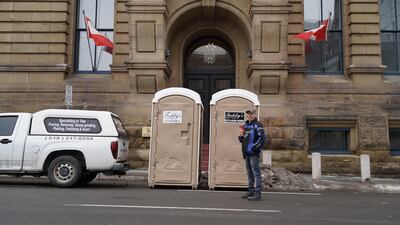
Portable toilets have been set up near the main protest site in Ottawa. Willy Lowry / The National -

A counter-protester stands near the anti-vaccine protesters in central Ottawa. Willy Lowry / The National -
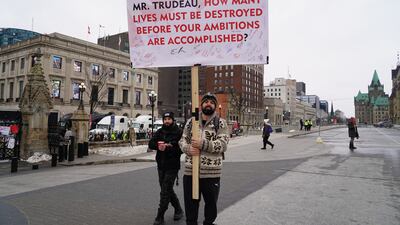
A man holds a sign criticising Canadian Prime Minister Justin Trudeau. Willy Lowry / The National


“The ability of the federal government to protect itself and its legitimacy is what we're dealing with here.”
The two Trudeaus are very different leaders but their actions have had equally profound effects on the country.
The elder Trudeau was an intellectual who studied communism in China and got his political start organising labour protests for miners in rural Quebec. He was combative and polarising, both loved and reviled by Canadians from coast to coast.
His son is no less polarising but has been less combative than his father, trying to steer clear of major constitutional questions. His handling of the pandemic has won him the support of many but has also stoked the ire of the small but vocal anti-vaccine-mandate protesters.
For them, he is public enemy number one and his name is often prefaced by profanity.
The implementation of the Emergencies Act is likely to further antagonise the demonstrators in Ottawa but it is an important show of strength to the majority of Canadians who do not support these protests, Mr Cohen said.
“Up to now, he has looked weak,” said Mr Cohen. By invoking the Emergencies Act, Mr Cohen said the prime minister is trying to “retake” the narrative.
-
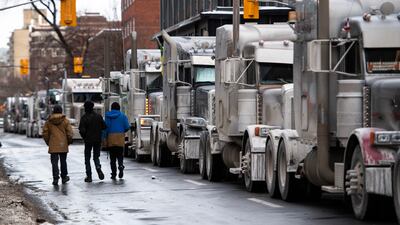
Lorries are parked on Metcalfe Street during a rally against Covid-19 restrictions in Ottawa, Canada. AP -
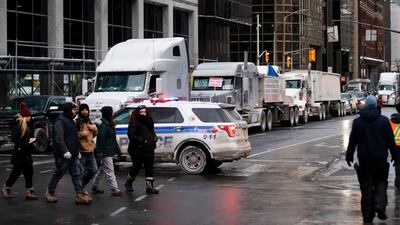
The rally began as a lorry drivers took part in cross-country convoy to protest against a federal vaccine mandate for cross-border drivers. AP -
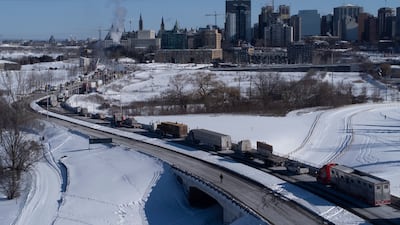
Lorries in the 'Freedom Convoy' are parked on the Sir John A Macdonald motorway leading into Ottawa's city centre. AP -
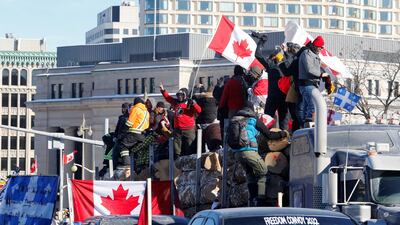
Lorries began arriving in Ottawa on Friday in several convoys and were joined by thousands of other anti-vaccination protesters. Reuters -
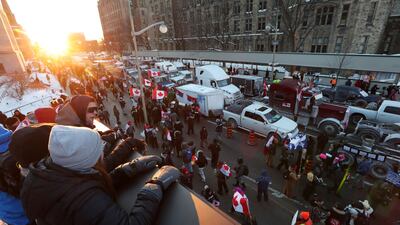
The chaos clogged Ottawa's city centre near Parliament at the weekend and protesters said they did not intend to leave anytime soon. Bloomberg -
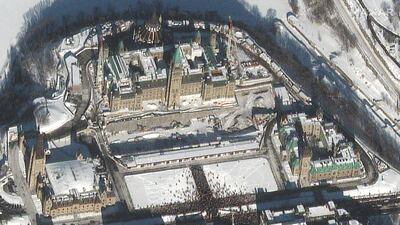
A satellite image of lorries at Parliament Hill in Ottawa. Lorry drivers are unhappy with at a requirement for them to provide proof of vaccination as they cross into Canada from the US. Reuters -
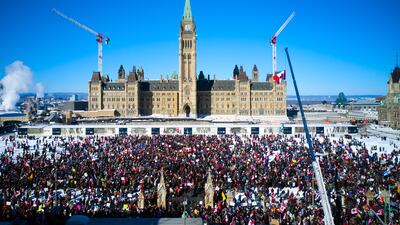
Demonstrators believe Canada's federal government has overstepped its reach with the vaccine mandates. EPA -
The protests brought Canada's capital to a standstill for a second day on Sunday. EPA -

A few protesters wore masks but many were in balaclavas due to the cold. EPA -

The 'Freedom Convoy' makes its way into Ottawa after a week of travel from British Columbia province. AP -

The convoy was joined by other sympathetic drivers. AP -

Supporters wave flags on a bridge as the convoy makes its way to Parliament Hill in Ottawa. AP


While the Emergencies Act is more narrow in scope and doesn’t suspend civil liberties in the same way as the measure taken by the elder Trudeau in 1970, it does allow the government to ban demonstrations when it deems it necessary.
“The government will designate, secure and protect places and infrastructure that are critical to our economy and people's jobs, including border crossings and airports,” said Mr Trudeau. “We cannot and will not allow the illegal and dangerous activities to continue.”
The act also takes aim at the protesters' financing. Millions of dollars have been raised in support of the demonstrators on crowdfunding sites like GoFundMe and GiveSendGo.
GoFundMe cancelled the freedom convoy’s first fund-raising efforts but supporters have found other ways to funnel money to the demonstrators.
Under the act, “all crowdfunding platforms and the payment service providers they use must register with Fintrac [Financial Transactions and Reports Analysis Centre of Canada] and they must report large and suspicious transactions,” said Finance Minister Chrystia Freeland.
Mr Trudeau made it clear that by invoking the Emergencies Act, he was not calling in the military as his father had done.
“Let me be equally clear about what it does not do,” he said. “We're not using the Emergencies Act to call in the military. We're not suspending fundamental rights or overriding the Charter of Rights and Freedoms.”
“My sense is he doesn't want to be the second Trudeau in a generation to bring troops into the streets,” said Mr Cohen.
But the question remains whether the emergency powers will be enough to quell the largest wave of civil unrest seen in Canada in a generation.

