Protesters against Covid-19 vaccine mandates are stopped by police as they block the entrance to the Ambassador Bridge in Windsor, Ontario, Canada. AFP.

Canadian police and protesters face off at Ambassador Bridge crossing


Willy Lowry
  • English
  • Arabic

Dressed in winter hats, gloves and yellow vests, police in Windsor, Ontario slowly moved in on protesters blocking the Ambassador Bridge connecting Ontario to Detroit, Michigan on Saturday.

Late Friday evening an Ontario Superior Court judge issued an injunction against the protesters in Windsor, giving them until 7pm Friday to vacate the bridge, which is the busiest border crossing between the US and Canada.

Protesters ignored the injunction, setting up a tense day-long stand off with police.

“It is, I would say, of critical national importance that this border crossing be reopened,” said Drew Dilkens, the mayor of Windsor.

For six days protesters have blocked the bridge causing major financial headaches to both the Canadian and US governments.

A quarter of trade between the two countries passes over the 92-year-old bridge.

“You effectively have 200 people who are holding hostage the national economic interests of Canada but also having a big impact on US trade and US families as well,” Mr Dilkens told The National.

Mr Dilkens said Windsor had never experienced a protest so crippling and far reaching in its impact.

The mayor had been calling for provincial and federal support for several days and said he’s relieved it has finally arrived in the form of added officers from both the Ontario Provincial Police and the Royal Canadian Mounted Police.

Authorities were being extremely careful in clearing protesters because of the presence of children in the crowd, he said.

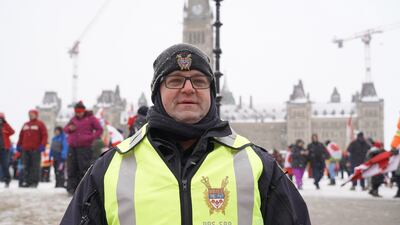
  • A police officer stands guard at Parliament Hill in Ottawa. Willy Lowry / The National.
    A police officer stands guard at Parliament Hill in Ottawa. Willy Lowry / The National.
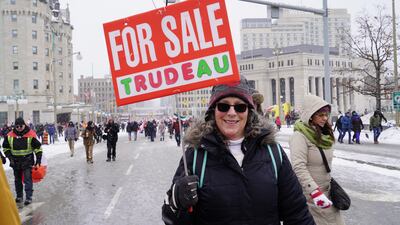
  • A woman carries a sign that says "For Sale: Trudeau." Willy Lowry / The National.
    A woman carries a sign that says "For Sale: Trudeau." Willy Lowry / The National.
  • A man holds a boombox and a Canadian flag. Willy Lowry / The National.
    A man holds a boombox and a Canadian flag. Willy Lowry / The National.
  • Three men pose for a picture while attending the anti-vaccine protests in Ottawa. Willy Lowry / The National.
    Three men pose for a picture while attending the anti-vaccine protests in Ottawa. Willy Lowry / The National.
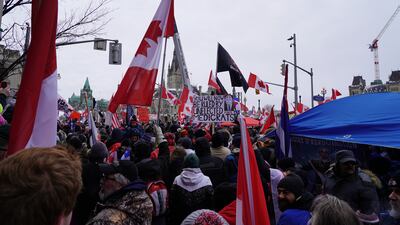
  • Thousands of people attend an anti-vaccine mandate protest in Ottawa on Saturday, February, 12. Willy Lowry / The National.
    Thousands of people attend an anti-vaccine mandate protest in Ottawa on Saturday, February, 12. Willy Lowry / The National.
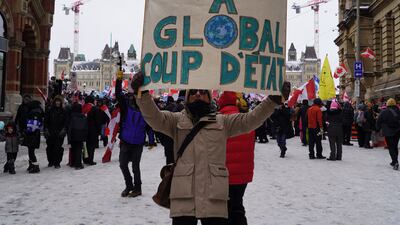
  • A man holds a sign reading "A global coup d'etat" at a protest in downtown Ottawa. Willy Lowry / The National.
    A man holds a sign reading "A global coup d'etat" at a protest in downtown Ottawa. Willy Lowry / The National.
  • Two people pose for a picture while attending the anti-vaccine protest in Ottawa. Willy Lowry / The National.
    Two people pose for a picture while attending the anti-vaccine protest in Ottawa. Willy Lowry / The National.
  • Thousands of people protest against government vaccine mandates in front of Peace Tower in Ottawa. Willy Lowry / The National.
    Thousands of people protest against government vaccine mandates in front of Peace Tower in Ottawa. Willy Lowry / The National.
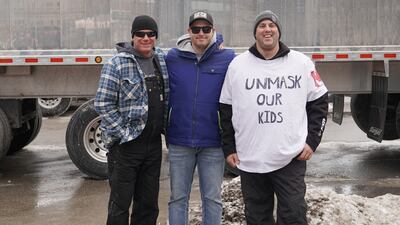
  • Mike Card, right, poses with two friends. They drove in from Sarnia, Ontario, to support the lorry drivers. Willy Lowry / The National
    Mike Card, right, poses with two friends. They drove in from Sarnia, Ontario, to support the lorry drivers. Willy Lowry / The National
  • A sign that reads 'my body, my choice' sits in front of the Canadian Parliament. Willy Lowry / The National
    A sign that reads 'my body, my choice' sits in front of the Canadian Parliament. Willy Lowry / The National
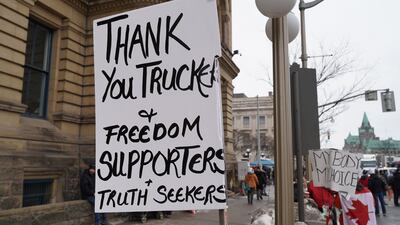
  • A sign thanking drivers hangs on Wellington Street in central Ottawa. Willy Lowry / The National
    A sign thanking drivers hangs on Wellington Street in central Ottawa. Willy Lowry / The National
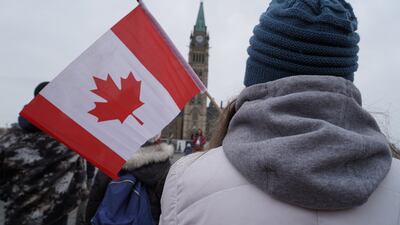
  • A woman waves a Canadian flag in front of Parliament. Willy Lowry / The National
    A woman waves a Canadian flag in front of Parliament. Willy Lowry / The National
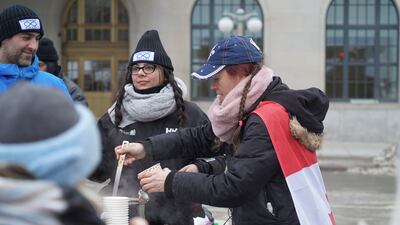
  • A woman hands out soup to protesters. Willy Lowry / The National
    A woman hands out soup to protesters. Willy Lowry / The National
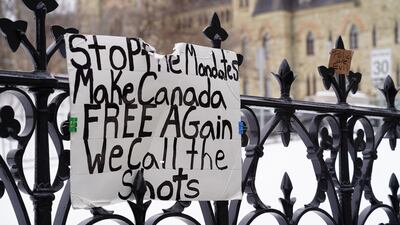
  • A sign calling for an end to mandates sits on the fence around the Canadian Parliament. Willy Lowry / The National
    A sign calling for an end to mandates sits on the fence around the Canadian Parliament. Willy Lowry / The National
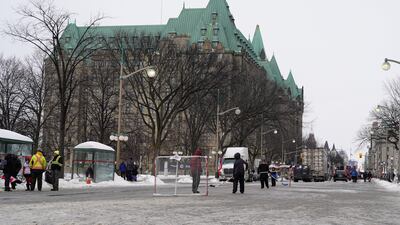
  • Police officers stand guard at a city intersection in central Ottawa. Willy Lowry / The National
    Police officers stand guard at a city intersection in central Ottawa. Willy Lowry / The National
  • A car is decorated with an anti-vaccine sign and both the American and Canadian flags. Willy Lowry / The National
    A car is decorated with an anti-vaccine sign and both the American and Canadian flags. Willy Lowry / The National
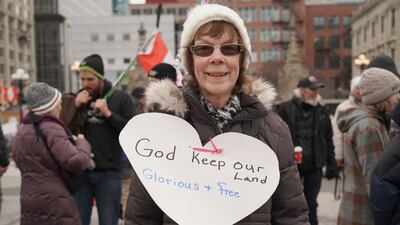
  • Donna Curry holds a sing saying 'God keep our land glorious and free' outside of Parliament. Willy Lowry / The National
    Donna Curry holds a sing saying 'God keep our land glorious and free' outside of Parliament. Willy Lowry / The National
  • Ant-vaccine signs litter and block a city intersection in central Ottawa. Willy Lowry / The National
    Ant-vaccine signs litter and block a city intersection in central Ottawa. Willy Lowry / The National
  • Police cruisers block an intersection in central Ottawa. Willy Lowry / The National
    Police cruisers block an intersection in central Ottawa. Willy Lowry / The National
  • Children play hockey on the street in front of the Canadian Parliament. Willy Lowry / The National
    Children play hockey on the street in front of the Canadian Parliament. Willy Lowry / The National
  • A man cracks an egg to help prepare food for the protesters. Willy Lowry / The National
    A man cracks an egg to help prepare food for the protesters. Willy Lowry / The National
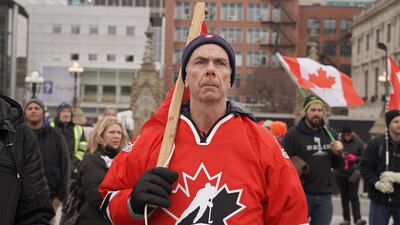
  • A protester wears a Hockey Canada jersey outside of Parliament. Willy Lowry / The National
    A protester wears a Hockey Canada jersey outside of Parliament. Willy Lowry / The National
  • Two men pose outside of Parliament. Willy Lowry / The National
    Two men pose outside of Parliament. Willy Lowry / The National
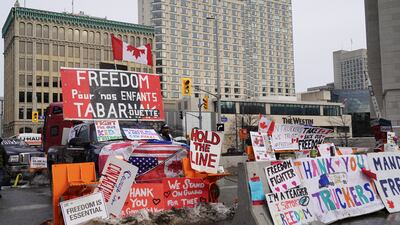
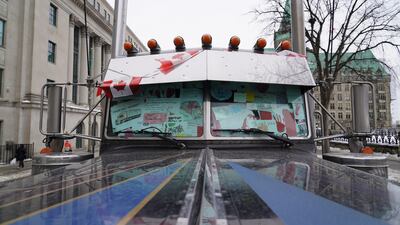
  • Signs fill the windshield of a parked lorry in central Ottawa. Willy Lowry / The National
    Signs fill the windshield of a parked lorry in central Ottawa. Willy Lowry / The National
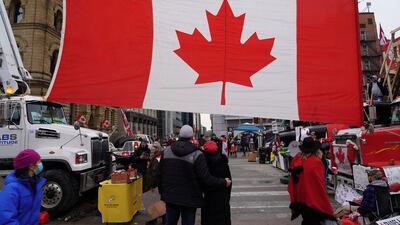
  • A giant Canadian flag hangs at an intersection near the Parliament. Willy Lowry / The National
    A giant Canadian flag hangs at an intersection near the Parliament. Willy Lowry / The National
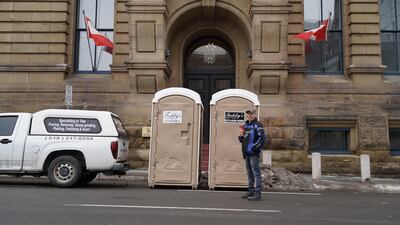
  • Portable toilets have been set up near the main protest site in Ottawa. Willy Lowry / The National
    Portable toilets have been set up near the main protest site in Ottawa. Willy Lowry / The National
  • A counter-protester stands near the anti-vaccine protesters in central Ottawa. Willy Lowry / The National
    A counter-protester stands near the anti-vaccine protesters in central Ottawa. Willy Lowry / The National
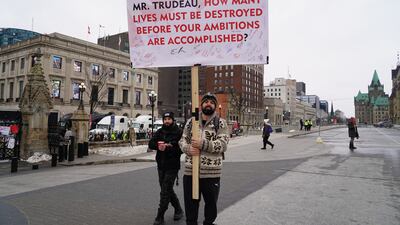
  • A man holds a sign criticising Canadian Prime Minister Justin Trudeau. Willy Lowry / The National
    A man holds a sign criticising Canadian Prime Minister Justin Trudeau. Willy Lowry / The National

The protest in Windsor is part of a trans-Canadian movement led by lorry drivers against Covid-19 restrictions and vaccine mandates.

For more than two weeks they have paralysed the Canadian capital, Ottawa.

On Saturday several thousand truckers and their supporters rallied in front of Parliament Hill, showing no signs of letting up as the demonstrations entered their third weekend.

Truck horns periodically pierced the frigid winter air, despite a court order injunction the noise pollution that has kept residents up for days. Peopled draped with Canadian flags on their backs danced in the street shouting "Freedom."

“This is like Canada Day on steroids, the amount of energy and positivity,” said Richard Graham.

The tooling manager for a manufacturing company in Ontario, said he was frustrated by all the restrictions that were impeding on his daily life. “I can't travel, I can’t cross the border,” he told The National.

While Mr Graham is not vaccinated, others were. Mike Scott, drove in for the weekend from his home near Barrie, Ontario, a five hour drive.

Mr Scott said he was against forcing people to get vaccinated despite getting both shots himself.

Police have maintained a relatively low profile throughout the more than two weeks ordeal in Ottawa with the chief of police saying he needs at least 1,800 more officers to be able to properly control what politicians are now calling a siege.

But the low profile may also be in part by design, as police don’t want to antagonise the crowds.

“We've learned that a strong show of force in the initial outset of these types of incidents only escalates the force, and it makes it more difficult to move these people along because you have lost the ability to communicate with them on an equal power base,” said Scott Blandford, assistant professor and program coordinator for public safety and policing programs at Wilfrid Laurier University in Waterloo, Ontario.

At this point, this situation has moved well beyond a police matter. This is a political matter.
Scott Blandford,
assistant professor at Wilfrid Laurier University

Mr Blandford, who spent 30 years as a police officer in Canada, said unlike the situation in Windsor, Ottawa will likely drag on for some time as it presents a set of quandaries for officers as they have to navigate in a dense urban environment and are dealing with both people and massive vehicles.

“At this point, this situation has moved well beyond a police matter,” Mr Blandford told The National. “This is a political matter.”

He said the occupation of Ottawa would only end through negotiation as the protesters appear to be fully entrenched in the Canadian Capital.


Ten tax points to be aware of in 2026

1. Domestic VAT refund amendments: request your refund within five years

If a business does not apply for the refund on time, they lose their credit.

2. E-invoicing in the UAE

Businesses should continue preparing for the implementation of e-invoicing in the UAE, with 2026 a preparation and transition period ahead of phased mandatory adoption. 

3. More tax audits

Tax authorities are increasingly using data already available across multiple filings to identify audit risks. 

4. More beneficial VAT and excise tax penalty regime

Tax disputes are expected to become more frequent and more structured, with clearer administrative objection and appeal processes. The UAE has adopted a new penalty regime for VAT and excise disputes, which now mirrors the penalty regime for corporate tax.

5. Greater emphasis on statutory audit

There is a greater need for the accuracy of financial statements. The International Financial Reporting Standards standards need to be strictly adhered to and, as a result, the quality of the audits will need to increase.

6. Further transfer pricing enforcement

Transfer pricing enforcement, which refers to the practice of establishing prices for internal transactions between related entities, is expected to broaden in scope. The UAE will shortly open the possibility to negotiate advance pricing agreements, or essentially rulings for transfer pricing purposes. 

7. Limited time periods for audits

Recent amendments also introduce a default five-year limitation period for tax audits and assessments, subject to specific statutory exceptions. While the standard audit and assessment period is five years, this may be extended to up to 15 years in cases involving fraud or tax evasion. 

8. Pillar 2 implementation 

Many multinational groups will begin to feel the practical effect of the Domestic Minimum Top-Up Tax (DMTT), the UAE's implementation of the OECD’s global minimum tax under Pillar 2. While the rules apply for financial years starting on or after January 1, 2025, it is 2026 that marks the transition to an operational phase.

9. Reduced compliance obligations for imported goods and services

Businesses that apply the reverse-charge mechanism for VAT purposes in the UAE may benefit from reduced compliance obligations. 

10. Substance and CbC reporting focus

Tax authorities are expected to continue strengthening the enforcement of economic substance and Country-by-Country (CbC) reporting frameworks. In the UAE, these regimes are increasingly being used as risk-assessment tools, providing tax authorities with a comprehensive view of multinational groups’ global footprints and enabling them to assess whether profits are aligned with real economic activity. 

Contributed by Thomas Vanhee and Hend Rashwan, Aurifer

Our legal consultant

Name: Dr Hassan Mohsen Elhais

Position: legal consultant with Al Rowaad Advocates and Legal Consultants.

Formula Middle East Calendar (Formula Regional and Formula 4)
Round 1: January 17-19, Yas Marina Circuit – Abu Dhabi
 
Round 2: January 22-23, Yas Marina Circuit – Abu Dhabi
 
Round 3: February 7-9, Dubai Autodrome – Dubai
 
Round 4: February 14-16, Yas Marina Circuit – Abu Dhabi
 
Round 5: February 25-27, Jeddah Corniche Circuit – Saudi Arabia
INFO
Jetour T1 specs

Engine: 2-litre turbocharged

Power: 254hp

Torque: 390Nm

Price: From Dh126,000

Available: Now

Blue%20Beetle
%3Cp%3E%3Cstrong%3EDirector%3A%3C%2Fstrong%3E%20Angel%20Manuel%20Soto%3Cbr%3E%3Cstrong%3EStars%3A%20%3C%2Fstrong%3EXolo%20Mariduena%2C%20Adriana%20Barraza%2C%20Damian%20Alcazar%2C%20Raoul%20Max%20Trujillo%2C%20Susan%20Sarandon%2C%20George%20Lopez%3Cbr%3E%3Cstrong%3ERating%3A%20%3C%2Fstrong%3E4%2F5%C2%A0%3C%2Fp%3E%0A
Itcan profile

Founders: Mansour Althani and Abdullah Althani

Based: Business Bay, with offices in Saudi Arabia, Egypt and India

Sector: Technology, digital marketing and e-commerce

Size: 70 employees 

Revenue: On track to make Dh100 million in revenue this year since its 2015 launch

Funding: Self-funded to date


Name: Peter Dicce

Title: Assistant dean of students and director of athletics

Favourite sport: soccer

Favourite team: Bayern Munich

Favourite player: Franz Beckenbauer

Favourite activity in Abu Dhabi: scuba diving in the Northern Emirates 


Company: Instabug

Founded: 2013

Based: Egypt, Cairo

Sector: IT

Employees: 100

Stage: Series A

Investors: Flat6Labs, Accel, Y Combinator and angel investors

Frankenstein in Baghdad
Ahmed Saadawi
​​​​​​​Penguin Press

COMPANY PROFILE

Name: Lamsa

Founder: Badr Ward

Launched: 2014

Employees: 60

Based: Abu Dhabi

Sector: EdTech

Funding to date: $15 million

UPI facts

More than 2.2 million Indian tourists arrived in UAE in 2023
More than 3.5 million Indians reside in UAE
Indian tourists can make purchases in UAE using rupee accounts in India through QR-code-based UPI real-time payment systems
Indian residents in UAE can use their non-resident NRO and NRE accounts held in Indian banks linked to a UAE mobile number for UPI transactions

Mercer, the investment consulting arm of US services company Marsh & McLennan, expects its wealth division to at least double its assets under management (AUM) in the Middle East as wealth in the region continues to grow despite economic headwinds, a company official said.

Mercer Wealth, which globally has $160 billion in AUM, plans to boost its AUM in the region to $2-$3bn in the next 2-3 years from the present $1bn, said Yasir AbuShaban, a Dubai-based principal with Mercer Wealth.

Within the next two to three years, we are looking at reaching $2 to $3 billion as a conservative estimate and we do see an opportunity to do so,” said Mr AbuShaban.

Mercer does not directly make investments, but allocates clients’ money they have discretion to, to professional asset managers. They also provide advice to clients.

“We have buying power. We can negotiate on their (client’s) behalf with asset managers to provide them lower fees than they otherwise would have to get on their own,” he added.

Mercer Wealth’s clients include sovereign wealth funds, family offices, and insurance companies among others.

From its office in Dubai, Mercer also looks after Africa, India and Turkey, where they also see opportunity for growth.

Wealth creation in Middle East and Africa (MEA) grew 8.5 per cent to $8.1 trillion last year from $7.5tn in 2015, higher than last year’s global average of 6 per cent and the second-highest growth in a region after Asia-Pacific which grew 9.9 per cent, according to consultancy Boston Consulting Group (BCG). In the region, where wealth grew just 1.9 per cent in 2015 compared with 2014, a pickup in oil prices has helped in wealth generation.

BCG is forecasting MEA wealth will rise to $12tn by 2021, growing at an annual average of 8 per cent.

Drivers of wealth generation in the region will be split evenly between new wealth creation and growth of performance of existing assets, according to BCG.

Another general trend in the region is clients’ looking for a comprehensive approach to investing, according to Mr AbuShaban.

“Institutional investors or some of the families are seeing a slowdown in the available capital they have to invest and in that sense they are looking at optimizing the way they manage their portfolios and making sure they are not investing haphazardly and different parts of their investment are working together,” said Mr AbuShaban.

Some clients also have a higher appetite for risk, given the low interest-rate environment that does not provide enough yield for some institutional investors. These clients are keen to invest in illiquid assets, such as private equity and infrastructure.

“What we have seen is a desire for higher returns in what has been a low-return environment specifically in various fixed income or bonds,” he said.

“In this environment, we have seen a de facto increase in the risk that clients are taking in things like illiquid investments, private equity investments, infrastructure and private debt, those kind of investments were higher illiquidity results in incrementally higher returns.”

The Abu Dhabi Investment Authority, one of the largest sovereign wealth funds, said in its 2016 report that has gradually increased its exposure in direct private equity and private credit transactions, mainly in Asian markets and especially in China and India. The authority’s private equity department focused on structured equities owing to “their defensive characteristics.”

Updated: February 12, 2022, 10:50 PM