

Richard Branson blasted into space on Sunday aboard a rocket built by his space tourism company Virgin Galactic, in a landmark moment for the space tourism industry he has long dreamed of creating.
The British billionaire was part of a crew of six people on board the rocket ship VSS Unity, which soared into the skies over New Mexico for a short, sub-orbital flight.
Video footage broadcast by Virgin Galactic showed the small white spacecraft separating from the larger mothership at an altitude of around 45,000 feet before the pilots ignited the ship’s single rocket engine, sending it streaking into the blackness of space some 86 kilometres above the Earth.
“Seventeen years of hard work to get us this far,” said a smiling Mr Branson as he congratulated his team on the trip back.
Those on board had a brief experience of weightlessness, before the craft glided to a landing on the same runway at Spaceport America that it took off from. The entire flight, from takeoff to landing, lasted about an hour.
Mr Branson, 70, founded Virgin Galactic in 2004 with the dream of making space travel more accessible and is betting on building the experience into a billion-dollar a year business.
The maverick businessman’s participation in Sunday's flight fitted well with his public image as the daredevil executive whose Virgin brands - which include airlines and music companies - have long been associated with hair-raising exploits involving hot air balloons and sailing boats.
In making the successful flight, Mr Branson also beat Jeff Bezos to the honour of becoming the first person to reach space on a rocket built by their own company.
The Amazon founder, who has also set his sights on sub-orbital space tourism, is planning to make his own trip to space on board his company’s New Shepard rocket on July 20.
-

The release of VSS Unity from VMS Eve and ignition of rocket motor over Spaceport America, New Mexico. AP Photo -
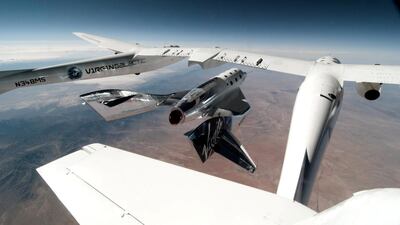
Virgin Galactic's VSS Unity, piloted by CJ Sturckow and Dave Mackay, is released from its mothership, VMS Eve. Reuters -
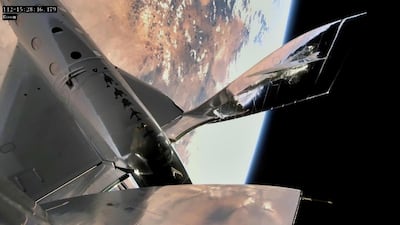
VSS Unity is seen in a still image from video during its first manned spaceflight after being released from its mothership. Reuters -
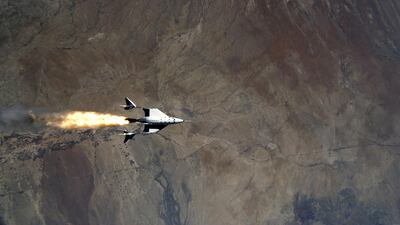
VSS Unity achieved a speed of Mach 3 after being released from the mothership. Reuters -
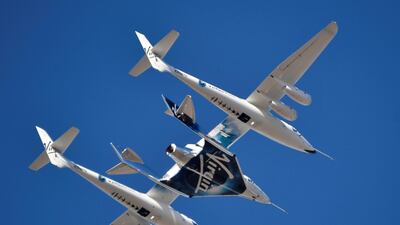
Virgin Galactic rocket plane, the WhiteKnightTwo carrier aircraft, with SpaceShipTwo passenger craft takes off from Mojave Air and Space Port in the US. Reuters


The competition between the two entrepreneurs was popularised as a “billionaire space race,” and Mr Bezos’s company continued to disparage the Virgin Galactic flight in the days before Sunday’s flight, prompting a debate over where the boundary of space actually lies.
At 85.9 kilometres, Mr Branson’s flight met the definition used by Nasa and the US Federal Aviation Administration (FAA), which say outer space begins 80km above Earth.
But he did not cross the Karman line, another definition that says space begins at 100km, which Mr Bezos has set out to cross.
"New Shepard was designed to fly above the Kármán line so none of our astronauts have an asterisk next to their name," Blue Origin said in a series of Twitter posts on Friday.
Mr Branson has insisted, however, that he and Mr Bezos are not engaged in a personal contest to beat one another into space.
Virgin is planning to carry out at least two further test flights of its rocket ship this year before regular commercial operations begin in 2022.
Demand for tickets is apparently strong, with several hundred wealthy would-be citizen astronauts already having reserved seats, which cost around $250,000.
Earlier on Sunday, Mr Branson revealed that his fellow billionaire and space entrepreneur Elon Musk, who also watched the flight in person, had reserved a seat on a future flight.
Another major player in the emerging space tourism industry, Mr Musk’s company is planning its first all-civilian space flight for later this year.

Proving Virgin Galactic’s service is safe was also a key objective of Sunday’s flight.
Its flight programme has suffered several setbacks throughout its development.
An earlier prototype of its space plane crashed during a test flight over the Mojave Desert in 2014, killing one pilot and seriously injuring another.
Mr Branson's role in Sunday's test flight was to "evaluate the private astronaut experience," Virgin Galactic said in the live-stream.
Also on board were the spaceplane's two veteran test pilots, Dave Mackay and Michael Masucci, and three mission specialists: Beth Moses, the company's chief astronaut instructor; Virgin Galactic's lead operations engineer Colin Bennett; and Sirisha Bandla, its vice president of government relations.
Sunday’s flight was hailed as a watershed moment for the space tourism sector, which the Swiss-based investment bank UBS has estimated could be worth as much as $3 billion a year by 2030.

