

Sri Lanka has imposed a ban on women covering their faces in public after the Easter Sunday terror atrocities.
The ruling comes amid warnings of further attacks by terrorists disguised in military uniform.
The authorities used emergency powers to introduce the ban with immediate effect on Monday.
President Maithripala Sirisena said he was imposing restrictions on any facial garment that "hinders identification".
The ban comes a week after it was first proposed by one of the country’s MPs.
The move has also been backed by All Ceylon Jamiyyathul Ulama, an organisation of Muslim clerics in Sri Lanka.
ISIS fighters have dressed as women to avoid justice and escape territory the militant group once held.
Security services in the country said they received intelligence that terrorists dressed in military uniform could target five sites with car bombs.
One of the targets was the eastern city of Batticaloa, where 27 people were killed in a suicide attack on a church on Easter Sunday.
The suicide attacks on churches and hotels killed more than 250 people, including 40 foreign citizens. It was the deadliest attack conducted by terrorists in Sri Lanka.
Two other suicide bombers died triggering blasts, one to avoid capture by the police and the other at an inn where he was staying.
Authorities suspect members of two little-known groups – National Tawheed Jamaat and Jammiyathul Millathu Ibrahim – were behind the attacks, although ISIS has claimed responsibility.
It released a video of eight people it claimed were members pledging allegiance to leader Abu Bakr Al Baghdadi.
-
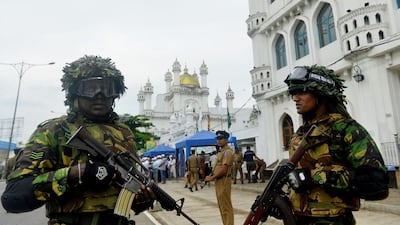
Security personnel stand guard outside a mosque in Colombo, Sri Lanka. AFP -
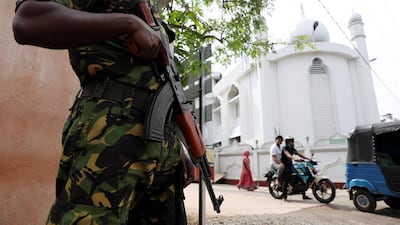
A soldier stands guard outside the Grand Mosque in Negombo. Reuters -
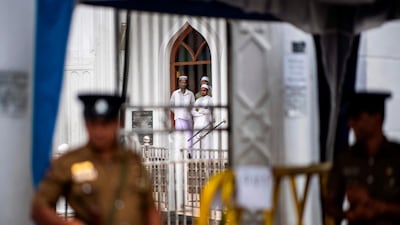
Devotees look out from a mosque as security personnel stand guard during Friday noon prayer in Colombo. AFP -

A policeman frisks a Muslim devotee as he arrives at a mosque in Colombo. AFP -
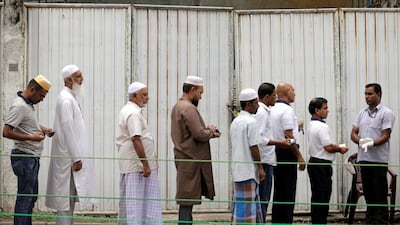
Muslim devotees wait in a line for security check near a mosque in Colombo. Reuters -
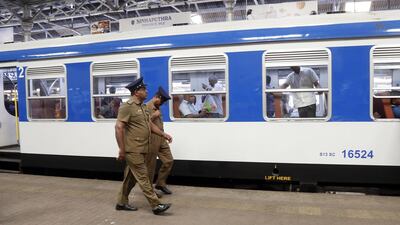
Security personnel walk past a passenger train at Fort train station in Colombo. EPA -
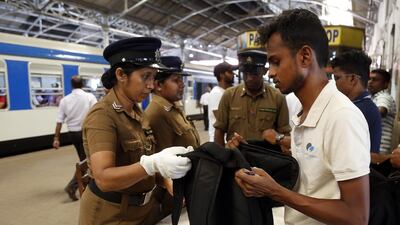
A security personnel checks the bag of a passenger at Fort train station. EPA -
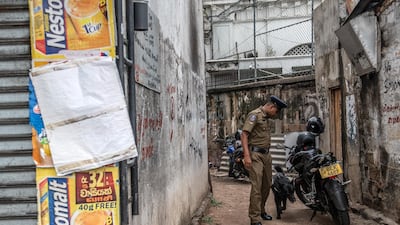
A police sniffer dog is led around the area next to Dawatagaha Jumma Masjid in Colombo. Getty Images -
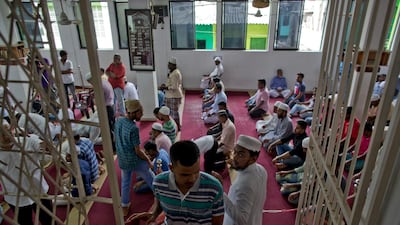
A volunteer assigned to spot unfamiliar visitors looks at a man inside a mosque in Colombo. AP Photo -
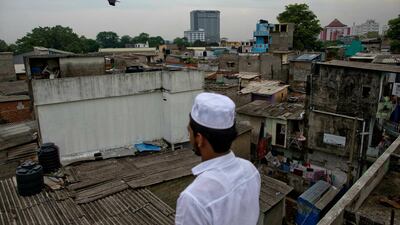
A volunteer stands in a roof of a mosque to spot possible attackers. AP Photo -
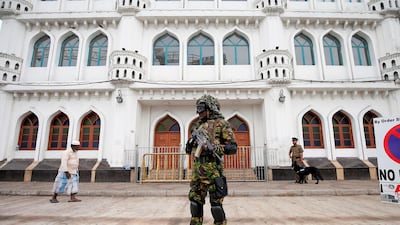
Special Task Force soldiers stand guard in front of a mosque in Colombo. Reuters


Security has been increased across the country and police are continuing to conduct random body checks and searches.
The government has declared a state of emergency and has thousands of troops searching for extremists since the co-ordinated attacks.
More than 150 people have been arrested since April 21 and 15 people have been killed in raids.
On Sunday night, a curfew imposed after the bombings was lifted.
The authorities have come under heavy criticism after it was revealed that because of a breakdown in communication, there was no action on key intelligence about an imminent attack.
Prime Minister Ranil Wickremesinghe has pledged to make significant changes as a result. He has already replaced the head of police, Pujith Jayasundara.
Police are searching for as many as 140 people believed to be connected to the atrocities.
Last Friday, the military were involved in a shootout with terrorists after uncovering a safe house.
The father and brother of suspected mastermind, Mohammed Zaharan, were among 15 people killed, along with six children.
At the end of the clash some of the suspects detonated explosives. Zaharan’s wife Sadia and his daughter Rusaina, 4, survived and are being treated in hospital.
On Monday, Cardinal Malcolm Ranjith, the archbishop of Colombo, urged the government to do more to prevent further attacks, warning that people could take the law into their own hands.
"I want to state that we may not be able to keep people under control in the absence of a stronger security programme," Cardinal Ranjith said.
"We can't forever give them false promises and keep them calm."
The country has been dealt a further blow as tourism officials warned it was expecting a 50 per cent drop in visitors, with SriLankan Airlines already reporting a 10 per cent increase in cancellations.

