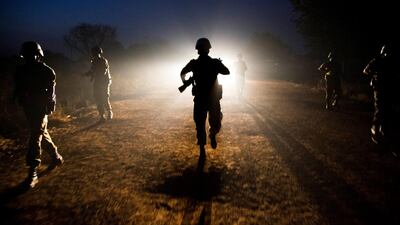
The UK’s aid watchdog says there is “limited evidence” the British government’s £3.8m ($4.9m) projects to tackle sexual abuse by peacekeeping troops is having an effect.
The number of reports to the UN of sexual exploitation and abuse rose by a third last year.
The Independent Commission for Aid Impact has conducted a review, which was published on Wednesday, into UK efforts to tackle sexual exploitation and abuse by UN peacekeepers.
It reveals that despite the millions being spent on projects between 2014 and 2019 to train thousands of peacekeepers, including soldiers, police and civilian personnel, there is no evidence to show it has been a success.
The review also criticises the UK for failing to invest in programmes to help victims.
“The ICAI found that the UK government has been a leading voice in tackling the problem, raising awareness internationally of the standards expected of troops, and funding small-scale aid projects designed primarily to drive forward UN reform,” it said.
“However, there was limited evidence that this work had led to reductions in abuses, and there had not been enough focus on working with survivors and vulnerable communities.
“The UK’s efforts to train peacekeeping troops appear useful and important, helping to shift the knowledge and understanding of peacekeepers before they are deployed.
"However, considering the level of training taking place, it is striking that more efforts were not made until very recently to track the results of the training.”
Britain’s endeavours to tackle abuse were supported by aid projects managed by the former Foreign and Commonwealth Office, the report said, mainly in the form of funding for UN reform initiatives and training programmes for international peacekeepers run by the Ministry of Defence.
One initiative has seen international peacekeepers given No Excuse cards to carry at all times, setting out the standards expected of them.
The cards, a result of a key initiative in 2017, contain a concise list of UN rules and prohibitions relating to sexual exploitation and abuse.
UK aid funding has also contributed to a UN-wide Clear Check system for tracking allegations against UN staff, ensuring those dismissed for breaches cannot take new jobs in the UN system.
Additional funding was spent by the ministry’s British Peace Support Team to train more than 10,000 peacekeeping troops each year, with soldiers taught how to identify, report and prevent abuse.
The commission said the training scheme showed “promise”, but it noted that the team did not track trends in reporting abuse when troops had been posted, and did not gather evidence of long-term changes in practice.
The review concluded it was “impossible” to gauge the impact of the training, and there is no evidence yet of a reduction in cases of abuse in peacekeeping.
“The UK’s efforts in this area have been prominent compared to other member states, and its achievements are important and useful,” ICAI chief commissioner Dr Tamsyn Barton said.
“But with survivors facing significant and daunting barriers to obtaining justice, there should be a greater focus on their needs.
"And the government should do more to link up its learning on what works across all forms of conflict-related sexual violence, in order to build an integrated body of evidence that all departments can use.
"These steps would help the UK to have more impact in tackling this persistent and widespread problem.”
The review has also raised concerns over the ability to prosecute abusers.
“Legal and practical barriers, such as peacekeepers being immune from prosecution by the country in which they are based and different legal standards across countries, mean effective investigation is difficult and prosecutions are infrequent,” the report said.
“Given the climate of impunity, achieving changes in behaviour in peacekeeping missions is likely to be a long-term endeavour.”
It has recommended that the UK government should ensure efforts to improve discipline among peacekeepers are balanced with measures to promote the interests and welfare of survivors.
It has also advised Britain to aim for “closer integration and sharing of learning” between its efforts to tackle abuse in international peacekeeping and its wider work on conflict-related sexual violence.
“The UK government could certainly do more to contribute to systematic learning efforts on how best to overcome the entrenched cultural and bureaucratic barriers to preventing abuses in international peacekeeping and achieving justice for survivors,” the report said.
Last year, the UK’s Department for International Development announced it would spend about £40m until 2023 on tackling abuse in the aid sector.
“We were informed by DFID that while much of this sum has been allocated, it has not yet been spent and most of the programming has not yet started,” the review said.
“DFID also confirmed that the vast majority of this spending will focus on safeguarding in the aid sector broadly speaking, and will not be specific to abuses in international peacekeeping.”

UAE currency: the story behind the money in your pockets
Why are asylum seekers being housed in hotels?
The number of asylum applications in the UK has reached a new record high, driven by those illegally entering the country in small boats crossing the English Channel.
A total of 111,084 people applied for asylum in the UK in the year to June 2025, the highest number for any 12-month period since current records began in 2001.
Asylum seekers and their families can be housed in temporary accommodation while their claim is assessed.
The Home Office provides the accommodation, meaning asylum seekers cannot choose where they live.
When there is not enough housing, the Home Office can move people to hotels or large sites like former military bases.
THE BIO
Born: Mukalla, Yemen, 1979
Education: UAE University, Al Ain
Family: Married with two daughters: Asayel, 7, and Sara, 6
Favourite piece of music: Horse Dance by Naseer Shamma
Favourite book: Science and geology
Favourite place to travel to: Washington DC
Best advice you’ve ever been given: If you have a dream, you have to believe it, then you will see it.
Mercer, the investment consulting arm of US services company Marsh & McLennan, expects its wealth division to at least double its assets under management (AUM) in the Middle East as wealth in the region continues to grow despite economic headwinds, a company official said.
Mercer Wealth, which globally has $160 billion in AUM, plans to boost its AUM in the region to $2-$3bn in the next 2-3 years from the present $1bn, said Yasir AbuShaban, a Dubai-based principal with Mercer Wealth.
“Within the next two to three years, we are looking at reaching $2 to $3 billion as a conservative estimate and we do see an opportunity to do so,” said Mr AbuShaban.
Mercer does not directly make investments, but allocates clients’ money they have discretion to, to professional asset managers. They also provide advice to clients.
“We have buying power. We can negotiate on their (client’s) behalf with asset managers to provide them lower fees than they otherwise would have to get on their own,” he added.
Mercer Wealth’s clients include sovereign wealth funds, family offices, and insurance companies among others.
From its office in Dubai, Mercer also looks after Africa, India and Turkey, where they also see opportunity for growth.
Wealth creation in Middle East and Africa (MEA) grew 8.5 per cent to $8.1 trillion last year from $7.5tn in 2015, higher than last year’s global average of 6 per cent and the second-highest growth in a region after Asia-Pacific which grew 9.9 per cent, according to consultancy Boston Consulting Group (BCG). In the region, where wealth grew just 1.9 per cent in 2015 compared with 2014, a pickup in oil prices has helped in wealth generation.
BCG is forecasting MEA wealth will rise to $12tn by 2021, growing at an annual average of 8 per cent.
Drivers of wealth generation in the region will be split evenly between new wealth creation and growth of performance of existing assets, according to BCG.
Another general trend in the region is clients’ looking for a comprehensive approach to investing, according to Mr AbuShaban.
“Institutional investors or some of the families are seeing a slowdown in the available capital they have to invest and in that sense they are looking at optimizing the way they manage their portfolios and making sure they are not investing haphazardly and different parts of their investment are working together,” said Mr AbuShaban.
Some clients also have a higher appetite for risk, given the low interest-rate environment that does not provide enough yield for some institutional investors. These clients are keen to invest in illiquid assets, such as private equity and infrastructure.
“What we have seen is a desire for higher returns in what has been a low-return environment specifically in various fixed income or bonds,” he said.
“In this environment, we have seen a de facto increase in the risk that clients are taking in things like illiquid investments, private equity investments, infrastructure and private debt, those kind of investments were higher illiquidity results in incrementally higher returns.”
The Abu Dhabi Investment Authority, one of the largest sovereign wealth funds, said in its 2016 report that has gradually increased its exposure in direct private equity and private credit transactions, mainly in Asian markets and especially in China and India. The authority’s private equity department focused on structured equities owing to “their defensive characteristics.”
Ways to control drones
Countries have been coming up with ways to restrict and monitor the use of non-commercial drones to keep them from trespassing on controlled areas such as airports.
"Drones vary in size and some can be as big as a small city car - so imagine the impact of one hitting an airplane. It's a huge risk, especially when commercial airliners are not designed to make or take sudden evasive manoeuvres like drones can" says Saj Ahmed, chief analyst at London-based StrategicAero Research.
New measures have now been taken to monitor drone activity, Geo-fencing technology is one.
It's a method designed to prevent drones from drifting into banned areas. The technology uses GPS location signals to stop its machines flying close to airports and other restricted zones.
The European commission has recently announced a blueprint to make drone use in low-level airspace safe, secure and environmentally friendly. This process is called “U-Space” – it covers altitudes of up to 150 metres. It is also noteworthy that that UK Civil Aviation Authority recommends drones to be flown at no higher than 400ft. “U-Space” technology will be governed by a system similar to air traffic control management, which will be automated using tools like geo-fencing.
The UAE has drawn serious measures to ensure users register their devices under strict new laws. Authorities have urged that users must obtain approval in advance before flying the drones, non registered drone use in Dubai will result in a fine of up to twenty thousand dirhams under a new resolution approved by Sheikh Hamdan bin Mohammed, Crown Prince of Dubai.
Mr Ahmad suggest that "Hefty fines running into hundreds of thousands of dollars need to compensate for the cost of airport disruption and flight diversions to lengthy jail spells, confiscation of travel rights and use of drones for a lengthy period" must be enforced in order to reduce airport intrusion.
The Cockroach
(Vintage)
Ian McEwan
