
Russian foreign minister Sergey Lavrov criticised Israeli air strikes against Iran-linked sites in Syria, saying Israel should instead provide his country with intelligence about such threats so that it can “neutralise” them.
Mr Lavrov said Russia would take action so Israeli Defence Forces wouldn’t have to.
“If Israel is really forced to respond to threats to the Israeli security coming from the Syrian territory, we have told our
Israeli colleagues many times: if you see such threats please give us the information,” Mr Lavrov said, according to the Kremlin’s Sputnik news site.
Mr Lavrov stressed that Russia does not want Syrian territory to be used either against Israel or "as a platform for the Iranian-Israeli strife."
His statement comes days after Israeli warplanes carried out intense air strikes in eastern Syria, apparently targeting positions and arms depots of Iran-backed forces.
At least 57 fighters were killed and dozens wounded, according to a Syrian opposition war monitoring group.
A senior US intelligence official with knowledge of the attack told The Associated Press that the air strikes were carried out with intelligence provided by the United States – a rare incidence of publicised co-operation between the two countries over choosing targets in Syria.
On the US presence in the region, and Russia's interaction with Washington, Mr Lavrov said: “We have contacts with the US through military channels, not because we recognise the legitimacy of its presence in Syria, but simply because it must act in a certain framework.”
-

A US military convoy patrols near the Rumaylan oil fields in Syria's Kurdish-controlled north-eastern Hassakeh province on September 17, 2020, a day before the US said it was sending more troops and vehicles to north-east Syria. AFP -
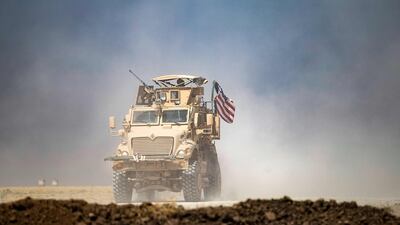
A US military vehicle patrols near the Rumaylan oil fields in Syria's Hassakeh province. AFP -
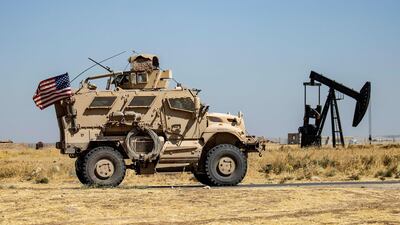
A US military vehicle passes a pumpjack in the Rumaylan oil field in north-east Syria. The major oil field, located near a US airbase, has been among the Syrian Kurds' most prized assets since regime forces withdrew early on in the Syrian civil war. AFP -
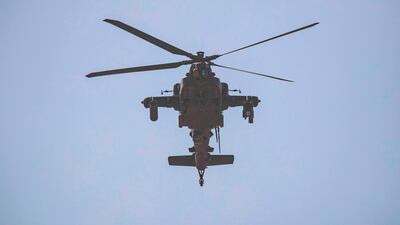
A US Apache attack helicopter flies over a field near the town of Tal Haddad in the countryside of Syria's Hassakeh province on September 15, 2020. AFP -
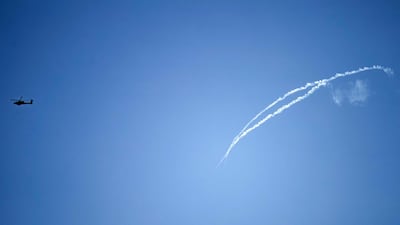
A US helicopter deploys flares as it flies over the Rumaylan oilfields in Hassakeh province on September 17, 2020. AFP -
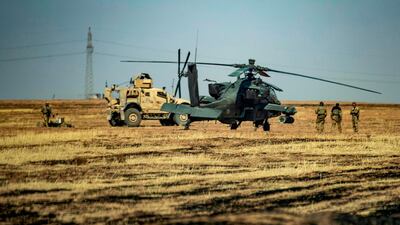
US soldiers and military vehicles stand next to an attack helicopter near the town of Tal Haddad in Syria's Hassakeh province. AFP -
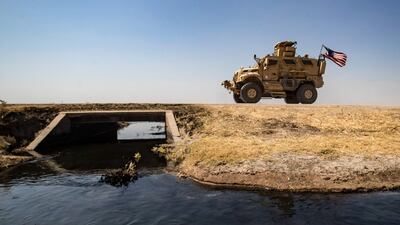
A US military vehicle patrols near the Rumaylan oil fields in Hassakeh province. AFP


"We have more than once expressed our assessments of what is happening in Syria," Mr Lavrov said
UN Security Council Resolution requires respect for Syria's sovereignty.
"Equally, Washington's line of blocking by all possible means the delivery of humanitarian aid to Syria is also in breach of this resolution," Mr Lavrov said.
“We cannot expel them from there, we will not engage in armed clashes with them of course.
"But due to their presence there, we are conducting a dialogue with them about the so-called non-conflict, and among other things, we strongly demand that force is not used against the sites of the Syrian state.”

