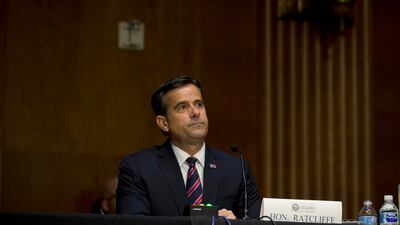
Director of National IntelligenceJohn Ratcliffe sits during a Senate Intelligence Committee nomination hearing at the Dirksen Senate Office building on Capitol Hill, Washington, on May 5, 2020. AFP

Russia probable culprit behind massive cyber attack, US intelligence agencies say


  • English
  • Arabic

The office of the US Director of National Intelligence said the group behind a string of hacks on American federal agencies that was identified last month was probably Russian in origin.

Intelligence gathering appeared to be the hackers’ goal rather than any destructive act, it said in a statement with the FBI, National Security Agency and Cybersecurity and Infrastructure Security Agency.

The offices said they had identified fewer than 10 agencies that were hacked and that the perpetrator, probably Russian in origin, was responsible for most or all of the recently discovered ongoing cyber compromises of both government and non-governmental networks. Their investigation is continuing, they said, and could uncover more security breaches.

It was the first formal statement of attribution by the Trump administration.

Elected officials briefed on the inquiry and Secretary of State Mike Pompeo had previously said Russia was behind the hacking spree, but President Donald Trump said it could have been China.

The incoming administration of Joe Biden has already promised a response to the SolarWinds hacks. On Tuesday, the top Democrats on the Congressional intelligence committees underscored that need.

“Congress will need to conduct a comprehensive review of the circumstances leading to this compromise, assess the deficiencies in our defences, take stock of the sufficiency of our response in order to prevent this from happening again, and ensure that we respond appropriately,” said Adam Schiff, head of the House committee.

Russian officials denied involvement and did not immediately respond to questions on Tuesday.

The penetration of departments including Defence, State, Homeland Security, Treasury, and Commerce is already considered to be the worst known breach of cyber-security since electronic dossiers on most Americans with security clearance were taken from the Office of Personnel Management five years ago.

Officials briefed on the case said the main target of the hackers appeared to be email. One said no classified network seemed to have been breached and that fewer than 50 private companies had been fully compromised, a smaller number than initially feared.

The SolarWinds logo is seen outside its headquarters in Austin, Texas, US, December 18, 2020. Reuters

The security company FireEye Inc, which was itself hacked, discovered the new round of attacks, many of which were traced to a tainted software update from SolarWinds Corp, which makes widely used network-management programs.

It remains unknown how the hackers got deep inside SolarWinds’ production system as long as a year ago. But once there, they were able to slip “back doors” into two digitally signed updates of the company’s flagship Orion software.

As many as 18,000 customers downloaded those updates, which sent signals back to the hackers. At a small number of high-value targets, the group then manipulated access to cloud services to read emails or other content and potentially installed other back doors, making clean-up after discovery a daunting task.

A few major technology companies said they had at least downloaded the bad code from SolarWinds. Microsoft Corp said on December 31 the penetration had gone well beyond that, enabling the intruders to view its prized source code and look for security flaws.

The attackers also hacked sellers of Microsoft services, which often maintain access to customers, to go after email at non-SolarWinds customers, said security company CrowdStrike Holdings Inc and Microsoft employees.

Microsoft and federal investigators have not said how many resellers were hacked or how many customers were affected.


UAE currency: the story behind the money in your pockets
Inside%20Out%202
%3Cp%3E%3Cstrong%3EDirector%3A%C2%A0%3C%2Fstrong%3EKelsey%20Mann%3C%2Fp%3E%0A%3Cp%3E%3Cstrong%3EStarring%3A%3C%2Fstrong%3E%C2%A0Amy%20Poehler%2C%20Maya%20Hawke%2C%20Ayo%20Edebiri%3C%2Fp%3E%0A%3Cp%3E%3Cstrong%3ERating%3A%20%3C%2Fstrong%3E4.5%2F5%3C%2Fp%3E%0A

Mercer, the investment consulting arm of US services company Marsh & McLennan, expects its wealth division to at least double its assets under management (AUM) in the Middle East as wealth in the region continues to grow despite economic headwinds, a company official said.

Mercer Wealth, which globally has $160 billion in AUM, plans to boost its AUM in the region to $2-$3bn in the next 2-3 years from the present $1bn, said Yasir AbuShaban, a Dubai-based principal with Mercer Wealth.

Within the next two to three years, we are looking at reaching $2 to $3 billion as a conservative estimate and we do see an opportunity to do so,” said Mr AbuShaban.

Mercer does not directly make investments, but allocates clients’ money they have discretion to, to professional asset managers. They also provide advice to clients.

“We have buying power. We can negotiate on their (client’s) behalf with asset managers to provide them lower fees than they otherwise would have to get on their own,” he added.

Mercer Wealth’s clients include sovereign wealth funds, family offices, and insurance companies among others.

From its office in Dubai, Mercer also looks after Africa, India and Turkey, where they also see opportunity for growth.

Wealth creation in Middle East and Africa (MEA) grew 8.5 per cent to $8.1 trillion last year from $7.5tn in 2015, higher than last year’s global average of 6 per cent and the second-highest growth in a region after Asia-Pacific which grew 9.9 per cent, according to consultancy Boston Consulting Group (BCG). In the region, where wealth grew just 1.9 per cent in 2015 compared with 2014, a pickup in oil prices has helped in wealth generation.

BCG is forecasting MEA wealth will rise to $12tn by 2021, growing at an annual average of 8 per cent.

Drivers of wealth generation in the region will be split evenly between new wealth creation and growth of performance of existing assets, according to BCG.

Another general trend in the region is clients’ looking for a comprehensive approach to investing, according to Mr AbuShaban.

“Institutional investors or some of the families are seeing a slowdown in the available capital they have to invest and in that sense they are looking at optimizing the way they manage their portfolios and making sure they are not investing haphazardly and different parts of their investment are working together,” said Mr AbuShaban.

Some clients also have a higher appetite for risk, given the low interest-rate environment that does not provide enough yield for some institutional investors. These clients are keen to invest in illiquid assets, such as private equity and infrastructure.

“What we have seen is a desire for higher returns in what has been a low-return environment specifically in various fixed income or bonds,” he said.

“In this environment, we have seen a de facto increase in the risk that clients are taking in things like illiquid investments, private equity investments, infrastructure and private debt, those kind of investments were higher illiquidity results in incrementally higher returns.”

The Abu Dhabi Investment Authority, one of the largest sovereign wealth funds, said in its 2016 report that has gradually increased its exposure in direct private equity and private credit transactions, mainly in Asian markets and especially in China and India. The authority’s private equity department focused on structured equities owing to “their defensive characteristics.”

Dhadak 2

Director: Shazia Iqbal

Starring: Siddhant Chaturvedi, Triptii Dimri 

Rating: 1/5

MATCH INFO

Uefa Champions League semi-final, first leg
Bayern Munich v Real Madrid

When: April 25, 10.45pm kick-off (UAE)
Where: Allianz Arena, Munich
Live: BeIN Sports HD
Second leg: May 1, Santiago Bernabeu, Madrid

CREW
%3Cp%3E%3Cstrong%3EDirector%3A%20%3C%2Fstrong%3ERajesh%20A%20Krishnan%3C%2Fp%3E%0A%3Cp%3E%3Cstrong%3EStarring%3A%20%3C%2Fstrong%3ETabu%2C%20Kareena%20Kapoor%20Khan%2C%20Kriti%20Sanon%26nbsp%3B%3C%2Fp%3E%0A%3Cp%3E%3Cstrong%3ERating%3A%3C%2Fstrong%3E%203.5%2F5%3C%2Fp%3E%0A
Islamophobia definition

A widely accepted definition was made by the All Party Parliamentary Group on British Muslims in 2019: “Islamophobia is rooted in racism and is a type of racism that targets expressions of Muslimness or perceived Muslimness.” It further defines it as “inciting hatred or violence against Muslims”.