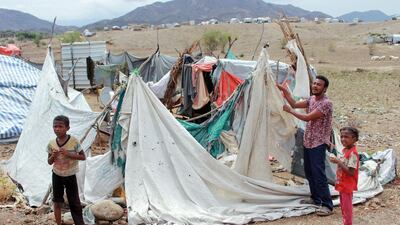

The highest total number of internally displaced people ever was recorded last year at 50.8 million people around the world, as conflict and disasters forced more people from their homes.
Annual statistics released by the Norwegian Refugee Council’s Internal Displacement Monitoring Centre show that the highest number of people on record were living in internal displacement as a result of conflict and violence alone in 2019 across 61 countries, at 45.7 million. A further 5.1 million had been displaced by natural disasters such as earthquakes and extreme weather.
The total is 10 million more than in 2018, with Syria, the country with the highest number of displacements from conflict, also seeing more people flee their homes in 2019 than in the year before at almost 1.9 million. This is in part due to President Bashar Al Assad's aggressive moves to retake territory in areas such as the last rebel stronghold of Idlib in the the north-west of the country, which displaced tens of thousands in December alone.
Secretary General of the NCR said on Twitter that the figure was "horrific" and that "politicians, generals and diplomats must seek ceasefires, not guns and grenades".
"Political violence is utterly senseless in this coronavirus era," he said.
Most of the new displacements caused by conflict and violence were recorded in sub-Saharan Africa, the Middle East and North Africa. The report said an unprecedented number were recorded in Burkina Faso, and significant increases were seen in Mali and Libya.
The Mena region saw 2.6 million new displacements, with figures for Iraq slightly lower than the decade average as the country’s conflict wanes, said the report. However, long-running conflicts in Yemen and Libya increased displacement.
India had the highest number of displacements overall, at over five million due to weather-related events. Most of the new displacements triggered by disasters in 2019 were recorded in East Asia and Pacific and South Asia, including the Philippines and Bangladesh. Monsoon rains, floods and tropical storms hit highly exposed areas that are home to millions of people.
Perhaps unexpectedly, the US is among the 10 countries with the most newly displaced people at over 900,000 due to natural disasters, such as hurricanes Dorian and Imelda.
With the global coronavirus pandemic now compounding fears for the safety of the displaced, the IDMC urged that the next decade "has the potential to become an important chapter in global efforts to reduce protracted displacement".
-

Displaced Syrian women walk at a camp in Kafr Lusin village on the border with Turkey in Syria's northwestern province of Idlib. When protesters in March 2011 demanded their rights and regime change, they likely never imagined it would trigger a reaction that has led to the 21st century's biggest war. Nine years on, President Bashar al-Assad is still in power and there to stay, more than 380,000 people have died, dozens of towns and cities razed to the ground and half of the country's entire population displaced. AFP -

Syrian Ibrahim al-Ali is assisted by his children, at the Deir Hassan camp for the displaced where they reside, in Idlib's northern countryside near the Turkish border. The 33-year-old father of four first lost three fingers, later his hearing in one ear. Then all at once, both legs and eyes. Ibrahim al-Ali was wounded every time he tried to escape Syria's war. AFP -

Syrian Ibrahim al-Ali sits in his wheelchair at the Deir Hassan camp for the displaced in Idlib's northern countryside near the Turkish border. The 33-year-old father of four first lost three fingers, later his hearing in one ear. Then all at once, both legs and eyes. Ibrahim al-Ali was wounded every time he tried to escape Syria's war. AFP -

Displaced Syrian children pose for a picture at a camp created by Turkey's Humanitarian Relief Foundation (IHH) in Kafr Lusin village on the border with Turkey in Syria's northwestern province of Idlib. When protesters in March 2011 demanded their rights and regime change, they likely never imagined it would trigger a reaction that has led to the 21st century's biggest war. Nine years on, President Bashar al-Assad is still in power and there to stay, more than 380,000 people have died, dozens of towns and cities razed to the ground and half of the country's entire population displaced. AFP -

Displaced Syrian children play in a camp created by Turkey's Humanitarian Relief Foundation (IHH) in Kafr Lusin village on the border with Turkey in Syria's northwestern province of Idlib. When protesters in March 2011 demanded their rights and regime change, they likely never imagined it would trigger a reaction that has led to the 21st century's biggest war. Nine years on, President Bashar al-Assad is still in power and there to stay, more than 380,000 people have died, dozens of towns and cities razed to the ground and half of the country's entire population displaced. AFP -

Displaced Syrian children live in a camp created by Turkey's Humanitarian Relief Foundation (IHH) in Kafr Lusin village on the border with Turkey in Syria's northwestern province of Idlib. When protesters in March 2011 demanded their rights and regime change, they likely never imagined it would trigger a reaction that has led to the 21st century's biggest war. Nine years on, President Bashar al-Assad is still in power and there to stay, more than 380,000 people have died, dozens of towns and cities razed to the ground and half of the country's entire population displaced. AFP -

A Syrian man rides his motorcycle in a destroyed neighbourhood of Sarmin town, about eight kilometres southeast of the city of Idlib in northwestern Syria. When protesters in March 2011 demanded their rights and regime change, they likely never imagined it would trigger a reaction that has led to the 21st century's biggest war. Nine years on, President Bashar al-Assad is still in power and there to stay, more than 380,000 people have died, dozens of towns and cities razed to the ground and half of the country's entire population displaced. AFP -

A Turkish military tank is seen in a destroyed neighbourhood of Sarmin town, about eight kilometres southeast of the city of Idlib in northwestern Syria. When protesters in March 2011 demanded their rights and regime change, they likely never imagined it would trigger a reaction that has led to the 21st century's biggest war. Nine years on, President Bashar al-Assad is still in power and there to stay, more than 380,000 people have died, dozens of towns and cities razed to the ground and half of the country's entire population displaced. AFP -

A Syrian woman waits with her children next to a motorcycle in Sarmin town, about eight kilometres southeast of the city of Idlib in northwestern Syria. When protesters in March 2011 demanded their rights and regime change, they likely never imagined it would trigger a reaction that has led to the 21st century's biggest war. Nine years on, President Bashar al-Assad is still in power and there to stay, more than 380,000 people have died, dozens of towns and cities razed to the ground and half of the country's entire population displaced. AFP -

A mural painting is seen on the wall of a destroyed school in Sarmin town, about eight kilometres southeast of the city of Idlib in northwestern Syria. When protesters in March 2011 demanded their rights and regime change, they likely never imagined it would trigger a reaction that has led to the 21st century's biggest war. Nine years on, President Bashar al-Assad is still in power and there to stay, more than 380,000 people have died, dozens of towns and cities razed to the ground and half of the country's entire population displaced. AFP



