


Lebanon’s former Prime Minister Saad Hariri commemorated the 15th anniversary of his father’s brutal assassination with a feisty speech on Friday.
He attacked his political rivals and lauded Rafik Hariri’s controversial legacy amidst clashes in downtown Beirut between his supporters and anti-government protesters.
After listing the achievements of his father, who became prime minister in 1992 shortly after the end of the Lebanese civil war, Mr Hariri spent most of his speech attacking his main political rivals, announcing that the deal he struck with President Michel Aoun in 2016 had ended.
“I am staying,” he repeated several times as he refuted claims that his political career had ended following his resignation on October 29.
It came nearly two weeks after the start of nation-wide anti-government protests.
The crowd cheered him on and booed when he mentioned both Gebran Bassil, the leader of his party, the Free Patriotic Movement, and President Aoun.
"Iran's cash payments can help a [political] party, but not a country,” said Mr Hariri, in a veiled criticism of Hezbollah’s leader Hassan Nasrallah, who has assured his supporters in the past that they would keep receiving help from Iran.
In contrast, Mr Hariri highlighted his close connections to Gulf and Western countries that Lebanon is expected to turn to for help to ward off its worst economic crisis in decades.
“It’s the first time that he has spoken like that and said everything that is in his heart. Before he could not do so, because he was part of the government. It’s good for us,” said Sami, who had come to listen to the commemoration speech that Mr Hariri delivered for the first time from his house in central Beirut. The reason for the change remains unclear.
Shortly before Mr Hariri’s mid-afternoon speech, dozens of his supporters who had been bused in from outside Beirut gathered in Martyrs' Square carrying his party’s blue flag and chanting “Saad Saad” and “Abou Bahaa” – a reference to Rafik Hariri and his eldest son.
After attempting to break tents set up by demonstrators over the past months, the supporters threw rocks and water bottles at protesters who had gathered to honour his father’s memory, but rejected his son. Riot police intervened to separate them and MPs who had gathered near Rafik Hariri’s grave made a rapid exit.
“Saad is better than all other politicians because he does not steal,” said one of his supporters, who came from the eastern region of the Bekaa.
Like many others, he pointed to the fact that Mr Hariri’s business empire was suffering as proof that he was an honest politician. “The revolution is against him,” he said, referring to protesters.
“Everybody knows that my city traditionally supports the Hariri family,” said Moustafa Dohabyeh, from Miniyeh, in North Lebanon.
“But since October 17, we changed and took to the streets altogether to ask for our rights.” In stark contrast with Saad Hariri supporters, Mr Dohabyeh and his friends only carried Lebanese flags.
-
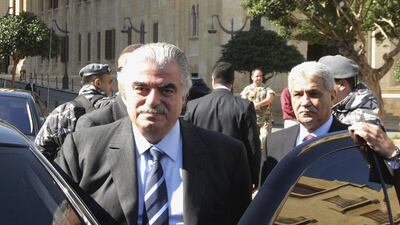
Rafik Hariri, left, and his bodyguard Yahya Arab, leave the Parliament in Beirut, Lebanon in 2005. Minutes later, Hariri and several of his bodyguards were killed in a massive bomb explosion. AP -
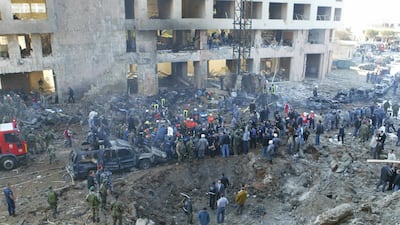
The site of devastation where former Lebanon prime minister Hariri was assassinated in the blast in Beirut on February 14, 2005. AFP -
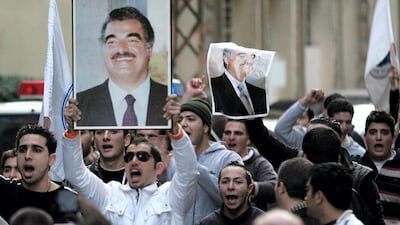
Supporters of former Lebanese prime minister Hariri after Hariri's death outside his house in Beirut. AFP -
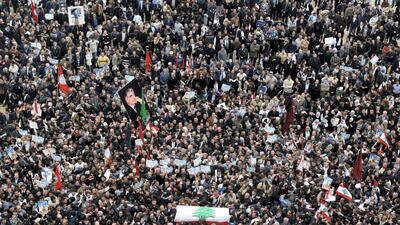
The national flag-draped coffin of Hariri is carried to his final resting place in central Beirut two days after the killing. AFP -
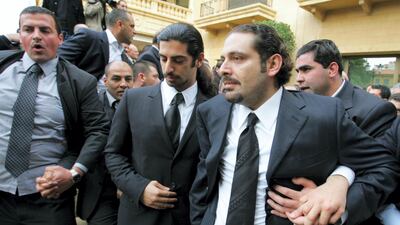
Saad Hariri and other family members leave their family home to join the funeral procession. AFP -
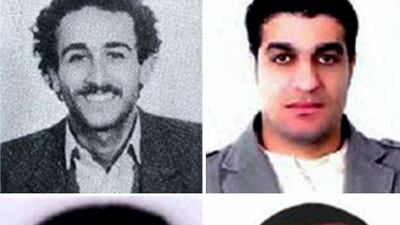
A combination of handout pictures obtained on July 29, 2011 from the website of the Special Tribunal for Lebanon shows four Hezbollah suspects indicted in the assassination case of Hariri, (from top left to right) Mustafa Amine Badreddine, Assad Hassan Sabra, Hussein Hassan Oneissi and Salim Jamil Ayyash. AFP -
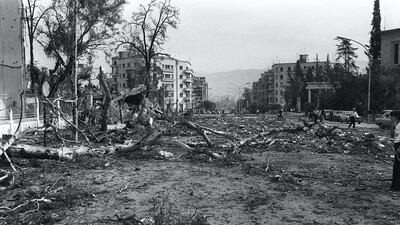
An avenue in central Beirut destroyed by 18 months of civil war is pictured, November 15, 1976. AFP -
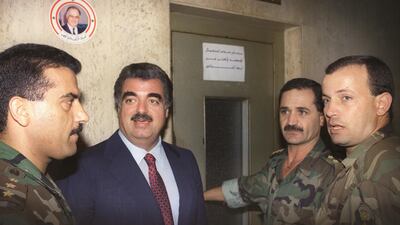
Hariri on October 22, 1992 in Beirut, after being nominated as prime minister by then president Elias Hrawi. AFP -

Hariri and his wife Nazic on September 1, 1996 in their villa in Beirut. AFP -
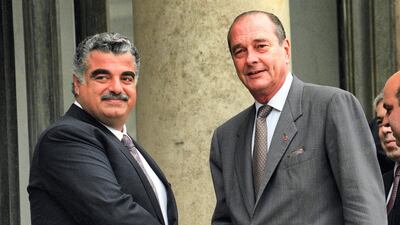
Then French president Jacques Chirac greets Hariri at the Elysee Palace in Paris, September 28, 1996. AFP -
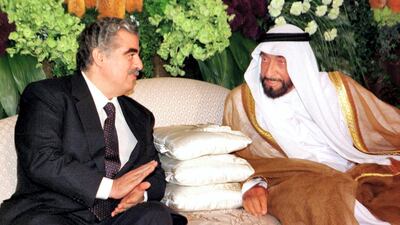
Sheikh Zayed, the Founding Father, meets Hariri in Dubai on March 17, 1999. Hariri was in Dubai for a three-day official visit. AFP -
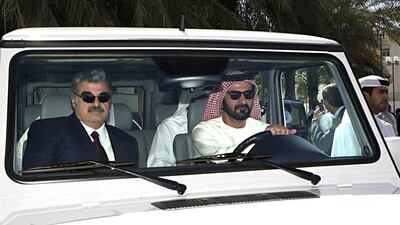
Sheikh Mohammed bin Rashed, then Crown Prince of Dubai, drives Hariri in Dubai on March 6, 2000. AFP -
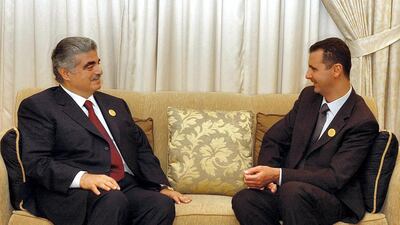
Hariri meets Syrian President Bashar al Assad on the sidelines of the Arab summit in Beirut, March 27, 2002. AFP -
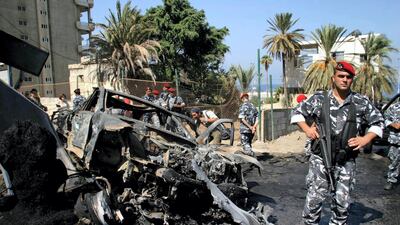
Lebanese policemen gather at the site where outgoing economy and trade minister Marwan Hamadeh's car was targeted by a bomb in Beirut on October 1, 2004. AFP -
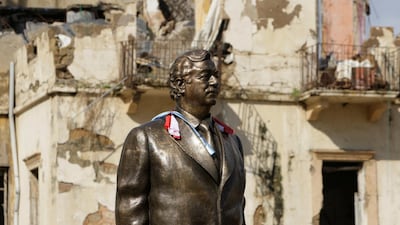
The Hariri monument in Beirut. Reuters


Though the anti-government movement has dwindled since October 17, many Lebanese still support its rejection of the political elite that they accuse of corruption.
In a rare criticism of Rafik Hariri, some protesters have traced Lebanon's current economic crisis back to decisions he took in the 1990s, including liberalising the economy and excessively supporting banks while neglecting agriculture and industry.
By stepping down early, Saad Hariri has attempted to cast himself as the only political leader who listened to protesters’ demands.
In his speech on Friday, he derided politicians who “became stars on TV” after demonstrations started.
But many Sunni Muslims also felt that his resignation weakened their community, as neither President Aoun nor Parliament Speaker Nabih Berri resigned along with him.
The country’s fragile sectarian balance rests on a division of power among religious groups, with the premiership always going to a Sunni Muslim, while the president is Maronite Christian and Parliament Speaker Shiite Muslim.
Mr Hariri’s obscure successor, Hassan Diab, does not enjoy the same popularity among Lebanon’s Sunni Muslim community.
Among those present at the memorial ceremony on Rafik Hariri’s tomb on Martyrs’ Square were relatives of the 21 other people who were killed with him.
"His death was a loss for all of Lebanon," Ihsan Fayed, told The National. She is the widow of one of Rafik Hariri's bodyguards, Talal Nasser, who is buried alongside him.
“As time passes, the situation in Lebanon only gets worse,” she lamented.
She was ambivalent about the protest movement and worried about the vandalism against buildings in downtown Beirut these past weeks.
“Even if Rafik Hariri did not achieve his dream, we cannot break what he built,” she said.
After becoming Prime Minister, he founded a private development company that rapidly rebuilt the city centre destroyed in the war, but critics say that he did so without respecting the area’s initial spirit and now only caters to the rich.
Clémence Tarraf also defended the slain premier.
“He is not the only one responsible for the problems today. All parties share responsibility,” she said. Her brother Ziad was also one of Rafik Hariri’s bodyguards who died in the blast on February 14, 2005.
Set up four years after Rafik Hariri’s death to prosecute crimes related to the bombing that killed him, the Special Tribunal for Lebanon has not yet issued a ruling but has issued charges against five Hezbollah operatives.
Soldiers and riot police remained deployed in Martyr’s Square on Friday evening, banning access to Saad Hariri’s supporters after they attempted to return when his speech ended.
They said that they wanted to pray at Al Amine mosque, built on the same square by Rafik Hariri and inaugurated after his death in 2005.
It is unclear whether Saad Hariri's aggressive tone on Friday will succeed in bolstering support for him across the country.
“Rafik Hariri became an untouchable figure after his assassination,” said Karim Bitar, an international relations analyst at the Paris-based Institute for International and Strategic Affairs.
“But Saad Hariri is an easier target because he is still around and does not have the fire power that his father used to have. It will be interesting to see if Hariri’s Future Movement will survive this unprecedented wave of protests and whether he will be able to defend his father’s political and economic legacy,” he said.

