
Shortly after Palestinians rejected the economic component of the US Middle East plan unveiled on Saturday, top Lebanese officials said that they refused to be tempted by the plan – despite it allocating billions of dollars to support infrastructure development and business in Lebanon.
Lebanese politicians have boycotted the two-day "economic workshop" in Manama, Bahrain, during which the US unveiled the peace plan, fearing that it aims to settle Palestinian refugees in their country permanently and grant them citizenship.
They argue that Palestinians who fled Israel in 1948 to neighbouring countries such as Lebanon should be allowed to return to their homeland and that their long-term presence in Lebanon disrupts the country’s delicate confessional balance. Palestinian refugees are mainly Sunni Muslim and their arrival to Lebanon is widely seen as one of the causes of the Lebanese civil wa, which lasted from 1975 until 1990.
"Those who think that waving billions of dollars can lure Lebanon… into succumbing or bartering over its principles are mistaken," Parliament speaker Nabih Berri said in a statement on Sunday, adding that Lebanon would continue refusing Palestinian permanent settlement in their country.
-
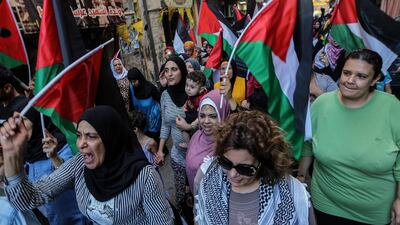
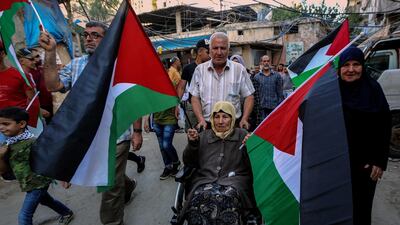
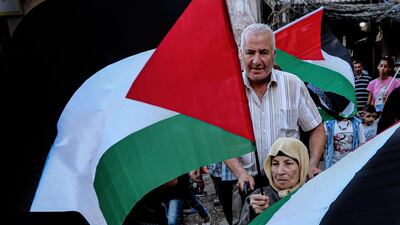
Palestinians protest against the Bahrain Conference, and the so-called 'century deal' during a rally organized by "factions of the Palestine Liberation Organization" and Fatah in the Bourj Barajneh Palestinian refugees camp, in southern suburb of Beirut, Lebanon. EPA -
Jared Kushner, a main architect of the US deal to solve the Palestinian-Israeli conflict said boycotting the meeting was a strategic error. EPA -
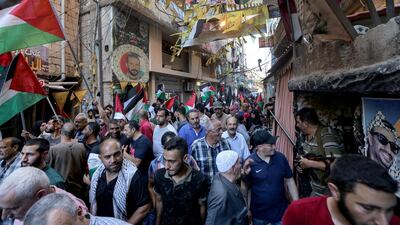
Palestinian wave their national flag in southern Beirut, protesting against the Bahrain conference. EPA -
The Bahrain conference aims to attract $50 billion (Dh183.64bn) to invest in projects in the occupied West Bank, Gaza, Lebanon, Jordan and Egypt. EPA -
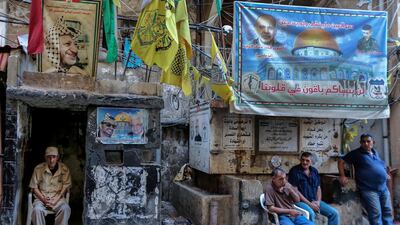
Outside the Fatah office in the refugee camp. Few senior regional figures are expected to attend the workshop, although the head of the International Monetary Fund will attend. EPA -
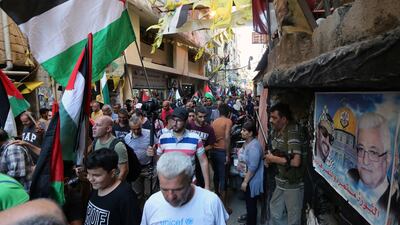
Mr Kushner has failed to comment on the political aspect of the plan, which is expected to be unveiled after Israel’s election in September. EPA -
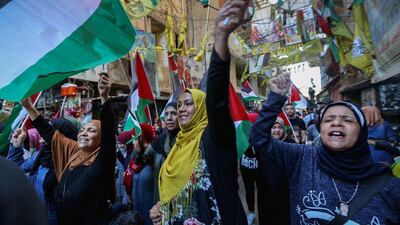
Palestinians protest against the Bahrain Conference. EPA -
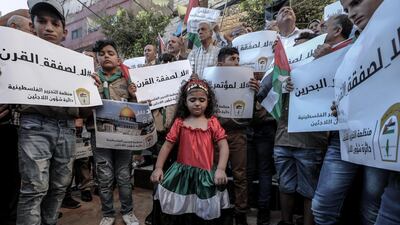
A little girl takes part in the protest. EPA -
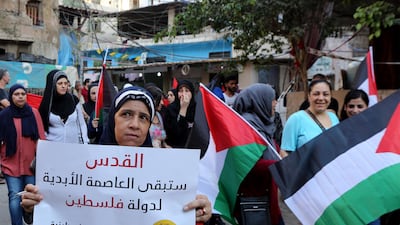
Palestinians protest against the Bahrain Conference. EPA -
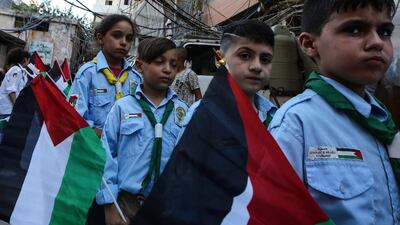
Palestinians protest against the Bahrain Conference. EPA -
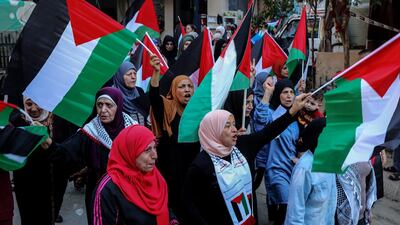
Palestinians protest against the Bahrain Conference. EPA -
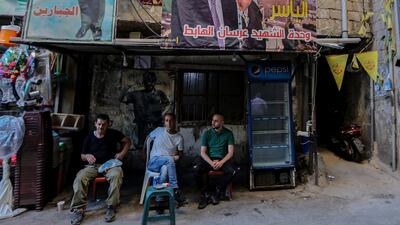
Palestinians protest against the Bahrain Conference. EPA


“Mr Kushner, you need to realise that we did not offer tens of thousands of martyrs for tens of billions of dollars to settle Palestinians and others in Lebanon. Lebanon is not a real estate company,” tweeted Lebanese MP Nadim Gemayel.
Representatives of Palestinian factions and Lebanese political parties issued a joint press release on Monday saying that that the US’s aim to permanently resettle 5.2 million Palestinian refugees outside of their country of origin would represent a “new fragmentation of the Arab region” and pose “grave dangers to both the Palestinian cause and host countries.”
The US peace plan calls for investing $27 billion in Gaza and the West Bank, $9.1 billion in Egypt, $7.3 billion in Jordan, and $6.3 billion in Lebanon.
Suggested investments in Lebanon do not focus on Palestinians, targeting instead Lebanon's crumbling infrastructure, with a proposed mixture of grants, loans and private investments raising $3 billion to improve highways, $2 billion to build a railway network, and $1 billion to expand ports and airports.
A government source told The National that Lebanon had not been consulted by the US or international bodies such as the World Bank regarding these proposals.
International support for Lebanon to revamp its infrastructures already exist. Lebanon is currently implementing reforms to receive over $11 billion in soft loans and grants that were awarded during a conference in Paris in April 2018.
The economic programme of the US peace plan does not mention living conditions of Palestinians in Lebanon. Out of the five areas in which the United Nations Relief and Works Agency for Palestine Refugees in the Near East (UNRWA) operates, Lebanon has the highest percentage of Palestinian refugees living in poverty.
Lebanon bars Palestinians from working in 20 professions. Over half of the country’s Palestinians live in 12 refugee camps, which suffer from poverty, overcrowding and unemployment.
The 2017 Lebanese census found that there were 175,000 Palestinian refugees living in the country.

