
The US envoy to Israel, a staunch supporter of Jewish settlements in the occupied West Bank, has emerged as a central figure in the uncertainty surrounding Israel's annexation plans in the Palestinian territory.
Ambassador David Friedman has, according to some experts, encouraged Israeli Prime Minister Benjamin Netanyahu's government to act swiftly on annexation – even more swiftly than the White House wants.
Mr Friedman, a 61-year-old lawyer, was an enthusiastic supporter of the US embassy's 2018 move to Jerusalem and has a long history of supporting West Bank settlements, communities considered illegal under international law.
Before being named ambassador in 2017, he worked with an organisation called the American Friends of Beit El Institutions, which supports an illegal settlement outside the West Bank town of Ramallah.
Since taking up his post, Mr Friedman has asserted Israel's "right" to annex occupied West Bank territory.
Mr Friedman also has a long-standing relationship with President Donald Trump, having represented Trump-linked companies in US bankruptcy proceedings.
The US president's controversial Middle East peace plan paves the way for Israel to annex about 30 per cent of the occupied West Bank as part of a larger package of proposals, including negotiations with the Palestinians on a future state.
-
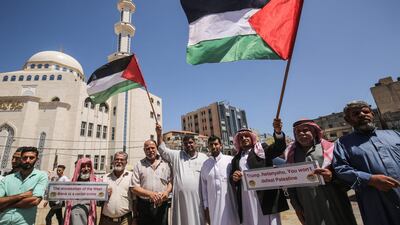
Palestinian protesters take part in a demonstration against Israel's plans to annex parts of the occupied West Bank, in Khan Yunis in the southern Gaza Strip. AFP -
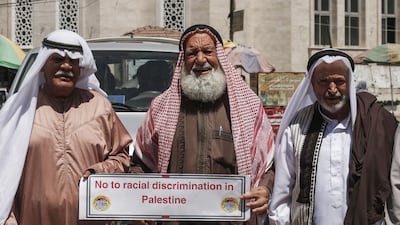
Palestinian protesters shout slogans as they take part in a demonstration against Israel's plans to annex parts of the occupied West Bank, in Khan Yunis in the southern Gaza Strip. AFP -

Palestinian protesters shout slogans as they take part in a demonstration against Israel's plans to annex parts of the occupied West Bank, in Khan Yunis in the southern Gaza Strip. AFP -
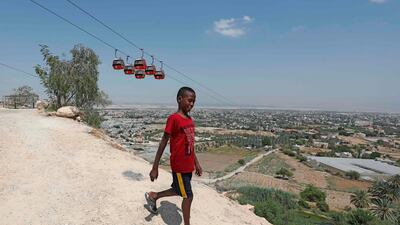
A Palestinian youth walks down a hillside overlooking the West Bank city of Jericho. When Israeli Prime Minister Benjamin Netanyahu unveiled a map of his plans in September, he pointed to a long blue zone to be annexed, leaving a brown speck in the middle: Jericho. Now the city's farmers in the occupied West Bank fear being marooned on a scrap of Palestinian land if Israel forges ahead with its plans to annex the Jordan Valley. AFP -
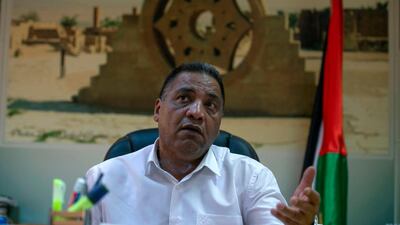
Palestinian mayor of Jericho Salem Ghrouf speaks during an interview at his office in the West Bank city. When Israeli Prime Minister Benjamin Netanyahu unveiled a map of his plans in September, he pointed to a long blue zone to be annexed, leaving a brown speck in the middle: Jericho. Now the city's farmers in the occupied West Bank fear being marooned on a scrap of Palestinian land if Israel forges ahead with its plans to annex the Jordan Valley. AFP -
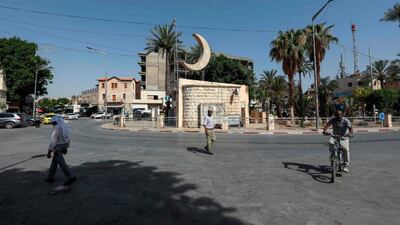
Palestinians pass by on a street of the West Bank city of Jericho. When Israeli Prime Minister Benjamin Netanyahu unveiled a map of his plans in September, he pointed to a long blue zone to be annexed, leaving a brown speck in the middle: Jericho. Now the city's farmers in the occupied West Bank fear being marooned on a scrap of Palestinian land if Israel forges ahead with its plans to annex the Jordan Valley. AFP -
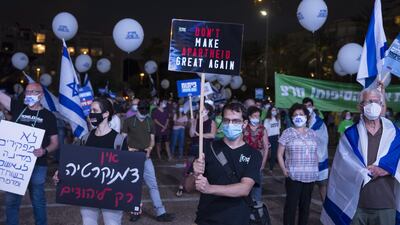
Israelis hold signs as they protest against the Israeli goverment's plan to annex parts of the West Bank in Tel Aviv, Israel. Getty Images -
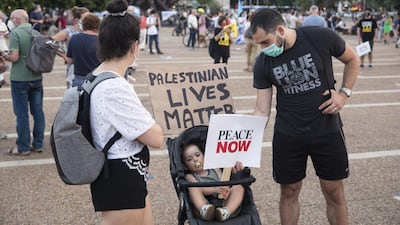
Israelis hold signs as they protest against Israel goverment's plan to annex parts of the West Bank in Tel Aviv, Israel. Getty Images -
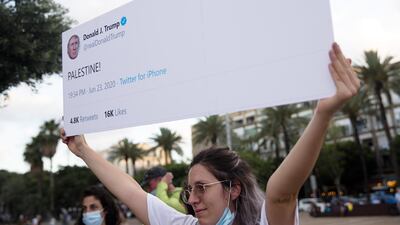
An Israeli woman holds a sign as she protests against Israel goverment's plan to annex parts of the West Bank in Tel Aviv, Israel. Getty Images -

Protesters, wearing masks of Israel's Prime Minister Benjamin Netanyahu and his coalition partner Defence Minister Benny Gantz, take part in a demonstration in Tel Aviv's Rabin Square to denounce Israel's plan to annex parts of the occupied West Bank. AFP -
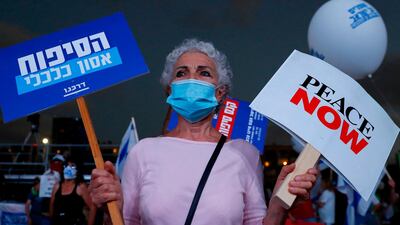
A protester, wearing a protective mask due to the COVID-19 pandemic, holds placards during a demonstration in Tel Aviv's Rabin Square to denounce Israel's plan to annex parts of the occupied West Bank. AFP -
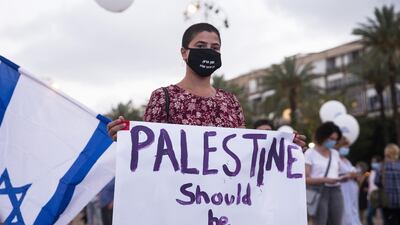
TEL AVIV, ISRAEL - JUNE 23: An Israeli woman holds a sign that reads "Palestine should be free" as she protest against Israel goverment's plan to annex parts of the West Bank in Tel Aviv, Israel. Getty Images


The Palestinians have rejected negotiations on Mr Trump's terms and some see Mr Friedman as the main US voice pushing Israel to move forward unilaterally on annexations alone – a move certain to cause international outrage.
"I think he is not representing exactly the US, but more his own opinion or goals," Nitzan Horowitz, an Israeli opposition politician and head of the left-wing Meretz party, said.
"He is pursuing a very obsessive agenda of annexation, which according to my knowledge and understanding, is not shared by most of his colleagues in Washington," Mr Horowitz said, explaining that his information came from talks with foreign and Israeli officials.
The US embassy declined to comment.
Mr Netanyahu's centre-right coalition had set July 1 as the date it could begin acting on annexation under the terms listed in Mr Trump's plan.
When no implementation detail was announced on Israel's self-declared starting date last week, speculation began circulating in Israeli media that US reticence about immediate action partly compelled Mr Netanyahu to pull back.
Michael Oren, who served as Mr Netanyahu's envoy to Washington, told AFP that the US position on annexation is split between Mr Friedman's view and that of senior White House adviser Jared Kushner.
Mr Kushner, Mr Trump's son-in-law and a leading architect of the peace proposals, sees the plan as an "organic whole", said Mr Oren, an expert on US-Israeli affairs.
For Mr Kushner, if Israel acts unilaterally on annexation it risks alienating regional players whose support for the broader plan is essential, especially Arab states in the Gulf theoretically responsible for financially supporting a future Palestinian state.
Mr Oren, who said he knows Mr Friedman "fairly well", agreed that the ambassador wanted action on annexation independent of progress on the rest of the Trump plan.
But he played down the notion Mr Friedman was motivated purely by religious zeal or a personal desire to see so-called Jewish Law applied in occupied West Bank areas some Israelis refer to by the biblical terms "Judea and Samaria".
"Yes, [Friedman] is pro-settlement, yes he is pro-annexation," Mr Oren said. People wrongly attribute to the ambassador a desire "to annex the entire West Bank", he said.
Mr Oren said Mr Friedman's motives were partly tactical.
"You have to show movement on the peace programme or it is going to die like every other peace programme."
Moving ahead with annexation would in effect put the Trump plan in motion, he said.
Mr Friedman's view is that if the Palestinians "leave the [negotiating] table they cannot go unpunished," said Mr Oren, who also advised former prime minister Yitzhak Rabin, who signed the 1994 Oslo peace accords with the Palestinians.
Evidence of a Friedman-Kushner split was on display within days after Trump's plan was unveiled at the White House in January.
The ambassador told reporters that night that Israel "does not have to wait at all" before annexing West Bank territory, comments publicly rejected by Mr Kushner days later.

