
Poverty in the occupied West Bank may double as Palestinians are hit by the economic fallout of the coronavirus pandemic, the World Bank warned on Monday.
The Palestinian territories have reported low infection rates after acting quickly to curtail the spread of Covid-19, with three deaths out of 450 cases registered among about five million residents in Gaza and the West Bank.
But the Palestinian Authority's financial situation is "expected to become increasingly difficult" due to loss of income and increased spending on health care and other areas, the World Bank said in a report.
The fallout is expected to increase the number of households living below the poverty line this year from 14 to 30 per cent in the West Bank, largely because Palestinians cannot cross into Israel for work.
-

Policemen from the Beirut municipality warn citizens walking the promenade without wearing face masks along the Corniche Al Bahr just before the start of the nightly restrictions, in Beirut, Lebanon. EPA -

Members of medical team wearing protective suits walk to a clinic in Misrata, Libya. Reuters -

A woman wearing a face mask passing by a mural depicting a pharaonic graffiti in Cairo, Egypt. EPA -

A man lowers his face mask as he drinks tea in Cairo, Egypt. EPA -

Local residents sit at an area, near to Ataturk Olympic Stadium, background, in Istanbul. AP Photo -

A medic checks the body temperature of passengers, who were stranded following the closure of border upon their arrival from Iraqi Kurdistan to the Syrian side of the Semalka border crossing in north-east Syria. AFP -

Passengers, who were stranded following the closure of border because of the Covid-19 pandemic, wait on their arrival from Iraqi Kurdistan to the Syrian side of the Semalka border crossing in north-east Syria. AFP -
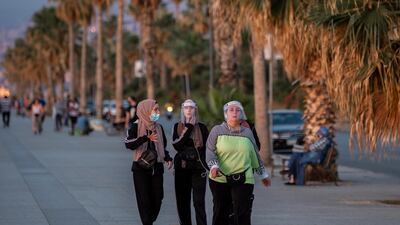
People walk the promenade during a sunset along the Corniche Al Bahr just before the start of nightly restrictions, in Beirut, Lebanon. EPA -

A worshipper wearing surgical gloves to prevent the spread of Covid-19 prays at Al Mirabi Mosque in Jeddah, Saudi Arabia. AP Photo -

Worshippers wearing face masks to prevent the spread of Covid-19 pray at Al Mirabi Mosque in Jeddah, Saudi Arabia. AP Photo


The PA last week announced an end to the lockdown it had imposed in early March across the West Bank after an outbreak of Covid-19 in the city of Bethlehem.
The easing allowed more than 63,000 Palestinians to pass through checkpoints for work on Sunday, according to the Israeli military branch handling civilian affairs in the occupied Palestinian territories.
The borders of the Hamas-run Gaza Strip, which has been under a crippling Israeli blockade since 2007, remain closed to all but a few returning Gazans, who are quarantined on arrival.
The poverty rate was already 53 per cent in Gaza before the pandemic and the World Bank forecast it would rise to 64 per cent this year.
Overall, the Palestinian economy is set to shrink between 7.6 and 11 per cent, the global body said, a severe downturn after one per cent growth in 2019.
Despite the PA taking steps to manage the economic blow of the coronavirus, the World Bank said its financial gap "could increase alarmingly" from $800 million last year to $1.5 billion this year.
"At this point, it is not possible to say how long it will take for the economy to recover from the current containment measures," the bank said.
The report recommended investing in mobile networks to boost the economy.
Palestinians rely on 2G and 3G mobile data networks in Gaza and the West Bank respectively, while some countries are already adopting 5G.

