
Two American hostages held in Yemen were freed in a prisoner swap involving more than 200 Houthis.
Aid worker Sandra Loli was held for three years and businessman Mikael Gidada for about one year, Kash Patel, a deputy assistant to US President Donald Trump, told The Wall Street Journal.
They were flown out of Sanaa, the Yemeni capital held by the Iran-backed Houthis, on a Royal Air Force of Oman plane. The body of a third American, Bilal Fateen, was also on board.
The US gave no details about how the freed hostages were captured or what they had been doing in Yemen.
Mr Patel said the US was ensuring that the released Houthis did not return to fighting.
US Secretary of State Mike Pompeo thanked American officials, Saudi Arabia's King Salman and Crown Prince Mohammed bin Salman, and Sultan Haitham of Oman for their diplomatic efforts.
"My deepest condolences go out to the family of a third American who died while in captivity but whose remains are being repatriated," Mr Pompeo said.
A source in Sanaa told The National that two Omani jets landed in Sanaa airport on Wednesday afternoon carrying 283 Houthis from Muscat.
The source said the Omani planes took off from Sanaa airport back to Muscat transferring Houthis and the freed American hostages.
“One of the Omani planes evacuated American detainees released from the Houthi prisons in Sanaa and the other plane flew Houthi loyalists from Sanaa back to Oman,” the source said.
The source did not give details about the Houthis who were taken to Muscat.
A member in the Yemen government prisoner swap team told The National that the release of the American hostages from the Houthi prisons was part of a deal struck by the Arab Coalition and the US with the rebels.
The prisoner swap committee convened in Geneva in September and reached a deal to swap 1,081 detainees, including Saudi Arabians and Sudanese.
“We didn’t discuss topics related to foreign prisoners during the last negotiation round in Geneva,” Yaser Al Haddi, a member in the Yemen government team, said on Wednesday
“We have no idea about this deal. I think it was struck by the coalition and the Americans with the Houthis.
Mr Al Haddi said the prisoner swap agreed to with the Houthis would begin on October 16 led by the International Committee of the Red Cross.
Saudi officials were said to be reluctantly supportive of the swap.
For months, UN envoy to Yemen Martin Griffiths has been pushing all sides to agree to a ceasefire that would pave the way for broader peace talks.
The conflict erupted in 2014, when the Houthis seized Sanaa and much of the country’s north.
A Saudi-led Arab Coalition intervened the following year in an effort to restore the government of President Abdrabu Mansur Hadi to power.
Yemen’s internationally recognised government said that at least 1,000 Houthi fighters were killed in September as the Arab Coalition thwarted a rebel attack.
The rebels have been pushing on several fronts towards the last government-controlled major northern city, Marib, and other towns.
-
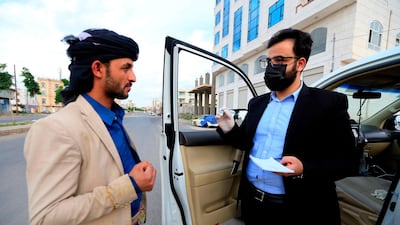
Yemeni physician Sami Yahya Al Hajj provides free medical service from his car in the capital Sanaa. AFP -
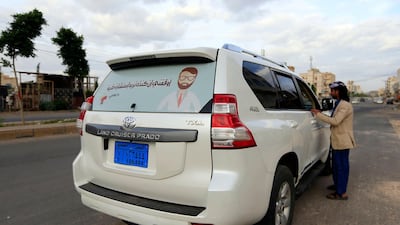
'Stop me if you need a medical consultation', reads a sticker on the rear window of Sami Yahya Al Hajj's car, alongside a cartoon figure of the bearded doctor wearing his square spectacles. AFP -
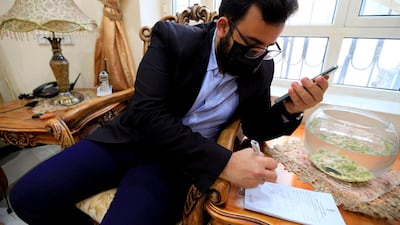
In a war-ravaged country now battling coronavirus, the Yemeni doctor has hit the road to dispense medical advice from his car, gathering a large social media following along the way. AFP -
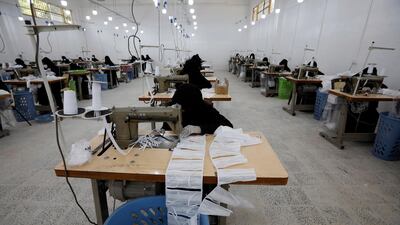
Women make protective face masks to be used to help curb the spread of the ongoing Covid-19 pandemic, at a textile factory in Sanaa. EPA -
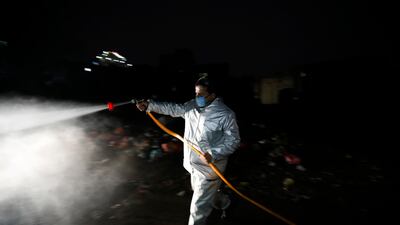
A Yemeni volunteer wearing a protective suit sprays disinfectant at a neighbourhood amid the ongoing Covid-19 pandemic in Sanaa. EPA -
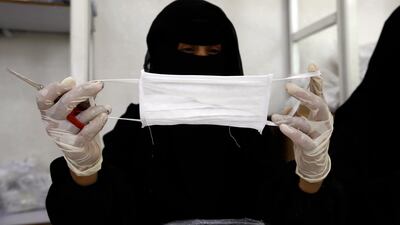
More than 160 Yemeni women work in a revitalised textile factory in Sanaa to make nearly 15,000 protective face masks per day amid a severe shortage of surgical masks. EPA -
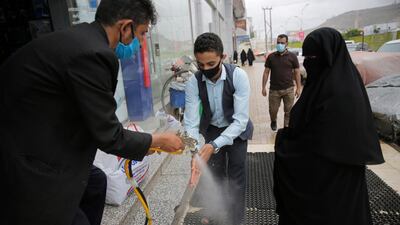
A worker disinfects a shopper's hands as a preventive measure against the spread of the new coronavirus before they enter a mall in Sanaa. AP -
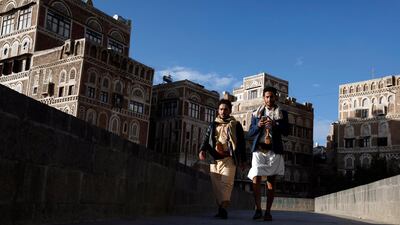
Yemenis walk past historic buildings amid the ongoing Covid-19 pandemic in the old quarter of Sanaa. EPA -
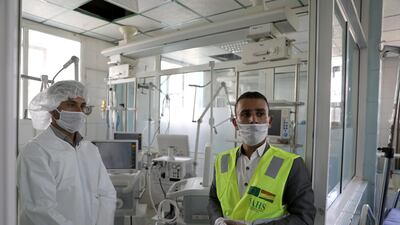
A nurse and a trainer during a lesson on how to operate ventilators recently provided by the World Health Organisation, in an intensive care ward for coronavirus patients in Sanaa. Reuters, file -
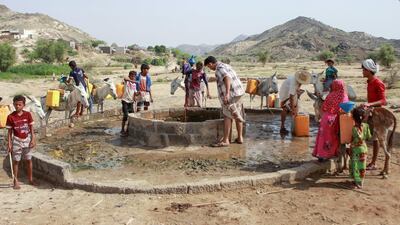
Yemenis fill their jerrycans carried by donkeys with water from a cistern at a make-shift camp for the internally displaced in the northern Hajjah province. AFP



