


The head of the UN food agency said on Monday that he is “very, very concerned” Lebanon could run out of bread in about 2 and a half weeks because 85 per cent of the country’s grain comes through Beirut’s devastated port – but he believes an area of the port can be made operational this month.
David Beasley, who is in Beirut assessing damage and recovery prospects, told a virtual UN briefing on the humanitarian situation following last week’s explosion in the Lebanese capital that “at the devastated site, we found a footprint that we can operate on a temporary basis.”
“Working with the Lebanese army, we believe that we can clear part of that site,” Mr Beasley said. “We’ll be airlifting in a lot of equipment, doing everything we can.”
Mr Beasley said he had met with Cabinet ministers – who all resigned later on Monday – and told them the UN needs “absolute co-operation now, no obstacles” because people on the streets are angry and said they need international help but “please make certain that the aid comes directly to the people.”
For the first time since last week’s blast, two ships docked at Beirut’s port on Monday including one carrying grain, according to state media.
The head of the workers union at the port, Bechara Asmar told Al Jadeed TV that since the grain silos were destroyed by the explosion, the material will be pumped directly to trucks or bags after being sanitised.
“This is a glimmer of hope,” Mr Asmar said about the first arrivals adding that the port’s fifth basin where the ships docked remains intact despite the blast.
-

Lebanese anti-government protesters pull a protection wall leading to the Parliament square during a protest in Beirut. EPA -

A protester strikes a wall with a metal bar inside the Lebanese Banks Association (ABL) headquarters. Bloomberg -
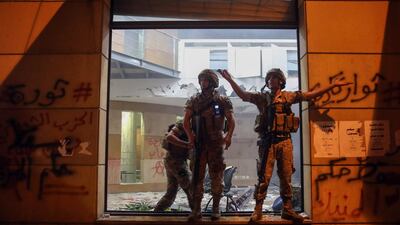
Lebanese army soldiers stand guard by a shattered window inside the Lebanese Banks Association (ABL) headquarters during a demonstration. Bloomberg -

Protesters break into the Lebanese Banks Association (ABL) headquarters during a demonstration. Bloomberg -

A protester strikes the ceiling inside the Lebanese Banks Association (ABL) headquarters during a demonstration. Bloomberg -
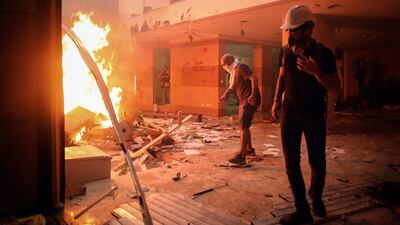
Protesters light fires inside the Lebanese Banks Association (ABL) headquarters during a demonstration. Bloomberg -
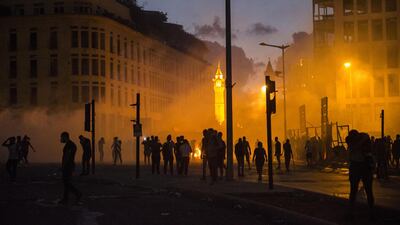
A cloud of tear gas drifts through a crowd of protesters during a protest at Martyrs Square. Getty Images -

Lebanese security forces run during clashes with anti-government protesters. EPA -

A Lebanese anti-government protester flashes a victory sign and holds a blood-stained yellow jacket of a fellow protester during clashes with riot police. EPA -

Protesters use fire extinguishers to block protesters' movements from the Internal Security Forces, not pictured, during a protest at Martyrs Square. Getty Images -

Protesters move through a cloud of tear gas during a protest at Martyrs Square. Getty Images -
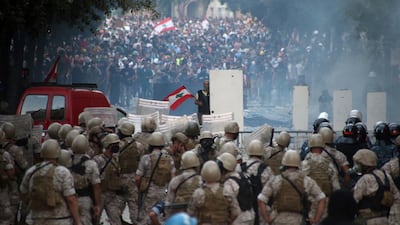
Lebanese anti-government protesters face off with riot police. EPA -

A Lebanese protester waves the national flag during clashes with security forces in downtown Beirut. AFP -

A Lebanese protester speaks to soldiers at the headquarters of the Lebanese association of banks in downtown Beirut. AFP -

An injured demonstrator is evacuated during a protest. Reuters


Mr Beasley, the executive director of the World Food Programme, said a ship with 17,500 metric tons of wheat flour should arrive in Beirut “within two weeks, and that’s to put bread on the table of all the people of Lebanon and that will give us a bread supply for 20 days.”
“While we’re doing that, we’ve got a 30-day supply of about 30,000 metric tons of wheat that we’re bringing in, and then another 100,000 metric tons over the next 60 days after that,” Mr Beasley said.
Najat Rochdi, the UN humanitarian co-ordinator for Lebanon, told a press conference after briefing UN members that Beasley went to the port with engineers to assess what can be done.
“They are very optimistic to start actually this rehabilitation as soon as this week to increase the capacity of the port of Beirut,” she said.
Ms Rochdi said she understands a ship will be arriving Thursday with some construction material, followed by a ship with wheat and grain, “to address the issue of food security and to hopefully make sure Beirut is not going to be short of bread.”
UN humanitarian chief Mark Lowcock told diplomats the “swift and wide-ranging” humanitarian response is just the first of a three-phased response to the tragedy.
“The second – recovery and reconstruction – will cost billions of dollars and require a mix of public and private finance,” he said. "The third element is responding to the Lebanon’s pre-existing socioeconomic crisis which is already exacerbated by Covid-19.”
Mr Lowcock, the undersecretary-general for humanitarian affairs and emergency relief co-ordinator, stressed the Beirut explosion last Tuesday “will have repercussions far beyond those we see in front of us now.”
He urged donors, international financial institutions and the wider international community to “come together and put their shoulder to the wheel,” stressing that the Lebanese people will be served best by a collective response.
UN Secretary-General Antonio Guterres told UN member nations the voices of Lebanon’s angry people “must be heard.”
“It is important that a credible and transparent investigation determine the cause of the explosion and bring about the accountability demanded by the Lebanese people,” he said.
“It is also important that reforms be implemented so as to address the needs of the Lebanese people for the longer term.”
Mr Guterres also pledged that “the United Nations will stand with Lebanon to help alleviate the immediate suffering and support its recovery.”

