


US President Donald Trump unveiled his long-awaited peace plan yesterday, offering the Palestinians a sovereign state with a capital in parts of occupied East Jerusalem if they meet a range of conditions. He called it a “historic opportunity” to end the decades-long conflict.
The 180-page plan, rejected by the Palestinians before and after its roll-out, would “more than double” the size of Palestinian territory in occupied East Jerusalem and the occupied West Bank, while meeting Israel’s security requirements, he claimed.
The US president made the announcement while standing next to Israeli Prime Minister Benjamin Netanyahu, who Mr Trump said endorsed the plan and agreed to negotiations with the Palestinians.
The plan is expected to recognise all of Israel’s settlements in the occupied West Bank – considered to be illegal by much of the international community – a move that would allow Israel to annex all of the outposts, which are home to more than 400,000 settlers.
Jerusalem will “remain Israel’s undivided capital”, Mr Trump said, announcing that Israel’s illegal settlement outposts in occupied East Jerusalem would fall under Israeli sovereignty. It would leave all of Jerusalem up to the security barrier that dissects Palestinian communities in occupied East Jerusalem as Israeli territory, with Arab neighbourhoods outside the wall serving as the Palestinian capital.
The plan will form the basis of negotiations if both sides agree to come to the table.
But the Palestinians immediately rejected the plan. Palestinian President Mahmood Abbas called for unity between all Palestinians, and said “we will not kneel and we will not surrender”. Rejecting the American peace plan, he said: “Jerusalem is not for sale.”
A Palestinian Liberation Organisation official told The National that the Trump administration is “making it easier for us than expected” in terms of rallying the international community around the Palestinian push for statehood because of what he said was its pro-Israeli approach to solving the conflict.
Senior Hamas official Khalil Al Hayya said: “We are certain that our Palestinian people will not let these conspiracies pass.
"So all options are open. The occupation and the US administration will bear the responsibility for what they did."
The official Palestinian news agency Wafa quoted Hamas leader Ismail Haniyeh as saying his group supported Mr Abbas's "steadfast positions".
Mr Haniyeh said Hamas rejected the White House's peace plan and called on Palestinian factions to set their differences aside and unite against the plan.
_______________
The peace plan document in full
_______________
Mr Trump also said he sent a letter to Mr Abbas outlining his vision "for a wonderful state."
"It will work," he said, inviting him to negotiate the plan. "I explained to him that the territory allocated for his new state will remain open and undeveloped for a period of four years.
“My vision presents a win-win opportunity for both sides, a realistic two-state solution that resolves the risk of Palestinian statehood to Israel’s security. Today, Israel has taken a giant step towards peace.
“Forging peace between Palestinians and Israelis may be the biggest challenge of all but I was not elected to do small things.”
Mr Trump was addressing an audience including US Secretary of State Mike Pompeo, Treasury Secretary Steve Mnuchin, special representative for Iran Brian Hook, Mr Trump’s daughter Ivanka, son-in-law Jared Kushner and Arab ambassadors including the UAE’s Yousef Al Otaiba.
The ambassadors of Oman and Bahrain were also present.
No Palestinians or Israelis will be uprooted from their homes in the implementation of the plan, Mr Trump said.


The US would open an embassy in any future Palestinian state as part of the plan.
Statehood would depend on the Palestinians respecting human rights, freedom of the press, and having a transparent and credible judiciary, the plan states.
It will include “the firm rejection of terrorism", Mr Trump said.
“Peace requires compromise but we will never ask Israel to compromise its security. Can’t do that,” he said.
Mr Trump said that his proposal represents a “historic opportunity” for the Palestinians to achieve a sovereign state, calling it their “last chance” to do so.
As part of the plan, Israel would agree to a four-year freeze on settlement activity while Palestinian statehood was negotiated.
Mr Netanyahu said he had agreed to negotiate with the Palestinians on the basis of Mr Trump's deal and thanked him for being the "greatest friend Israel has ever had in the White House".
The plan calls for Palestinian refugees to be able to return to a future state and creates a “generous compensation fund”.
The fate of Jerusalem's holy sites will remain unchanged, with Jordan retaining custodianship of Al Aqsa Mosque compound.
Mr Netanyahu said the site would be open to all faiths, hinting that Jews may be allowed to pray at the site under the plan, something that had been forbidden at the compound.
US ambassador to Israel and settlement donor David Friedman said in a conference call that he hoped the Palestinians "agree to come to the table we'll support continued negotiations on all the issues".
But Mr Friedman did not see Palestinians acquiescence as mandatory for the plan to succeed.
"It doesn't matter what the Palestinians say," he said. "We are going to keep this option open to them for four years."
In response to the plan, Jordan said an independent Palestinian state must be based on 1967 lines with East Jerusalem as its capital.
"The two-state solution that fulfils the legitimate rights of the Palestinian people, in accordance with international law, is the only path to a comprehensive and lasting peace," Jordan said.
The Jordanian Foreign Minister, Ayman Safadi, warned "against the dangerous consequences of unilateral Israeli measures".
King Abdullah will dedicate all resources "to protect Jerusalem and its holy sites, preserve the historical and legal status quo and protect their Muslim, Christian identity", Mr Safadi said.
“Jordan supports every genuine effort aimed at achieving just and comprehensive peace,” he said.
Mr Safadi said such peace was necessary for the security and stability of the region, and "protects the interests of Jordan, including these related to final status issues".
Mr Trump said Palestinians had been trapped in a cycle of “terrorism, poverty and violence” that had prevented their national hopes.
He made no mention of the Israeli military occupation that has existed in the Palestinian territories since the 1967 Arab-Israeli War.
“I was saddened by the fate of the Palestinian people. They deserve a far better life," Mr Trump said of his trip to Bethlehem to meet Mr Abbas in 2017.
"They deserve a chance to achieve their extraordinary potential."
He called extremism the biggest threat in the region and praised the state of Israel as a “light into the world”.
Mr Trump and Mr Netanyahu are under pressure at home.
Mr Trump is in the middle of an impeachment scandal, while the Israeli leader faces three corruption cases, for which he was formally charged by Israel’s attorney general on Tuesday.
His main rival, Benny Gantz, who he will face for the third time in less than a year in a March election, also travelled to Washington to meet Mr Trump.
Speculation has been rife about the plan's contents since the US president entered office in January 2017. Palestinians have long rejected it, predicting that it would only favour Israel.
Since 2017, Mr Trump has relocated the US embassy from Tel Aviv to Jerusalem, closed the Palestinian mission in Washington, cut aid to Palestinian hospitals in East Jerusalem, slashed all funding to the UN refugee agency helping Palestinians and reversed the US position of Israeli settlements as illegal outposts.
Settlers leaders expressed concern before its release that it would allow for the future creation of a Palestinian state, and said it would reject any plan that did so.
Mr Trump expressed optimism on Monday that the Palestinians would eventually accept the deal.
But the plan was released as rival Palestinians faction met in Ramallah, a rare coming together of Mr Abbas’s Fatah and Hamas, the rulers of Gaza, who have been at odds since Hamas took over the coastal enclave in 2007.
The Arab League said it would host an urgent meeting on Saturday to discuss its response to the proposal.
Mr Netanyahu’s office said he would travel to Moscow on Wednesday to discuss the plan with Russian President Vladimir Putin.
Russia on Tuesday called on Israelis and Palestinians to negotiate directly to find a "mutually acceptable compromise" after US President Donald Trump unveiled his controversial Middle East plan.
"We must enter direct negotiations to reach a mutually acceptable compromise. We do not know if the American proposal is mutually acceptable or not. We must wait for the reaction of the parties," Deputy Foreign Minister Mikhail Bogdanov told Russian news agencies.
"The important thing is that Palestinians and Arabs express their opinion," he said, adding that Moscow would study the US plan.
The EU was expected to repeat its position of support for a two-state solution.
British Prime Minister Boris Johnson's spokesman said the US Middle East plan could be a positive step. Mr Johnson spoke with Mr Trump by phone on Tuesday.
The grand imam of Egypt's prestigious Al Azhar mosque and university criticised the plan at a conference in Cairo on Tuesday, in the presence of many of the Sunni world's leading religious scholars.
"They're the ones planning, talking, controlling and solving problems for us and there's no Arab or Muslim," Ahmed Al Tayeb said.
Hours ahead of the release, Palestinians held protests against the plan, burning pictures of Mr Trump and the American flag in Gaza. More rallies are expected in the coming days.
The Israeli military said it had sent security reinforcements to the occupied West Bank in preparation for a reaction to the plan and had decided to “reinforce the Jordan Valley area with infantry”.
A settler group announced that the population of Jewish settlements in the occupied West Bank had surged by more than 3 per cent in 2019.
It said building would be even higher this year because of construction undertaken after Mr Trump's inauguration.
Baruch Gordon, director of West Bank Jewish Population Stats, said the population of the territory’s settlements rose to 463,353 as of January 1, up from 449,508 a year earlier. The group used official Israeli Interior Ministry data.
“We're here and we're not going anywhere,” he said.
________________
Timeline: the four-decade Middle East peace process
-
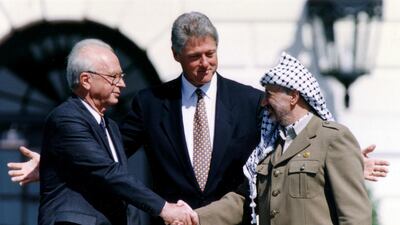
PLO chairman Yasser Arafat shakes hands with Israeli prime minister Yitzhak Rabin, as US president Bill Clinton stands between them, after the signing of the Israeli-PLO peace accord, at the White House September 13, 1993. Reuters -

United States' special envoy Dennis Ross looks on as Saeb Erekat, left, the chief Palestinian negotiator, and Dan Shomron, the chief Israeli negotiator, initial the documents that bring to a conclusion the long-delayed and overdue Israeli troop redeployment in the West Bank city of Hebron. Reuters -
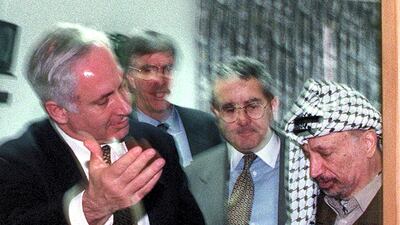
Palestinian president Yasser Arafat and Israeli Prime Minister Benjamin Netanyahu both gesture for the other to leave a meeting December 24 1996 in the Israeli Civil Administration headquarters located along the Israeli - Gaza Strip border area. The two leaders met for for over three hours in a bid to clinch the agreement on the long-delayed Israeli troop redeployment in Hebron. Although no agreement was reached US envoy Dennis Ross said that "real progress" was made towards the long-elusive accord. Reuters -

Israeli Prime Minister Benjamin Netanyahu shakes hands with a smiling Palestinian Authority president Yasser Arafat at a meeting at the Erez crossing between Israel and the Gaza Strip Wednesday Jan 15, 1997. Israel and the PLO concluded a long-elusive agreement on extending Palestinian rule to Hebron in the West Bank. Reuters -
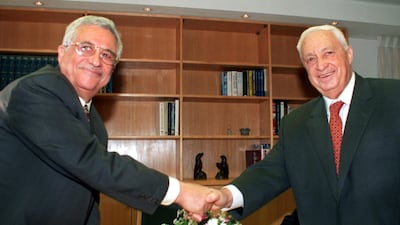
Mahmoud Abbas, left, and Ariel Sharon turn to the cameras and smile as they shake hands at the start of their meeting in Sharon's office November 18. The two met to review the work of all the Israeli-Palestinian peace committees and to set a date for the resumption of final status talks. Reuters -
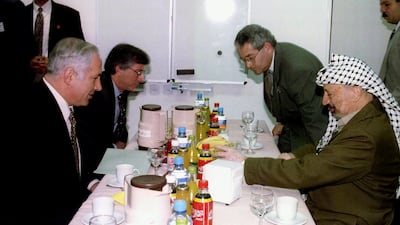
Israeli Prime Minister Benjamin Netanyahu and Palestinian president Yasser Arafat during their meeting at Erez crossing point, northern Gaza Strip, December 24, 1996. Arafat and Netanyahu met here in search of an agreement to end the Israeli occupation of Hebron and revive the peace process. In the background at left is US mediator Dennis Ross. Reuters -

PLO chairman Yasser Arafat holds the second phase of the Oslo peace accords after the initialling of the document, September 24, 1995, as Israeli Foreign Minister Shimon Peres looks on. Israel and the PLO will officially sign the agreement in Washington later this week. Reuters -
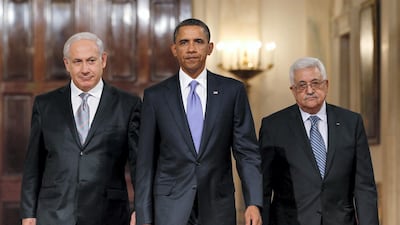
US President Barack Obama arrives with Israeli Prime Minister Benjamin Netanyahu, left, and Palestinian President Mahmoud Abbas to make a statement on Middle East Peace talks in the East Room of the White House, September 1, 2010. Reuters -

Israeli Prime Minister Ehud Barak jokingly pushes Palestinian president Yasser Arafat into the Laurel cabin on the grounds of Camp David as US President Bill Clinton watches during peace talks, July 11, 2000. Arafat and Barak were insisting that the other proceed through the door first. Camp David is the venue where Egypt and Israel made peace in September 1978, and the Laurel cabin was the site of many of the meetings. Reuters -

France's President Nicolas Sarkozy, centre, shakes hands with Palestinian President Mahmoud Abbas, left and Israel's prime minister Ehud Olmert after a joint news briefing at the Elysee Palace July 13, 2008. Reuters -

Palestinian President Yasser Arafat shakes hands with Israeli Prime Minister Benjamin Netanyahu after US special envoy Dennis Ross, centre, spoke, early January 15, 1997 after the two leaders met and agreed on the term for an Israeli troop redeployment in Hebron. The talks lasted less than two hours and concluded months of negotiations. Reuters -
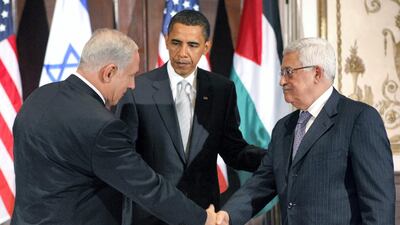
US President Barack Obama watches Israeli Prime Minister Benjamin Netanyahu, left, and Palestinian President Mahmoud Abbas shake hands during a trilateral meeting in New York September 22, 2009. Reuters -
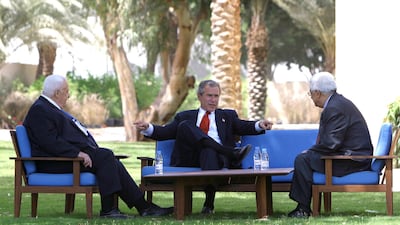
US President George W. Bush discusses the Middle East peace process with prime minister Ariel Sharon of Israel, left, and Palestinian Prime Minister Mahmoud Abbas in Aqaba, Jordan, June 4, 2003. Reuters -

Palestinian and Israeli top negotiators Abu Ala, left, and Uri Savir shake hands after signing the second phase of the Oslo peace accords September 24 1995. PLO chairman Yasser Arafat is in the middle speaking to team member Sait Barecat, (L), after eight days of talks. Reuters -

Israel's Prime Minister Ehud Olmert, right, greets Palestinian President Mahmoud Abbas during their meeting in Jerusalem September 16, 2008. Reuters -
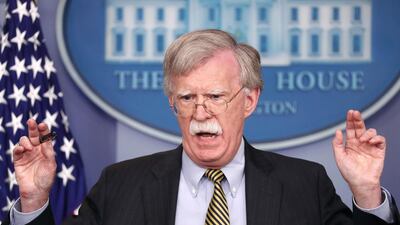
US National Security Advisor John Bolton answers a question from a reporter about how he refers to Palestine during a news conference in the White House briefing room in Washington, U.S., October 3, 2018. Reuters



