
The "man-made humanitarian nightmare" in Syria's Idlib province must end now, United Nations Secretary-General Antonio Guterres said on Friday.
Mr Guterres stopped short of offering any specific plan for curbing the bloodshed in the final rebel holdout.
Russian air strikes in the north-west province are bolstering a Syrian government offensive that has forced nearly 1 million civilians to flee – the biggest wave of displacement of the nine-year conflict.
"This man-made humanitarian nightmare for the long-suffering people of Syria must stop. It must stop now," Mr Guterres told reporters.
"The message is clear: There is no military solution for the Syrian crisis. The only possible solution remains political."
-

A Syrian man walks past damaged buildings in the town of Ihsim in the southern countryside of Idlib. AFP -

Displaced Syrians wait in a queue as an NGO delivers bread as they wait to receive aid in a stadium which has been turned into a makeshift shelter, Idlib, Syria. Getty -

Displaced Syrians sit on the tribunes of a stadium which has been turned into a makeshift refugee shelter in Idlib, Syria. Getty -

Displaced Syrians wait in front of their tents at the basement of a stadiums tribunes as it is turned into a makeshift refugee shelter in Idlib, Syria. Getty -
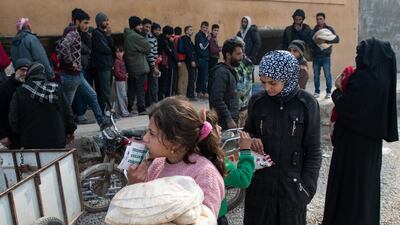
A displaced Syrian girl carries a bag of bread in a stadium which has been turned into a makeshift refugee shelter in Idlib, Syria. Getty -

Internally displaced people stand outside tents at a makeshift camp in Azaz, Syria. Reuters -
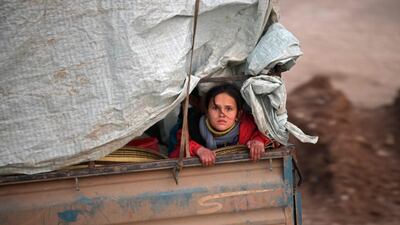
A displaced Syrian girl rides in the back of a truck on the way to Deir al-Ballut camp in Afrin's countryside along the border with Turkey. AFP -
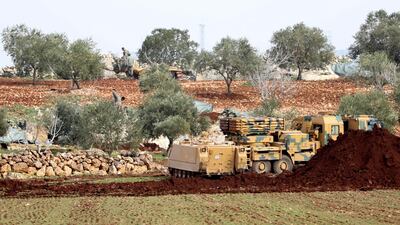
A view of Turkish soldiers and millitary armored vehicles at the Ad Dana district of north-east Idlib, Syria. EPA -

People drive motorcycles at the Turmanin district of north-east Idlib, Syria. EPA -

Displaced Syrians pass through the village of Deir al-Ballut in Afrin's countryside along the border with Turkey. AFP -

An aerial view taken on February 19, 2020 shows destroyed buildings in the Syrian town of Ihsim in the southern countryside of Idlib/ AFP -
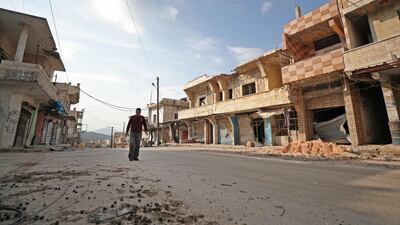
A Syrian man walks past damaged buildings in the town of Ihsim in the southern countryside of Idlib. AFP -
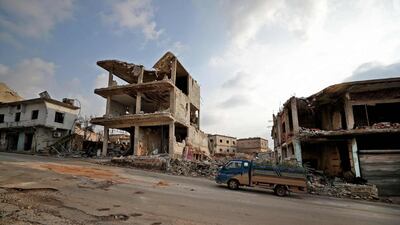
A truck rides past destroyed buildings in the town of Ihsim in the southern countryside of Idlib. AFP -

Displaced Syrians arrive to Deir al-Ballut camp in Afrin's countryside, along the border with Turkey. AFP


Mr Guterres recalled that he had repeatedly called for an "immediate ceasefire" in Idlib, and urged all parties to avoid any escalation in the fighting.
"It is crucial to break the vicious circle of violence and suffering," he said.
At least 900,000 have fled their homes since December 1, including 500,000 children, the UN has said.
"An estimated 2.8 million people in northwest Syria require humanitarian assistance," Mr Guterres said, launching an appeal for an additional $500 million (Dh1.8 billion) in donations to help the displaced over the next six months.
Turkish President Recep Tayyip Erdogan on Friday urged his Russian counterpart Vladimir Putin to halt the Syrian regime's violence in Idlib.
"The president during the call stressed that the regime should be restrained in Idlib and that the humanitarian crisis must be stopped," the Turkish presidency said in a statement after the two leaders spoke by phone.
The two leaders agreed to "intensify bilateral consultations on Idlib with the aim of reducing tensions, guaranteeing a ceasefire and neutralising the terrorist threat", the Kremlin said in a statement.
But Mr Putin said he was "seriously concerned" by the "aggressive actions" of extremists in the Idlib region.
The discussion between the two leaders came amid mounting tensions as the Syrian government pushes ahead with an offensive that has displaced hundreds of thousands of people. The offensive has tested ties between Turkey and Russia, who had been working together closely in Idlib, despite backing opposing sides in Syria’s nine-year civil war.
Earlier, Mr Erdogan also held a joint call with French President Emmanuel Macron and German Chancellor Angela Merkel in which he said that “the Syrian regime and its backers’ aggression in Idlib must be stopped.” He also emphasized the need for “strong support and concrete action” to halt the unfolding humanitarian crisis, his office said.
It followed a similar call by Ms Merkel and Mr Macron to Mr Putin on Thursday, during which they proposed urgent talks with Erdogan to ease tensions.
Mr Erdogan told reporters the European leaders had proposed a four-way meeting in Istanbul on March 5, but that Mr Putin had not responded to the offer.

