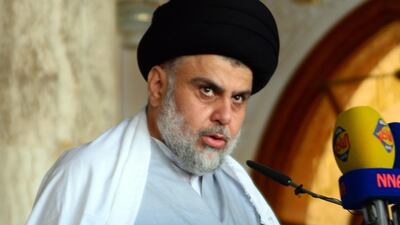
A call by populist Iraqi cleric Muqtada Al Sadr to form a joint committee to look at ways of halting attacks by militias on diplomatic outposts has been welcomed by politicians in the country.
The cleric’s call comes just days after he blasted militias for targeting diplomats following repeated rocket fire at the US embassy and as a British embassy vehicle was hit with an IED in Baghdad earlier this month.
Mr Al Sadr, whose Mahdi Army once fought pitched battles against US troops in Iraq, said that “given the seriousness of the security situation that threatens the country's present and future… we find it is an urgent interest to form a committee of security, military and parliamentary nature.”
He said that the aim must be to halt attacks on diplomats as it “harms Iraq's reputation in international forums.”
-

Damaged military vehicles in the aftermath of US air strikes at a militarised zone in the Jurf Al Sakhr area in Iraq's Babylon province controlled by Kataib Hezbollah. AFP -
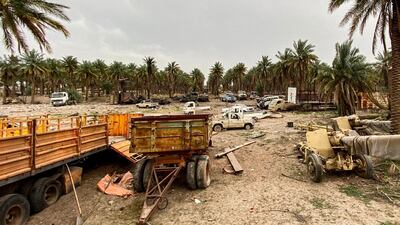
US air strikes targeting pro-Iranian military factions in Iraq killed one civilian and five security personnel early on March 13, the Iraqi military said. AFP -
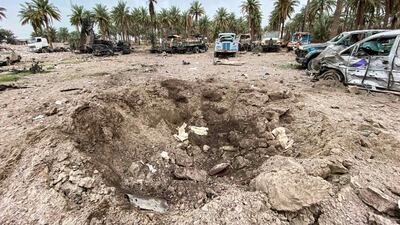
The Pentagon said the strikes were in retaliation for rocket fire against an Iraqi base the night of March 12 that killed one British and two US military personnel in the deadliest such attack in years. AFP -
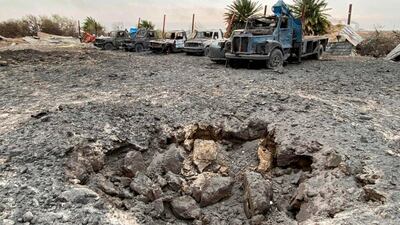
An impact crater in the aftermath of US military air strikes at a militarized zone in the Jurf Al Sakhr area in Iraq's Babylon province. AFP -
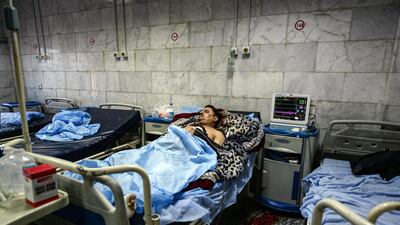
A member of the Hashed Al Shaabi paramilitaries injured in an area targeted by US military air strikes, receives treatment while lying on a bed at Hilla General Teaching Hospital in Iraq's central city of Hilla on March 13, 2020. AFP -
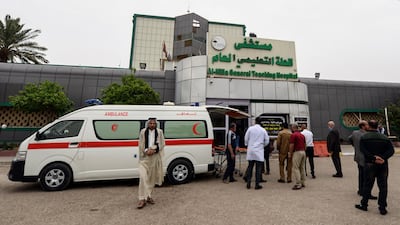
An ambulance that transported members of the Hashed Al Shaabi paramilitaries, injured in an area targeted by US military air strikes, arrives at Hilla General Teaching Hospital. AFP -
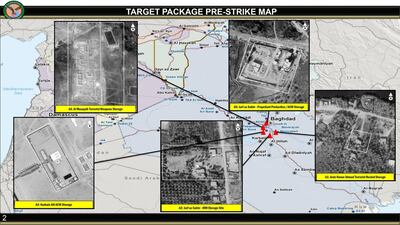
This annotated image provided by the US Department of Defense showing aerial images of sites targeted in airstrikes on Friday, March 13, 2020. US Department of Defense via AP -
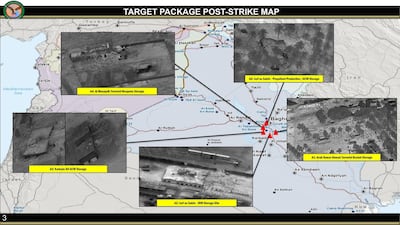
This annotated image provided by the US Department of Defense showing aerial images of sites targeted in airstrikes on Friday, March 13, 2020. US Department of Defense via AP -
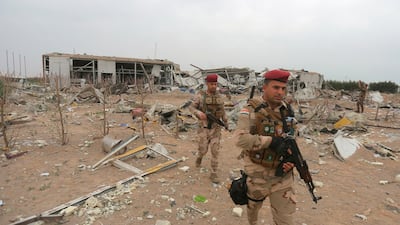
Iraqi army soldiers inspect the destruction at an airport complex under construction in Karbala. AP -

Marine Corps Gen Kenneth F McKenzie, commander of US Central Command, talks to journalists about the military response to rocket attacks that killed two US and one UK service members in Iraq. Getty Images via AFP -
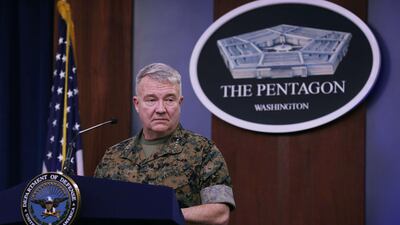
Marine Corps Gen Kenneth F McKenzie, commander of US Central Command, talks to journalists about the military response to rocket attacks that killed two US and one UK service members in Iraq. Getty Images via AFP


Prime Minister Mustafa Al Kadhimi and Parliament Speaker Mohamed Al Halbousi were both quick to praise the imitative.
“We affirm that the hand of the law is above the hand of those who violate it, no matter that some people think otherwise and that the alliance of corruption and uncontrolled weapons has a no place in Iraq,” the prime minister tweeted.
Mr Al Halbousi on Saturday tweeted that “We support this initiative, support it and call for the government, parliament and political forces to adopt [it] to preserve the sovereignty of state institutions and enforce the law to spare the country the slippery slope of unknown risk.”
Parliamentary Security and Defence Committee member, MP Badr Al Zayadi, told the state-run Iraq News Agency that a committee will be formed to study the recent attacks and will swiftly uncover those responsible.
Foreign Relations Committee member Rami Al Sakini also told INA that “Mr Al Sadr's proposal will distance the country from regional and international conflicts and limit the repeated targeting of diplomatic missions.”
For months, rockets have been fired at the US embassy in Baghdad on a near-daily basis, although few have hit the outpost and few casualties have been reported. No group has claimed responsibility for the attacks, and no one has been detained for the attacks, even as security forces often quickly locate launchers and material after the incidents.
Washington blames such attacks on Iranian-backed militia groups. Iran has not directly commented on the incidents but little-known groups believed to be connected to Iran-aligned militias have claimed responsibility for some attacks.
The accusations have been levelled against hardline factions of the Popular Resistance Brigades, Iran-backed militias that are nominally under the control of the state and have broad support in the largely Shiite parliament.
On September 15, a British diplomatic vehicle was hit by an explosive device on the airport road in Baghdad but no one was injured. Two security sources, who spoke on condition of anonymity, said the explosion was caused by a homemade explosive device that was planted on the side of the road.
On the same day, two Katyusha rockets landed inside the Green Zone, which houses government buildings and foreign missions, but caused no casualties or damage, the military said in a statement.
Iraq, often the scene of spillover violence from US-Iran tensions, seeks to avoid being drawn into any regional conflagration.
The Middle East came close to a full conflict in January after a US drone strike killed Iranian Maj Gen Qassem Suleimani and Iraqi PMF chief Abu Mahdi Al Muhandis at Baghdad airport.
Iran-aligned militias have sworn to avenge their deaths.

