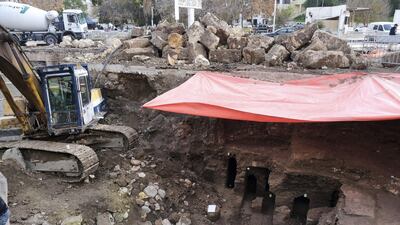
Municipal workers in downtown Amman, Jordan, dig up ancient Roman baths. Amy McConaghy / The National

Roman baths discovered next to Amman’s famed amphitheatre


Khaled Yacoub Oweis
  • English
  • Arabic

Construction crews installing new sewers in downtown Amman stumbled upon Roman baths, an archaeological treasure in the sprawling city built upon layers of antiquity and struggling to preserve its ancient past.

The discovery of the 2,300-year-old site immediately posed a dilemma last week for authorities responsible for completing infrastructure under a main thoroughfare.

Now they face the need to preserve the subterranean clay baths, the first to be found since the city was called Philadelphia in the Roman era.

Workers on the site of ancient Roman baths discovered last week in Amman, Jordan. Amy McConaghy / The National

Two other Roman bath sites were discovered decades ago in the Roman cities of Jerash and Um Qais, north of Amman.

Asem Asfour, head of the Amman sector at the Department of Antiquities, told The National from the site that the existence of the baths, a few hundred metres from the famed Roman amphitheatre of Amman, showed "the prosperity of Philadelphia" under its Roman rulers.

“Philadelphia was a seat of Roman government and the baths were one of the edifices they left behind in the city,” Mr Asfour said.

Pottery fragments found at the baths indicate that they were built in the 2nd to 3rd century BC, Mr Asfour said. At least one headless statue of what appears to be a Roman noble was also dug up.

The site appears to comprise typical components of Roman baths: a reception area and hot, lukewarm, and cold rooms, Mr Asfour said.

Although the Amman municipality has jurisdiction over the site the antiquities department formed a committee to “identify the options” for the site, which is next to a row of commercial and residential buildings.

Archaeological sites near Amman, such as a Byzantine garrison complex in the west of the city, are encroached upon by the plain white buildings that comprise the nondescript skyline of Amman.

Passersby observe an archaeological Roman site, uncovered during sewage works in Amman, Jordan. Amy McConaghy / The National

The Department of Antiquities must be informed when archaeological sites or ancient items are found, but property owners and developers are known to ignore the law so as not to delay construction or new buildings.

Mr Asfour said the main question facing the many authorities with jurisdiction over the baths site will be whether to continue installing a concrete sewage tank at the site or continue the archaeological excavations and preserve the baths.

But he made clear what his preference would be, describing the baths as “a main architectural component from the Roman era”.


Why it pays to compare

A comparison of sending Dh20,000 from the UAE using two different routes at the same time - the first direct from a UAE bank to a bank in Germany, and the second from the same UAE bank via an online platform to Germany - found key differences in cost and speed. The transfers were both initiated on January 30.

Route 1: bank transfer

The UAE bank charged Dh152.25 for the Dh20,000 transfer. On top of that, their exchange rate margin added a difference of around Dh415, compared with the mid-market rate.

Total cost: Dh567.25 - around 2.9 per cent of the total amount

Total received: €4,670.30 

Route 2: online platform

The UAE bank’s charge for sending Dh20,000 to a UK dirham-denominated account was Dh2.10. The exchange rate margin cost was Dh60, plus a Dh12 fee.

Total cost: Dh74.10, around 0.4 per cent of the transaction

Total received: €4,756

The UAE bank transfer was far quicker – around two to three working days, while the online platform took around four to five days, but was considerably cheaper. In the online platform transfer, the funds were also exposed to currency risk during the period it took for them to arrive.

COMPANY%20PROFILE
%3Cp%3E%3Cstrong%3ECompany%20name%3A%3C%2Fstrong%3E%20Revibe%20%0D%3Cbr%3E%3Cstrong%3EStarted%3A%3C%2Fstrong%3E%202022%0D%3Cbr%3E%3Cstrong%3EFounders%3A%3C%2Fstrong%3E%20Hamza%20Iraqui%20and%20Abdessamad%20Ben%20Zakour%20%0D%3Cbr%3E%3Cstrong%3EBased%3A%3C%2Fstrong%3E%20UAE%20%0D%3Cbr%3E%3Cstrong%3EIndustry%3A%3C%2Fstrong%3E%20Refurbished%20electronics%20%0D%3Cbr%3E%3Cstrong%3EFunds%20raised%20so%20far%3A%3C%2Fstrong%3E%20%2410m%20%0D%3Cbr%3E%3Cstrong%3EInvestors%3A%20%3C%2Fstrong%3EFlat6Labs%2C%20Resonance%20and%20various%20others%0D%3C%2Fp%3E%0A
Fixtures

Tuesday - 5.15pm: Team Lebanon v Alger Corsaires; 8.30pm: Abu Dhabi Storms v Pharaohs

Wednesday - 5.15pm: Pharaohs v Carthage Eagles; 8.30pm: Alger Corsaires v Abu Dhabi Storms

Thursday - 4.30pm: Team Lebanon v Pharaohs; 7.30pm: Abu Dhabi Storms v Carthage Eagles

Friday - 4.30pm: Pharaohs v Alger Corsaires; 7.30pm: Carthage Eagles v Team Lebanon

Saturday - 4.30pm: Carthage Eagles v Alger Corsaires; 7.30pm: Abu Dhabi Storms v Team Lebanon

MATCH INFO

Euro 2020 qualifier

Fixture: Liechtenstein v Italy, Tuesday, 10.45pm (UAE)

TV: Match is shown on BeIN Sports