

Iraqi political parties are failing to agree on a name to designate as the new prime minister to end a weeks-long political paralysis that has gripped the protest-hit country.
Outgoing prime minister Adel Abdul Mahdi resigned last month in an attempt to ease anti-government unrest that has shaken Iraq since October 1.
Following his resignation, Parliament Speaker Mohamed Al Halbousi asked President Barham Salih to nominate a new head of government. But first, Mr Al Halbousi must present the president with a name.
A parliamentary deadlock means no names have yet been agreed and the president has not been asked to formally tap the candidate and start the process of government formation.
The constitutional deadline to name a replacement expired last Thursday but was extended until Sunday night. With no resolution on Sunday, the second deadline has now been missed.
The Iraqi parliament’s two blocs of political parties, one backed by Iran and the other by a populist and anti-Iranian cleric, are closely involved in backroom deals.
Any candidate will need the backing of both blocs in order to progress and start trying to form a government but observers say in the current polarised climate, a consensus figure is proving impossible to find.
"Complicating and adding another layer to the problem are the protests who want a candidate from neither bloc it seems,” said Samuel Ramani, a doctoral researcher in international relations at the University of Oxford. “They [protesters] are pushing for an apolitical system and a more pluralist and less corrupt political order.”
Making matters worse, the two main blocs dispute who has the most seats because this was never made clear in the current parliament, and some politicians have frequently switched allegiance.
The Federal Supreme Court took steps to provide some guidance on this issue in a statement Saturday, but stopped short of naming the largest bloc.
-
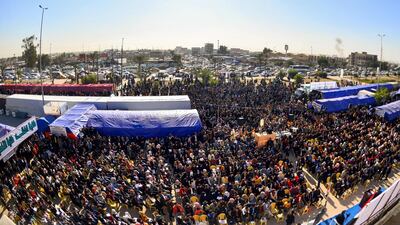
Protesters gather during an anti-government sit-in outside the gate of Kufa University in the holy Iraqi city of Najaf. AFP -
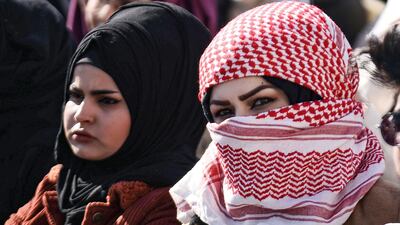
Protesters gather during an anti-government sit-in outside the gate of Kufa University. AFP -
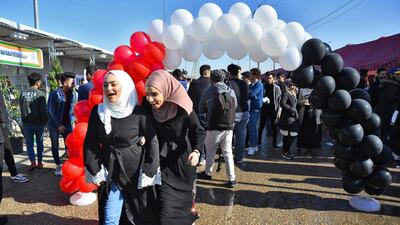
Protesters walk at an anti-government sit-in outside the gate of Kufa University. AFP -
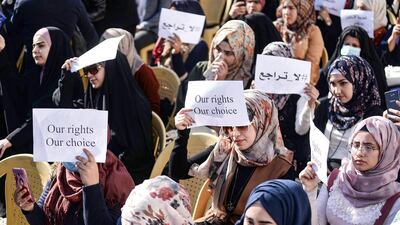
Protesters hold up signs reading "no retreat" and "our rights, our choice". AFP -

A protester holds up a sign reading in Arabic "the student sit-in continues". AFP -

An Iraqi protester burns tires during ongoing anti-government protests in Basra. REUTERS -

Iraqi anti-government protesters carry a banner as they rally during ongoing demonstrations in the capital Baghdad's Tahrir square. AFP -

Iraqi anti-government protesters carry a large natioanl flag during ongoing demonstrations in the capital Baghdad's Tahrir square. AFP -
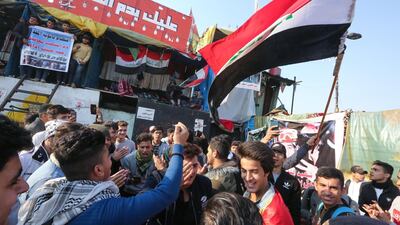
Iraqi anti-government protesters wave a natioanl flag as they chant during ongoing demonstrations in the capital Baghdad's Tahrir square. AFP -
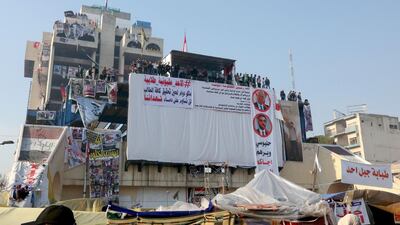
Iraqi anti-government protesters rally during ongoing demonstrations in the capital Baghdad's Tahrir square. AFP -
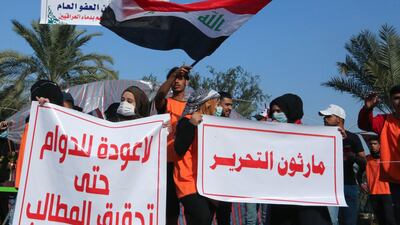
Iraqi students carry banners as they march during ongoing anti-government demonstrations in the capital Baghdad's Tahrir square. AFP -

Iraqi anti-government protesters carry a large natioanl flag during ongoig demonstrations in the capital Baghdad's Tahrir square. AFP


It said the largest bloc should be counted based on how the MPs stood during parliament's first session after taking office last year.
It still remains unclear which party had the largest bloc during the first session with multiple parties claiming MPs were allied to their faction and multiple groups claiming to have the largest share of seats.
The court also said it would accept a revision of the largest faction if two or more parties merged to become the largest faction in parliament.
What does the constitution say?
The constitution requires parliament’s largest bloc to name a candidate for the premiership within 15 days after the prime minister’s resignation.
Then the prime minister-designate has 30 days to form a government.
-

Iraqis ride a horse-drawn cart on Al Rashid street in the capital Baghdad amid ongoing anti-government demonstrations. AFP -

Shop owners throw out their burnt goods while cleaning their shops after clashes between security forces and anti-government protesters in Rasheed Street. AP -

Shops owners throw out their burnt goods while cleaning their shops after clashes between security forces and anti-government protesters in Rasheed Street. AP -
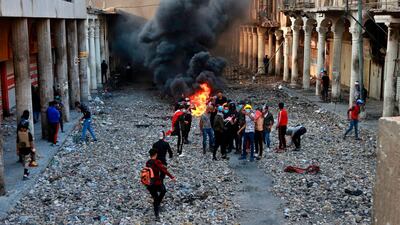
Anti-government protesters set fire while security forces close Rasheed Street during clashes in Baghdad, Iraq. AP -
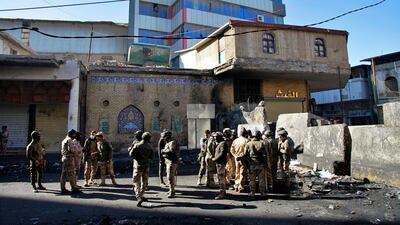
Iraqi security forces deploy in Al Rashid Street. AP -
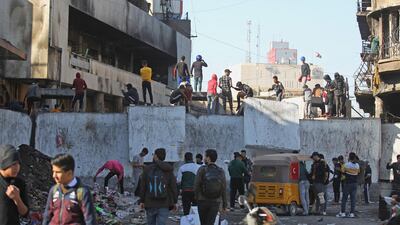
Iraqi protesters gather on Al Rashid street in the capital Baghdad amid ongoing anti-government demonstrations on December 19, 2019. AFP -
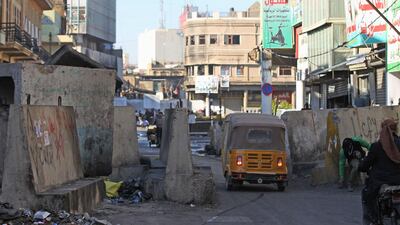
A tuk-tuk drives through a barricade at Al Rashid street in the Iraqi capital Baghdad amid ongoing anti-government demonstrations. AFP -
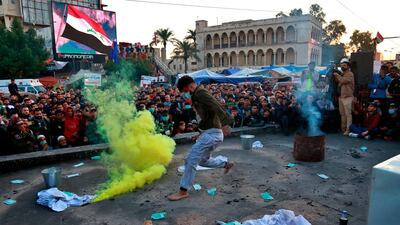
An Iraqi actor performs during a play titled "The revolution" during anti-government protests at Tahrir Square in Baghdad. AP -

Protesters stage a sit-in in Tahrir Square during anti-government demonstrations in Baghdad. AP -
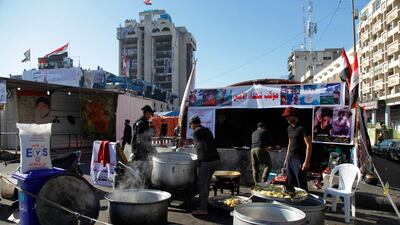
Volunteers prepare free food to anti-government protesters in Tahrir Square during ongoing protests in Baghdad. AP -

Iraqi women take selfies in front of a mural during ongoing anti-government protests in Tahrir square. AFP


What is the largest bloc?
Mr Abdul Mahdi’s nomination as prime minister was the product of a temporary alliance between parliament’s two main factions – Sairoon, led by Shiite cleric Moqtada Al Sadr, and Fatah, which includes leaders associated with the paramilitary Popular Mobilisation Units headed by Hadi Al Amiri.
During last year’s elections, neither coalition won a majority that would have enabled it to name the premier alone.
To avoid a political crisis they formed a fragile union.
"The current crisis goes back to September 2018 when Adel Abdul Mahdi was nominated without there being a clear declaration of which bloc is the largest in parliament," Safwan Al Amin, a lawyer and commentator on Iraqi constitutional matters, told The National.
Both blocs are addressing the issue that they should have resolved a year ago, Mr Al Amin said.
"From a legally technical perspective, it appears that there will not be a clear determination of the largest bloc in parliament," Mr Al Amin said. "It is incumbent on the president, who is the protector of the constitution, [who] is now left with the responsibility to devise a political solution that would also be legal and constitutional."
However, this might not ease the situation. If the largest bloc then gets its way and forces through their choice of prime minister then it would fuel public anger, Fanar Haddad, a senior research fellow at the National University of Singapore's Middle East Institute, said.
"This is the first time that 'the street' is a critical variable in government formation. Judging by how the political elites have gone about trying to form a new government, it does not seem that they have fully grasped this fact," Mr Haddad told The National.
What did the 2010 election show us?
Winning the largest number of seats in parliament does not automatically guarantee that the bloc will get their pick of a prime minister.
In the 2010 election, the former vice president Ayad Allawi’s group won the largest number of seats, albeit with a narrow margin, but he was prevented from becoming prime minister.
Mr Allawi blamed Tehran for manoeuvring Nouri Al Maliki into power.
“The attempts to form a new government are following a similar pattern to previous government formation exercises: backroom horse-trading with little transparency and a lot of foreign interference,” Mr Haddad said.
In doing so, they are perpetuating the very political culture that so many Iraqis have mobilised against, he said.
“In a way, this is to be expected: a sincere effort to meet the demands of the protesters would likely require voluntary political suicide for many of the most powerful political elites today,” M Haddad said.
What do the protesters want?
Protesters are demanding a new vote law and electoral committee, but also the removal of the entire political class and a prime minister with no party affiliation.
Many want a new government with no Iranian and foreign influence over politicians in Baghdad.
They are also demanding jobs and adequate public services such as electricity and clean water.

