
Palestinian officials on Friday rejected US allegations of inciting violence in response to President Donald Trump's peace plan, a day after three Palestinians were killed during protests against the proposed deal and more than a dozen Israelis were wounded in a car-ramming.
Jared Kushner, the architect of the plan and Mr Trump's son-in-law, suggested Palestinian president Mahmoud Abbas was responsible.
"He calls for days of rage in response and he said that even before he saw the plan," Mr Kushner told reporters after briefing the UN Security Council on the plan on Thursday.

But Palestinians said the violence was a response to the terms of Mr Trump's plan, which heavily favours Israel on all the most contentious issues of the conflict and would allow it to annex large parts of the occupied West Bank.
“Those who introduce plans for annexation and apartheid and the legalisation of occupation and settlements are the ones who bear full responsibility for deepening the cycle of violence and extremism,” senior Palestinian official Saeb Erekat said in a statement.
Israeli forces shot a Palestinian dead during clashes in the West Bank on Friday, the Palestinian health ministry said, part of a spike in violence after Washington announced a controversial Middle East plan.
The fatality brings to five the number killed in the occupied West Bank and Jerusalem since US President Donald Trump angered the Palestinians with his plan released last week.
The Palestinian health ministry said Badr Nafla, 19, died after being shot by Israeli forces in the neck during clashes near the northern West Bank city of Tulkarem.
The Israeli army said troops had fired at "a Palestinian who hurled a Molotov cocktail at them" and posed a risk in the course of "a violent riot," during which stones and firebombs were thrown at the soldiers.

On Thursday two Palestinians were killed in clashes in the West Bank and an Arab Israeli was shot dead after opening fire on police near the Al Aqsa mosque in Jerusalem's Old City.
Mr Erakat said Mr Abbas would soon bring his own plan to the Security Council, one that was rooted in international law and based on a two-state solution along the 1967 lines.
Hanan Ashrawi, a member of the Palestinian Liberation Organisation executive committee, said Israeli oppression and American collusion were among the factors promoting violence.
"Real incitement comes from Israeli oppression and violence, from American collusion and ignorant arrogant “plans”, and from regional and international timidity and helplessness," Ms Ashrawi said on Twitter.
The Palestinians want an independent state in the West Bank, east Jerusalem and the Gaza Strip, territories seized by Israel in the 1967 war. They view Israel's settlements in the West Bank and east Jerusalem — which are home to some 700,000 people — as a major obstacle to peace. Most of the international community views the settlements as illegal.
-

Palestinian demonstrators burn tyres during a protest against the US brokered Middle East peace plan, in Rafah in the southern Gaza Strip, on January 29, 2020. AFP -
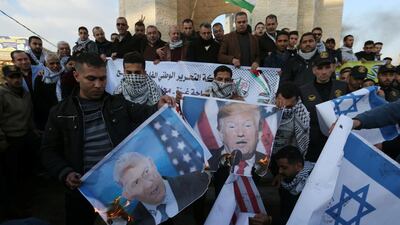
Palestinian demonstrators burn pictures depicting US President Donald Trump and Israeli Prime Minister Benjamin Netanyahu, and repsentations of US and Israeli flags during a protest in the southern Gaza Strip January 29, 2020. Reuters -

Palestinian demonstrators in Rafah in the southern Gaza Strip, on January 29, 2020. AFP -
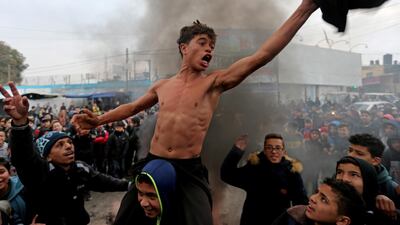
Palestinian students take part in a protest in the southern Gaza Strip January 29, 2020. Reuters -
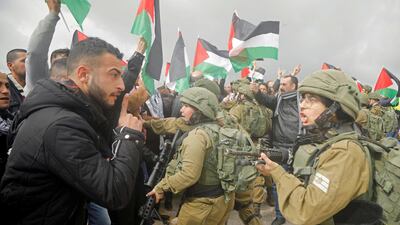
A Palestinian demonstrator argues with Israeli forces during a protest in Jordan Valley in the Israeli-occupied West Bank January 29, 2020. Reuters -
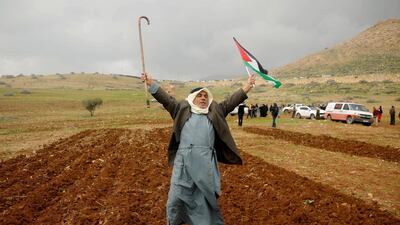
A demonstrator holds up a cane and a Palestinian flag in Jordan Valley in the Israeli-occupied West Bank January 29, 2020. Reuters -
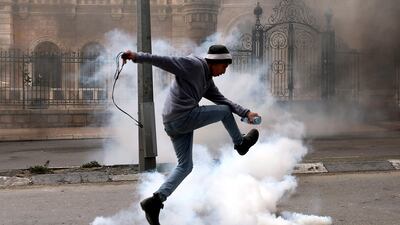
Palestinians clash with Israeli security forces following a protest in the West Bank city of Bethlehem, 29 January 2020. EPA -
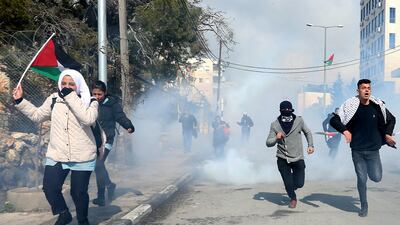
Palestinians clash with Israeli security forces following a protest in the West Bank city of Bethlehem, 29 January 2020. EPA -
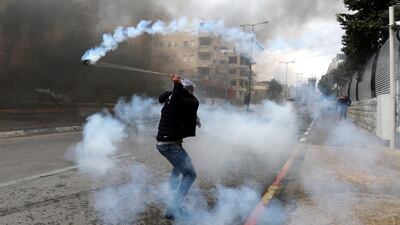
Palestinians clash with Israeli security forces following a protest in the West Bank city of Bethlehem, 29 January 2020. EPA -
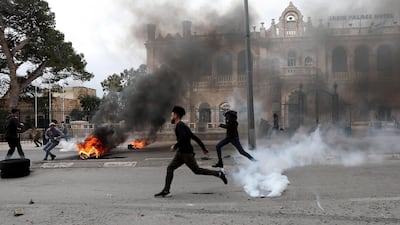
Palestinians clash with Israeli security forces following a protest in the West Bank city of Bethlehem, 29 January 2020. EPA -
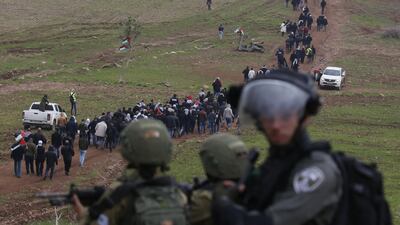
Israeli security forces monitor Palestinian demonstrators protesting near the West Bank village of Tubas, near the Jordan Valley, in the occupied West Bank on January 29, 2020. AFP -
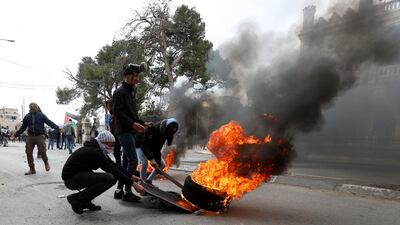
Palestinians clash with Israeli security forces following a protest in the West Bank city of Bethlehem, 29 January 2020. EPA -
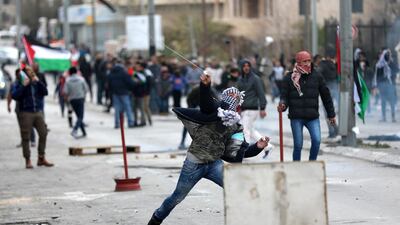
Palestinians clash with Israeli security forces following a protest in the West Bank city of Bethlehem, 29 January 2020. EPA -

An Israeli border policeman fires tear gas during clashes with Palestinian demonstrators following a protest in the West Bank city of Bethlehem, on January 29, 2020. AFP


The Trump plan would allow Israel to annex all its settlements as well as the strategic Jordan Valley. It would give the Palestinians limited autonomy in several chunks of territory with a capital on the outskirts of Jerusalem, but only if they meet nearly impossible conditions.
Israeli Prime Minister Benjamin Netanyahu has eagerly embraced the plan. The Palestinians have adamantly rejected it, but Mr Abbas has not called for violence.
His security forces work with Israel to combat militant groups in the parts of the West Bank where Israel allows them to operate. Mr Abbas has threatened to cut off security co-ordination in response to the Trump plan, but is not believed to have done so.
Mr Abbas' forces are not allowed to operate in Jerusalem, where two of the three attacks took place on Thursday, or near the West Bank settlements. He has no control over the Gaza Strip, where the Islamic militant group Hamas seized power from his forces in 2007.
His policy of co-operating with Israel on security is deeply unpopular among Palestinians, many of whom see it as serving the Israeli occupation.

